“The UK Encouraged It” Say Australian
p. 23 · Read in the full issue
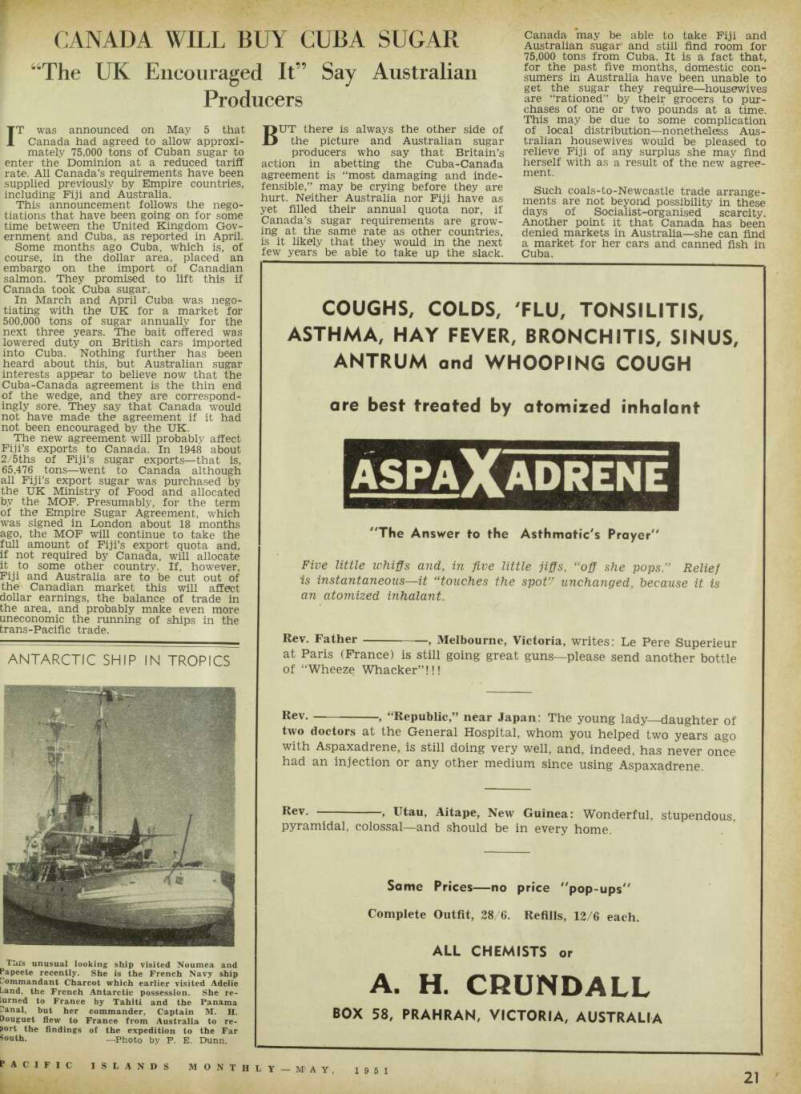
Canada Will Buy Cuba Sugar
“The UK Encouraged It” Say Australian Producers
IT was announced on May 5 that Canada had agreed to allow approxi mately 75,000 tons of Cuban sugar to enter the Dominion at a reduced tariff rate. All Canada’s requirements have been supplied previously by Empire countries, including Fiji and Australia.
This announcement follows the nego tiations that have been going on for some time between the United Kingdom Gov ernment and Cuba, as reported in April.
Some months ago Cuba, which is, of course, in the dollar area, placed an embargo on the import of Canadian salmon. They promised to lift this if Canada took Cuba sugar.
In March and April Cuba was nego tiating with the UK for a market for 500,000 tons of sugar annually for the next three years. The bait offered was lowered duty on British cars imported into Cuba. Nothing further has been heard about this, but Australian sugar interests appear to believe now that the Cuba-Canada agreement is the thin end of the wedge, and they are correspond ingly sore. They say that Canada would not have made the agreement if it had not been encouraged by the UK.
The new agreement will probably affect Fiji’s exports to Canada. In 1948 about 2/sths of Fiji’s sugar exports—that is, 65,476 tons—went to Canada although all Fiji’s export sugar was purchased by the UK Ministry of Food and allocated by the MOF. Presumably, for the term of the Empire Sugar Agreement, which was signed in London about 18 months ago, the MOF will continue to take the full amount of Fiji’s export quota and. if not required by Canada, will allocate it to some other country. If, however, Fiji and Australia are to be cut out of the Canadian market this will affect dollar earnings, the balance of trade in the area, and probably make even more uneconomic the running of ships in the trans-Pacific trade.
BUT there is always the other side of the picture and Australian sugar producers who say that Britain’s action in abetting the Cuba-Canada agreement is “most damaging and inde fensible,” may be crying before they are hurt. Neither Australia nor Fiji have as yet filled their annual quota nor, if Canada’s sugar requirements are grow ing at the same rate as other countries, is it likely that they would in the next few years be able to take up the slack.
Canada may be able to take Fiji and Australian sugar and still find room for 75,000 tons from Cuba. It is a fact that, for the past five mont hs, domestic con sumers in Australia have been unable to get the sugar they require—housewives are “rationed” by their grocers to pur chases of one or two pounds at a time.
This may be due to some complication of local distribution—nonetheless Aus tralian housewives would be pleased to relieve Fiji of any surplus she may find herself with as a result of the new agree rnent.
Such coals-to-Newcastle trade arrange ments are not beyond possibility in these days of Socialist-organised scarcity Another point it that Canada has been denied markets in Australia—she can find a market for her cars and canned fish in Cuba.