this STSȣ
pp. 7-8 · Read in the full issue
Top Level Changes In Pacific
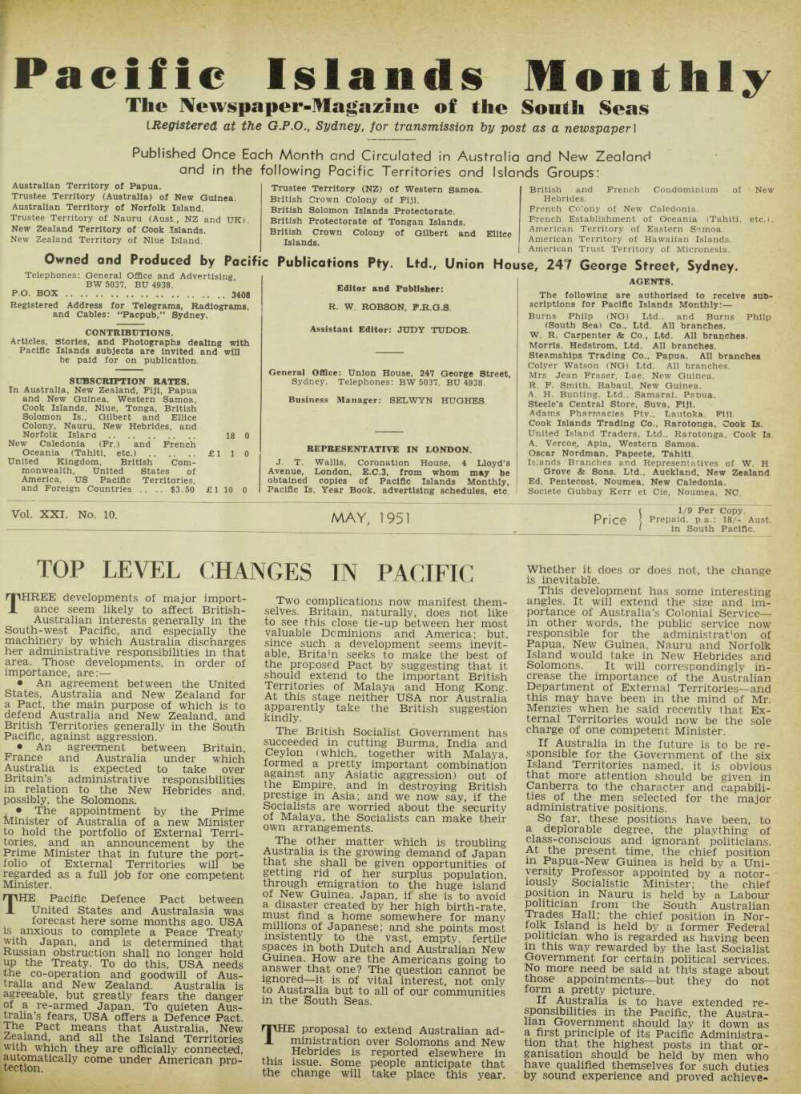
THREE developments of major import ance seem likely to affect British- Australian interests generally in the South-west Pacific, and especially the machinery by which Australia discharges her administrative responsibilities in that area. Those developments, in order of importance, are:— • An agreement between the United States, Australia and New Zealand for a Pact, the main purpose of which is to defend Australia and New Zealand, and British Territories generally in the South Pacific, against aggression. • An agreement between Britain, France and Australia under which Australia is expected to take over Britain’s administrative responsibilities in relation to the New Hebrides and, possibly, the Solomons. • The appointment by the Prime Minister of Australia of a new Minister to hold the portfolio of External Terri tories, and an announcement by the Prime Minister that in future the port folio of External Territories will be regarded as a full job for one competent Minister.
THE Pacific Defence Pact between United States and Australasia was forecast here some months ago. USA is anxious to complete a Peace Treaty with Japan, and is determined that Russian obstruction shall no longer hold up the Treaty. To do this, USA needs the co-operation and goodwill of Aus tralia and New Zealand. Australia is agreeable, but greatly fears the danger of a re-armed Japan. To quieten Aus tralia’s fears, USA offers a Defence Pact.
The Pact means that Australia, New Zealand, and all the Island Territories with which they are officially connected, automatically come under American pro tection.
Two complications now manifest them selves. Britain, naturally, does not like to see this close tie-up between her most valuable Dcminions and America; but, since such a development seems inevit able, Britam seeks to make the best of the proposed Pact by suggesting that it should extend to the important British Territories of Malaya and Hong Kong.
At this stage neither USA nor Australia apparently take the British suggestion kindly.
The British Socialist Government has succeeded m cutting Burma, India and F eyl °l3 (which, together with Malaya, forl T ed f a Pretty important combination Asiatic aggression) out of the Bm P ire ’ and *9 destroying British prestige 111 Asia; and we now say, if the Socialists are worried about the security Malaya, the Socialists can make their n arran gements.
The other matter which is troubling Australia is the growing demand of Japan that she shall be given opportunities of getting rid of her surplus population, through emigration to the huge island of , New Guinea - Japan, if she is to avoid a dl f a J er created by her high birth-rate, must find a home somewhere for many nill \ i( l ns of Japanese; and she points most insis tently to the vast, empty, fertile 5? aces in both Dutch and Australian New Gumea - How are the Americans going to answer . tbat one? The Question cannot be Ignored-1 is of vital interest, not only to Australia but to all of our communities m the South Seas rpHE proposal to extend Australian ad -1 S‘“ io . n over Solomons and New
this STSȣ
the change will take place this year,
Whether it does or does not, the change is inevitable.
This development has some interesting angles. It will extend the size and im portance of Australia’s Colonial Service — in other words, the public service now responsible for the administration of Papua, New Guinea, Nauru and Norfolk Island would take in New Hebrides and Solomons. It will correspondingly in crease the importance of the Australian Department of External Territories—and this may have been in the mind of Mr.
Menzies when he said recently that Ex ternal Territories would now be the sole charge of one competent Minister.
If Australia in the future is to be re sponsible for the Government of the six Island Territories named, it is obvious that more attention should be given in Canberra to the character and capabili ties of the men selected for the major administrative positions.
So far, these positions have been, to a deplorable degree, the plaything of class-conscious and ignorant politicians.
At the present time, the chief position in Papua-New Guinea is held by a Uni versity Professor appointed by a notor iously Socialistic Minister; the chief position in Nauru is held by a Labour politician from the South Australian Trades Hall; the chief position in Nor folk Island is held by a former Federal politician, who is regarded as having been in this way rewarded by the last Socialist Government for certain political services.
No more need be said at this stage about those appointments—but they do not form a pretty picture. ff Australia is to have extended re sponsibilities in the Pacific, the Austra lian Government should lay it down as a first principle of its Pacific Administra tion that the highest posts in that or ganisation should be held by men who have qualified themselves for such duties by sound experience and proved achieve
ment in the Islands administrative ser vices.
In recent years, since the Socialists have been in control at Whitehall, one has noted the appearance of nincipmpoops and inexperienced nobodies in high posts of the British Empire; but in the old days of British colonial achievement and glory, no man appeared in a high ad ministrative job in the colonies who was not well qualified for that post by scholarship, intensive training and proved ability. The Socialist practice, very noticeable in Australia under the Labour regime, of appointing political rejects to highly-paid administrative and diplo matic posts abroad, can have only bad results. Among other things, it breaks the hearts of the men who have devoted their lives to such services.
IF Australian administration is to be extended over New Hebrides and Solomons, Canberra will announce it with a flourish that will suggest it is a thing of great moment. In a way it is— it marks the growth of Australia as a Pacific Power.
But, if they can get the plan into true focus, the Australian taxpayers will not cheer —especially if they know anything
New Zealand’s Ridiculous Law About Polynesians
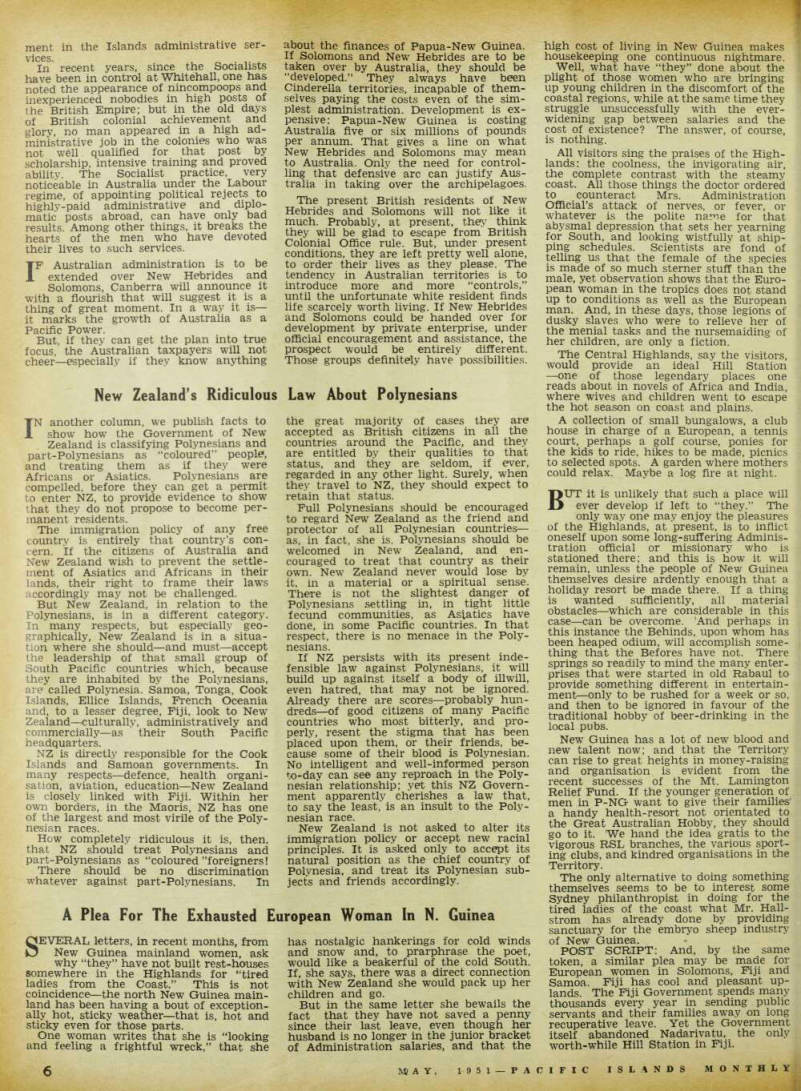
IN another column, we publish facts to show how the Government of New Zealand is classifying Polynesians and part-Polynesians as “coloured” people, and treating them as if they were Africans or Asiatics. Polynesians are compelled, before they can get a permit to enter NZ, to provide evidence to show that they do not propose to become per manent residents.
The immigration policy of any free country is entirely that country’s con cern. If the citizens of Australia and New Zealand wish to prevent the settle ment of Asiatics and Africans in their lands, their right to frame their laws accordingly may not be challenged.
But New Zealand, in relation to the Polynesians, is in a different category.
In many respects, but especially geo graphically, New Zealand is in a situa tion where she should—and must —accept the leadership of that small group of South Pacific countries which, because they are inhabited by the Polynesians, are called Polynesia. Samoa, Tonga, Cook Islands, Ellice Islands, French Oceania and, to a lesser degree, Fiji, look to New Zealand—culturally, administratively and commercially—as their South Pacific headquarters.
NZ is directly responsible for the Cook Islands and Samoan governments. In many respects—defence, health organi sation, aviation, education —New Zealand is closely linked with Fiji. Within her own borders, in the Maoris, NZ has one of the largest and most virile of the Poly nesian races.
How completely ridiculous it is, then, that NZ should treat Polynesians and part-Polynesians as “coloured’’foreigners!
There should be no discrimination whatever against part-Polynesians. In
A Plea For The Exhausted European Woman In N. Guinea
SEVERAL letters, in recent months, from New Guinea mainland women, ask why “they” have not built rest-houses somewhere in the Highlands for “tired ladies from the Coast.” This is not coincidence—the north New Guinea mainland has been having a bout of exceptionally hot, sticky weather—that is, hot and sticky even for those parts.
One woman writes that she is “looking and feeling a frightful wreck,” that she
about the finances of Papua-New Guinea.
If Solomons and New Hebrides are to be taken over by Australia, they should be “developed.” They always have been Cinderella territories, incapable of them selves paying the costs even of the sim plest administration. Development is ex pensive: Papua-New Guinea is costing Australia five or six millions of pounds per annum. That gives a line on what New Hebrides and Solomons may mean to Australia. Only the need for control ling that defensive arc can justify Aus tralia in taking over the archipelagoes.
The present British residents of New Hebrides and Solomons will not like it much. Probably, at present, they think they will be glad to escape from British Colonial Office rule. But, under present conditions, they are left pretty well alone, to order their lives as they please. The tendency in Australian territories is to introduce more and more “controls,” until the unfortunate white resident finds life scarcely worth living. If New Hebrides and Solomons could be handed over for development by private enterprise, under official encouragement and assistance, the prospect would be entirely different.
Those groups definitely have possibilities.
the great majority of cases they are accepted as British citizens in all the countries around the Pacific, and they are entitled by their qualities to that status, and they are seldom, if ever, regarded in any other light. Surely, when they travel to NZ, they should expect to retain that status.
Full Polynesians should be encouraged to regard New Zealand as the friend and protector of all Polynesian countries— as, in fact, she is. Polynesians should be welcomed in New Zealand, and en couraged to treat that country as their own. New Zealand never would lose by it, in a material or a spiritual sense.
There is not the slightest danger of Polynesians settling in, in tight little fecund communities, as Asiatics have done, in some Pacific countries. In that respect, there is no menace in the Poly nesians.
If NZ persists with its present inde fensible law against Polynesians, it will build up against itself a body of ill will, even hatred, that may not be ignored.
Already there are scores —probably hun dreds —of good citizens of many Pacific countries who most bitterly, and pro perly, resent the stigma that has been placed upon them, or their friends, be cause some of their blood is Polynesian.
No intelligent and well-informed person to-day can see any reproach in the Poly nesian relationship: yet this NZ Govern ment apparently cherishes a law that, to say the least, is an insult to the Poly nesian race.
New Zealand is not asked to alter its immigration policy or accept new racial principles. It is asked only to accept its natural position as the chief country of Polynesia, and treat its Polynesian sub jects and friends accordingly.
has nostalgic hankerings for cold winds and snow and, to prarphrase the poet, would like a beakerful of the cold South, If, she says, there was a direct connection with New Zealand she would pack up her children and go.
But in the same letter she bewails the fact that they have not saved a penny since their last leave, even though her husband is no longer in the junior bracket of Administration salaries, and that the
high cost of living in New Guinea makes housekeeping one continuous nightmare.
Well, what have “they” done about the plight of those women who are bringing up young children in the discomfort of the coastal regions, while at the same time they struggle unsuccessfully with the ever widening gap between salaries and the cost of existence? The answer, of course, is nothing.
All visitors sing the praises of the High lands: the coolness, the invigorating air, the complete contrast with the steamy coast. All those things the doctor ordered to counteract Mrs. Administration Official’s attack of nerves, or fever, or whatever is the polite name for that abysmal depression that sets her yearning for South, and looking wistfully at ship ping schedules. Scientists are fond of telling us that the female of the species is made of so much sterner stuff than the male, yet observation shows that the Euro pean woman in the tropics does not stand up to conditions as well as the European man. And, in these days, those legions of dusky slaves who were to relieve her of the menial tasks and the nursemaiding of her children, are only a fiction.
The Central Highlands, say the visitors, would provide an ideal Hill Station —one of those legendary places one reads about in novels of Africa and India, where wives and children went to escape the hot season on coast and plains.
A collection of small bungalows, a club house in charge of a European, a tennis court, perhaps a golf course, ponies for the kids to ride, hikes to be made, picnics to selected spots. A garden where mothers could relax. Maybe a log fire at night.
BUT it is unlikely that such a place will ever develop if left to “they.” The only way one may enjoy the pleasures of the Highlands, at present, is to inflict oneself upon some long-suffering Adminis tration official or missionary who is stationed there; and this is how it will remain, unless the people of New Guinea themselves desire ardently enough that a holiday resort be made there. If a thing is wanted sufficiently, all material obstacles—which are considerable in this case—can be overcome. 'And perhaps in this instance the Behinds, upon whom has been heaped odium, will accomplish some thing that the Befores have not. There springs so readily to mind the many enter prises that were started in old Rabaul to provide something different in entertain ment-only to be rushed for a week or so, and then to be ignored in favour of the traditional hobby of beer-drinking in the local pubs.
New Guinea has a lot of new blood and new talent now: and that the Territory can rise to great heights in money-raising and organisation is evident from the recent successes of the Mt. Lamington Relief Fund. If the younger generation of men in P-NG want to give their families a handy health-resort not orientated to the Great Australian Hobby, they should go to it. We hand the idea gratis to the vigorous RSL branches, the various sport ing clubs, and kindred organisations in the Territory.
The only alternative to doing something themselves seems to be to interest some Sydney philanthropist in doing for the tired ladies of the coast what Mr. Hall strom has already done by providing sanctuary for the embryo sheep industry of New Guinea.
POST SCRIPT: And, by the same token, a similar plea may be made for European women in Solomons, Fiji and Samoa. Fiji has cool and pleasant up lands. The Fiji Government spends many thousands every year in sending public servants and their families away on long recuperative leave. Yet the Government itself abandoned Nadarivatu, the only worth-while Hill Station in Fiji.