Uk Sugar Deal With
Cuba
Lesson for Fiji Growers
WHEN it was learned in March that the UK Government was negotiating for a sugar agreement with Cuba for 500,000 tons of sugar for three years, there were wails of protest from news papers and others in the UK, and from those interested in the sugar industry in the Colonial Empire.
The London Daily Express called the proposed British sugar deal the “black pact of 1951;” and Australian delegates who attended the Empire sugar con ference in London about 18 months ago, when Australia and other Empire countries were given export quotas, said that the UK Government was showing “an amazing disregard for her moral and contractual obligations.”
The UK Government replied that the Cuba contract will in no way affect the Empire sugar agreements of 1949 whereby Britain agreed to take 600,000 tons of raw sugar from Australia, 200,000 from South Africa, and 1,575,000 tons from other Empire countries, including 125,000 tons from Fiji. (In addition Fiji may sell an additional 45,000 tons a year on the open market.) Colonial sugar interests refuse to believe this entirely and are of the opinion that the Cuba proposal has a wheels-within wheels origin. It is belived that Cuba is using the fact that she is a dollar country as a lever to sell her sugar to Britain.
She has already put an embargo on Canadian canned fish but promises, in return for a sugar market in Canada and the UK, to lift this and also to lower tariffs on the import of British cars. (At present a large proportion of Fiji’s sugar crop goes to Canada.) IT is a fact, that as far as Fiji and Australia are concerned the total ex port quota permitted them has not been filled in the last two years and it is not until 1952 that either country is
expected to get into its stride in this regard Sugar production can not be increased overnight and both countries have had two exceptionally wet seasons which have reduced what would have been the normal crop. It has been stated that last year Britain took 800,000 tons from Cuba—3oo,ooo tons more than they now pronose to buy each year on contract.
Nonetheless, if Cuba is also to be guaranteed a quota of sugar, the “Empire” conference and the fixing of quotas 18 months ago was a farce.
At that time the West Indies sugar producing colonies were dissatisfied with the quota allotted them and if it is just a matter of the UK making up a deficiency in sugar imports one solution would have been to increase the quota of West Indies sugar.
The things that are done these days in the sacred name of trade, defy any laws of commonsense.
Australia cans and exports pineapples— there is virtually no Australian canned pineapple for the Australian home market; but Australia imports canned pineapple from Malaya. Again, as an offer ing to that post-war god, Dollar Shortage, no Canadian canned salmon, has been seen in the British portion of the South Pacific since 1942, yet in Australia there is to be had, at a price, any amount of Russian salmon. If someone gave as much time to overcoming these artificial dollar barriers as they do to building them higher and higher it would then be possible for Canada to ignore her market for canned fish in Cuba and sell it to other British countries in the South Pacific.
THE flirting of the UK Government with the idea of a Cuba sugar agreement should, however, contain some sort of a lesson for Fiji. Fiji Indian sugar farmers and their political leaders have behaved, since the war, as though their sellers’ market will continue for ever.
They have dithered with the idea of strikes, and no season has passed without some political agitator inciting the cane farmers not to plant cane; anything to embarrass the Colonial Sugar Refining- Company has been their aim.
As we have pointed out before in PIM: If the Fijian Indian sugar growers will not produce sugar and so fill the quota given Fiji, then there are many other sugar producing countries that are more than ready to fill Fiji’s quota for her.
Agreement Extended
SUVA, March 28.
THE UK Government has announced that they are willing to extend the Commonwealth Sugar Agreement for a further year, until 1958.
In a statement made on March 22, in connection with the trade discussions with Cuba, the UK Government said that if they agreed to buy Cuban sugar in 1953 they would also find a market in that year for the full quota allotted to each producing country under the agreement.
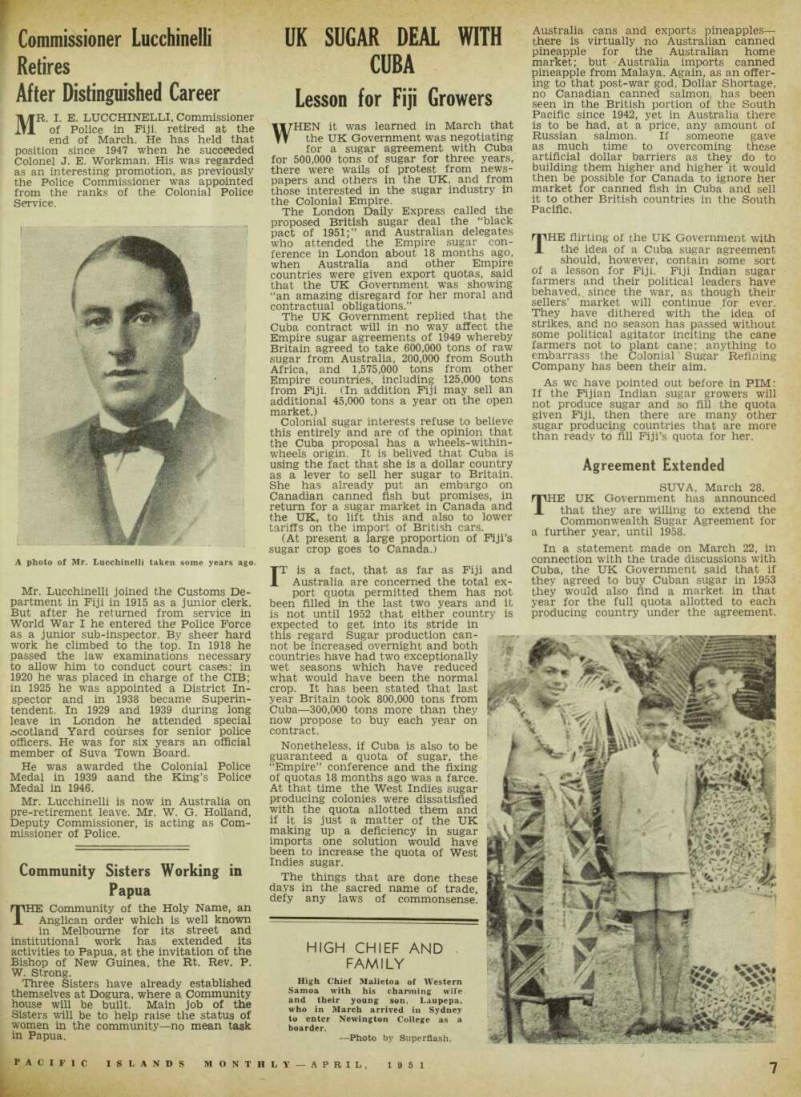
High Chief And
Family
High Chief Malietoa of Western Samoa with his charming wife and their young son, Laupepa. who in March arrived in Sydney to enter Newington College as a boarder. —Photo by Superflash.