25 Years In Pago Pago
p. 105 · Read in the full issue
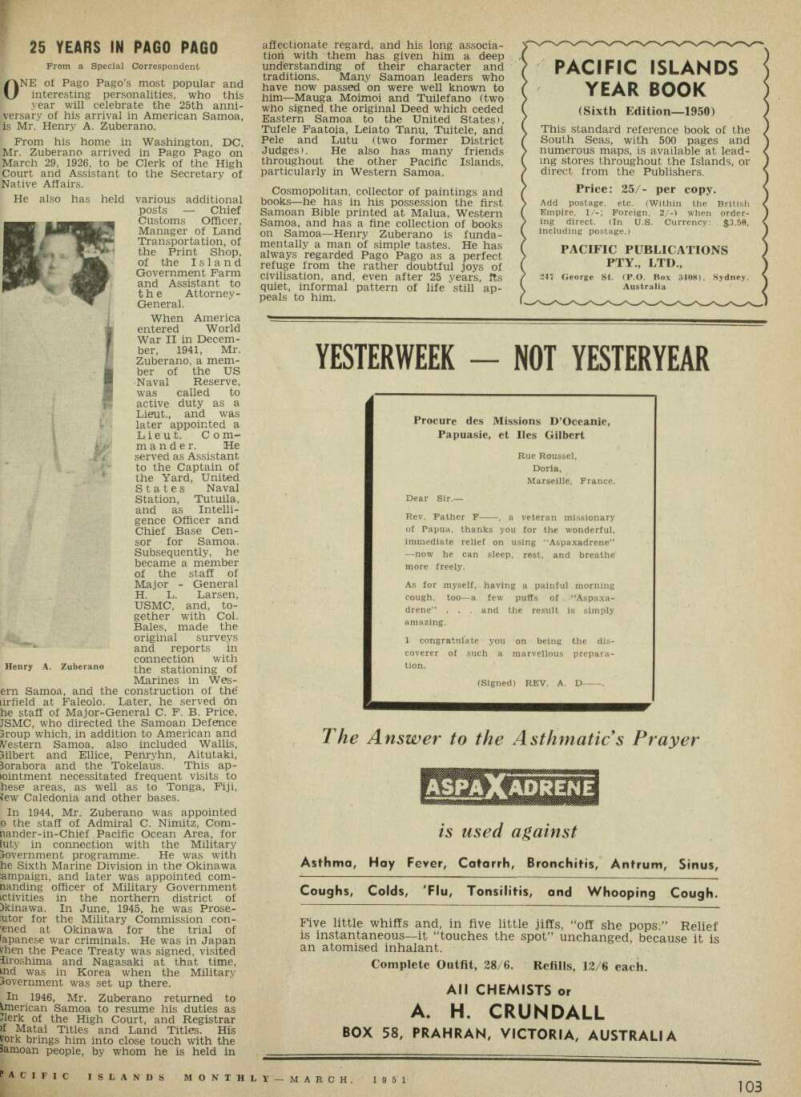
From a Special Correspondent ONE of Pago Pago’s most popular and interesting personalities, who this year will celebrate the 25th anni versary of his arrival in American Samoa, is Mr. Henry A. Zuberano.
From his home in Washington, DC, Mr. Zuberano arrived in Pago Pago on March 29, 1926, to be Clerk of the High Court and Assistant to the Secretary of Native Affairs.
He also has held various additional
posts Chief Customs Officer, Manager of Land Transportation, of the Print Shop, of the Island Government Farm and Assistant to the Attorney- General.
When America entered World War II in Decem ber, 1941, Mr.
Zuberano, a mem ber of the US Naval Reserve, was called to active duty as a Lieut., and was later appointed a Lieut. Com mander. He served as Assistant to the Captain of the Yard, United States Naval Station, Tutuila, and as Intelli gence Officer and Chief Base Cen sor for Samoa.
Subsequently, he became a member of the staff of Major - General H. L. Larsen, USMC, and, to gether with Col.
Bales, made the original surveys and reports in connection with the stationing of Marines in Wes
ern Samoa, and the construction of the' lirfield at Faleolo. Later, he served 6n he staff of Major-General C. F. B. Price, JSMC, who directed the Samoan Defence Group which, in addition to American and Western Samoa, also included Wallis, Gilbert and Ellice, Penryhn, Aitutaki, Gorabora and the Tokelaus. This ap lointment necessitated frequent visits to hese areas, as well as to Tonga, Fiji, Jew Caledonia and other bases.
In 1944, Mr. Zuberano was appointed o the staff of Admiral C. Nimitz, Com nander-in-Chief Pacific Ocean Area, for luty in connection with the Military Government programme. He was with he Sixth Marine Division in the Okinawa campaign, and later was appointed com nanding officer of Military Government activities in the northern district of Gkinawa. In June, 1945, he was Prose cutor for the Military Commission con 'ened at Okinawa for the trial of Japanese war criminals. He was in Japan vhen the Peace Treaty was signed, visited liroshima and Nagasaki at that time, md was in Korea when the Military Government was set up there.
In 1946, Mr. Zuberano returned to American Samoa to resume his duties as >lerk of the High Court, and Registrar )f Matai Titles and Land Titles. His vork brings him into close touch with the >amoan people, by whom he is held in
affectionate regard, and his long associa tion with them has given him a deep understanding of their character and traditions. Many Samoan leaders who have now passed on were well known to him —Mauga Moimoi and Tuilefano (two who signed the original Deed which ceded Eastern Samoa to the United States), Tufele Faatoia, Leiato Tanu, Tuitele, and Pele and Lutu (two former District Judges). He also has many friends throughout the other Pacific Islands, particularly in Western Samoa, Cosmopolitan, collector of paintings and books —he has in his possession the first Samoan Bible printed at Malua, Western Samoa, and has a fine collection of books on Samoa —Henry Zuberano is funda mentally a man of simple tastes. He has always regarded Pago Pago as a perfect refuge from the rather doubtful joys of civilisation, and, even after 25 years, ffs quiet, informal pattern of life still ap peals to him.
Henry A. Zuberano