Western Solomons
pp. 63-84 · Read in the full issue
Let's Visit Western Solomons
PROBABLY half the people in this rumour-ridden world would be thankful for a. cruise round the Western area of the British Solomon Islands—provided that they were not too depressingly urban in their demands for conventional comfort.
To embark at midnight from a rickety wharf, with clear stars overhead, the smell of spilled copra on the wharf underfoot, and the sound of a voice quietly singing Isa Lei in the darkness as the little copra ship pulls out, is a good beginning for a tired traveller.
Thereafter for 30 hours at sea the ship sails past misty islands. If the cabins are too hot for sleep, canvas stretchers are put out on deck, and there they stay by day and night.
If you are tired after breeakfast, you can sleep till 10.30 brings a cup of tea; if you are still tired after that, you can sleep till lunch at 12. There is nothing to stop you from sleeping all the after noon, if you feel like it. All the time, quiet islands loom dreamily to port or starboard.
Gizo is reached about first light. It is an attractive harbour and a good anchor age in most weather. Chinatown is near the old BP wharf site; beyo'd Chinatown are the buildings of the Government sta tion headquarters; and farther along the beach, married native quarters and the new hospital site, where building is pro gressing.
Everything on the station is as tidy as the grounds of an exclusive boarding school; neat paths are smooth, and fallen leaves are discreetly carried away, pre sumably to some hidden compost pit. The harbour is green and indigo and golden.
In the clear water round the wharf, coral fish, fish striped with electric blue, fish spotted with black and yellow, dazzling sapphire and viridian parrot fish, and fish in grey and white football jerseys hover and flicker.
“Never eat those striped grey and white fish,” an experienced resident said.
“They’re scavengers. Old So-and-So had his tutica built over the water, and he kept a fishing line in there. He always had plenty of fish, two or three times a week. We used to warn visitors not to eat fish in his house.”
Gizo has been a Government station for many years and has its share of history. Five minutes walk from the wharf, a stone monument commemorates Captain Thomas Woodhouse, “The Old Commodore.” The inscription reads: ‘Born at Exeter, England. Died at Gizo, 7th April, 1906, aged 63 years. A token ef public esteem, erected by those who mew his Stirling Worth. He never sold :he truth to serve the hour.” The stone
is marked by fire, but stands as sturdily as the old pioneer it commemorates.
Farther on, towards the new hospital site, is the old cemetery, indescribably remote from any tumult of our days Here are perhaps two dozen graves, some unmarked. The most haunting is that of a young plantation sub-manager who was stoned to death by natives one night years ago. Old hands believe he might have been saved if his unconscious body had been brought in at once. His tomb stone, sent out from England by his family, says only:—
In Memoriam
J. L. R. A. Cameron, died 26th August, 1927. Aged 25 years.
O lonely one who far from home art sleeping, God give you rest and have you in his keeping.
It is very restful there, with the short grass growing underfoot, and the coconut palms waving overhead, and the quiet sea some 60 yards away.
A WORD of warning for the female visitor. You may believe that shorts or slacks are the only decent wear for climbing in and out of boats and on to wharves, but don’t wear shorts at Gizo.
An unequivocal order that shorts will not do, may await you on the steps of the District Office as you go to pay a courtesy call, and in the mid-day sun, recalling many memories of Dear Dead Women like Queen Anne and Queen Victoria, you will have to take the torrid ten minute walk back to the wharf, wait in the sun for a whaleboat, return to the ship and change, and then wait for another whaleboat to go ashore again, if you have friends there who are ex pecting you.
AFTER Gizo, the next call was at Lutee plantation on Choiseul. The depth of Choiseul behind Lutee (which is on the saltwater) retains the feeling of mystery not always present now in the West. The air is changed on Choiseul; it blows down cool from the island’s cen tral mountains with a faery smell of remoteness. From a practical point of view, if you anchor off Lutee you will need two blankets at night. Here the old island hospitality still reigns, and you can go ashore and draw deep breaths in quiet, and feel, however illusorily, that you belong.
Here also we disembarked a young black boar to join the excellent herd that has been built up at Lutee. It was a darling pig, and would have converted the most hardened pig-hater. The pet of the ship’s cook, it was sleek, fat, shin
mg and friendly, with a coat like a pam pered cat, and as quiet as a guineapig.
The cook cried when it was crated and sent away. From the pig’s expression when uncrated ashore, it had been cry ing, too.
AFTER Lutee came Mono Island in the Treasury Group. Here is a very fine church presented by Allied Service men to the villagers in gratitude for their loyalty. Many New Zealanders and Americans owe their lives to the protec tion of Mono natives who hid them, fed them and looked after them at great personal risk while Japanese patrols searched the area.
In the church porch are two brass tablets, one bearing the names of Ameri cans, one the names of New Zealanders, killed on Mono. The front of the church is of plywood, cut out into patterns of American and New Zealand insignia, eagles and kiwis side by side.
The natives are pleased if a stranger comes knowing the story of their courage, but they make no fuss about it. A Mono man, it is clear, could do no less than risk his life for strangers.
They also have a sensible Pacific game of cricket, which instead of being played in the hot sun takes place under the largest village shade tree. Even the local equivalent of the deep field can spend most of his time in the shade. The chief’s house is an imposing plywood mansion; the rest of the village is of leaf and bam boo construction, neat and clean, with lawns and trees.
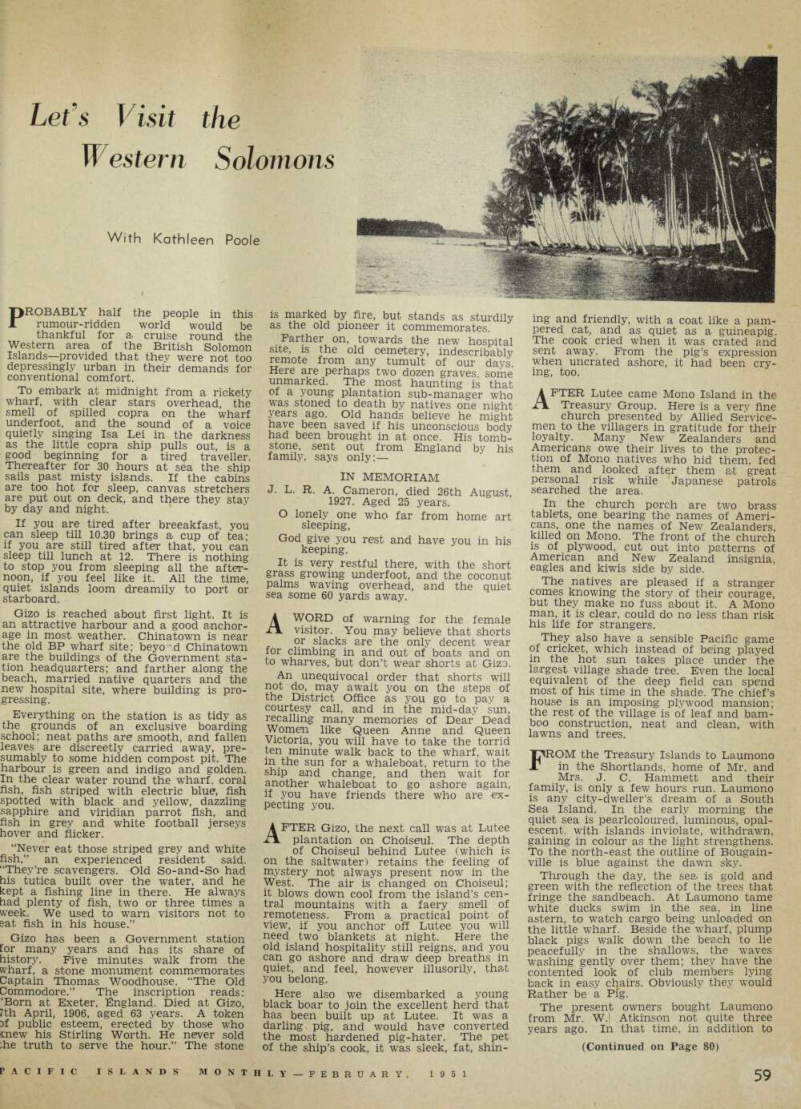
FROM the Treasury Islands to Laumono in the Shortlands, home of Mr. and Mrs. J. C. Hammett and their family, is only a few hours run. Laumono is any city-dweller’s dream of a South Sea Island. In the early morning the quiet sea is pearlcoloured, luminous, opal escent. with islands inviolate, withdrawn, gaining in colour as the light strengthens.
To the north-east the outline of Bougain ville is blue against the dawn sky.
Through the day, the sea. is gold and green with the reflection of the trees that fringe the sandbeach. At Laumono tame white ducks swim in the sea, in line astern, to watch cargo being unloaded on the little wharf. Beside the wharf, plump black pigs walk down the bea-ch to lie peacefully in the shallows, the waves washing gently over them; they have the contented look of club members lying back in easy chairs. Obviously they would Rather be a Pig.
The present owners bought Laumono from Mr. W.| Atkinson not quite three years ago. In that time, in addition to
(Continued on Page 80)
With Kathleen Poole
clearing away heavy undergrowth, they have put up a big and beautiful leaf house and built up a small dairy herd, a flourishing collection of pigs, ducks and fowls, and have begun clearing other islands, in spite of the chronic lack of labour in the Shortlands.
The Shortlands villages have names like bells —Gaumai, Aliang, Maliai —their leaf houses resting behind white sand beaches in the clear morning light. At Nila, even the roofs of the little Roman
Catholic mission station, painted in the post-war manure-tint, so common in the islands, make admirable colour among the green leaves and bright hibiscus.
Beyond Nila comes the hardly recognis able sites of the old Government station at Falsi, the beautiful quiet channel be tween Faisi and Fauro, and Parolang plantation where Mrs. Cruickshank, brought up in the Shortlands many years ago when the territory was under Ger man rule and now nearing 80, is gradu ally reclaiming her plantation, after hav ing lost all her possessions in the last war evacuation and later bombing.
No war damage compensation is pay able in the Protectorate. rOM Parolang, the little ship turned homeward. A call was made at Lambu Lambu, New Georgia, where an explosion of high octane petrol drums during the war left a dismal hollow in the middle of the village. The high tide seeps m to make a swamp, the low tide goes out to leave a mudflat; at night, so they say, the crocodiles go wandering under the village houses, but the villagers are calmly rebuilding in the same place. The beautiful sheltered harbour and the reef outside are alive with fish of the most vivid and unlikely colours. If among a catch of reef fish at Lambu Lambu one turned up coloured in an exact replica of the Royal Stewart tartan it wouldnt look overdressed.
Sasamuga, the neat, pleasant Method ist mission station on Choiseul, was also visited on the return journey; it has a charming air of happiness and bubbles over with cheerful little native children.
Near the anchorage is a very large tree with sweet-scented flowers like orange blossom; it is old now, and has fallen forward, looking as if it was lying on one elbow on the beach. The oldest men can remember when it stood upright and tall, and was the recognised starting place from which headhunting parties set out for other islands.
The ship is heading for Honiara, smell ing pleasantly of copra with an occasional less attractive reminder of trochus, the cabin washbasin is full of cuttings being kept in water for planting: on the shelf are two newspaper bundles of damp roots, six fishhooks, a cigarette tin full of seeds and a very fine mat that was a present, and in your head are a hundred memories of beautiful places and good .^^nds— the lucky, kindly people who live in the West.