Magazine Section
p. 57 · Read in the full issue
Territories Talk-Talk
By "Tolala"
11HE Mount Lamington eruption is a costly method of educating the Papua-New Guinea Administration as to the glaring necessity for a full range effort to install seismic apparatus, and to appoint a number of qualified vulcanologists (there is now only one) in a country which has more volcanos —dead and alive —than any other, unless it be Java and Sumatra.
With true Australian casualness we w T ait for something to happen before tak ing action. In other volcano-infested countries there are systematic warnings given of impending eruptions. Such systems were freely discussed by Dr.
Stehn when he made his survey of Rabaul and New Britain after the 1937 eruption and Dr. Fisher, undoubtedly the best vulcanologist Australia has, is quite aware of this. I cannot understand why Fisher was not on the spot from the first bang, armed with seismographs and whatnots.
It’s difficult to get a true perspective of events from press reports, or even from official statement, but it certainly seems as though the danger was grossly under estimated, due to the absence of seismic instruments and knowledge.
Why not get Dr. Stehn on the job? yULOANOLOGY is such a new science that experts are few and far be tween. It surprises me that some of these wealthy Foundations —Carnegie or Rockefeller —have not rushed the op portunity of organising a seismic research bureau of investigation in New Guinea, where there is such a mass of first-hand material available.
A suggestion in the right quarter might bring results, especially now that 4,000 natives have lost their lives.
TIMES change: One eruption brings a knighthood to the Administrator: another is threatened with a Public Inquiry.
APROPOS the criticism of the Works and Housing personnel which had, incidentally, been going on for many months before Editor Robson passed his
comments, it is rather interesting to note that about the time Rabaul correspondents were penning their defences of the W. & H. personnel, down in Canberra the Hon.
D. H. Drummond, Member for New England, was asking some pertinent questions of Minister Spender about the transfer of the control of the W. & H. to External Territories Department, as well as referring to “statements that have been made concerning the effect of the employment, and the rates of remunera tion paid to certain types of white people by the administration of native affairs in the territory.” (Hansard No. 38, p. 3621.) Minister Spender admitted that he knew all about the W. & H. set-up, but could not bring about the transfer of control immediately.
THE death-knell of the “pukka sahib” in TNG was first sounded when World War I influences started to be felt on the old German colony, and Australian troops, with their usual joy ful camaraderie fraternised with the natives, and European mechanics and technicians commenced plying their trades where, hitherto, all manual work had been carried out by Asiatics under the supervision of European executives.
And so down the years which followed, the European artisans became more numerous and the general standards of the European resident more elastic. But this change was not confined to New 7 Guinea by any means, it had become world-wode with the spread of so-called Democracy and the attempted eradication of class distinction, which really has only resulted in its greater recognition. As I have said before, there is no keener observer of caste than the New Guinea native, and he is capable of putting each individual in his respective class, I RECALL some 25 years ago an Indian Rajah closing his frontiers to visit ing European tourists because, he claimed, there were too many who were not “pukka sahibs” and he was desirous of maintaining the prestige of the whites in his country. That sounds funny in these days.
AND so the Matupi natives are once again defying the government (Jan.
PIM, p. 47). A very similar situation arose back in the mid-1930’s when beacons were required to be erected for
the Lakunai ‘drome. The Matupi-ites won out. So little wonder they have caused a stalemate once again.
There used to be a clause in all land agreements that resumptions could be made for “public purposes” and there was no argument about it at all.
A very sophisticated crowd are these Matupi Islanders.
MANUS Isiand base, or as it is officially known now, HMAS Tarangau, has received plentv of publicity since a special article, apparently penned by somebody who knows what he is talking about, appeared in a Sydney Sunday paper, and its publication coincided with in a day or two of the ninth anniversary of the Fall of Rabaul. It was therefore an opportune revelation of Australia’s position in the Pacific. Whether or not we’ll learn from past experiences remains to be seen. The article attacked Dr.
Evatt’s nolicy in keeping the US Navy out of the base, and described its present chaotic state.
In the same week there was a touch of pathos came over the air in a weekly magazine talk commemorating war doings in New Guinea: The voice of the late Gladys Baker clearly described some of her exneriences when she came out in 1942. No mention that she had passed away.
A NEWSPAPER report last month Quotes Commander H. V. Creer, who arrived in Sydney from NG, as describing portion of the New Ireland coast-line as being wrongly charted. He intends telling the Hydrographic Depart ment all about it. While he is on the job he could also mention that the east coast of Bougainville, near Numa Numa, and also the Mortlock Islands have been wrongly placed on charts for years.
BITS AND PIECES. Export of cutch, a dyeing and tanning extract from mangrove bark, will become a good dollar-earner, says Minister Spender. A factory is to be established in the Delta Division . . . Seventh Day Adventist Secretary, Pastor Mote, reports many Communists sneaking into NG . . .
Treasurer Rankin, of BSI, tells of many dangerous live-mines and bombs on Guadalcanal . . .W. R. Carpenter (Fiji) Ltd., earned a net profit of £19,900 for the year; up £2,214 on last.
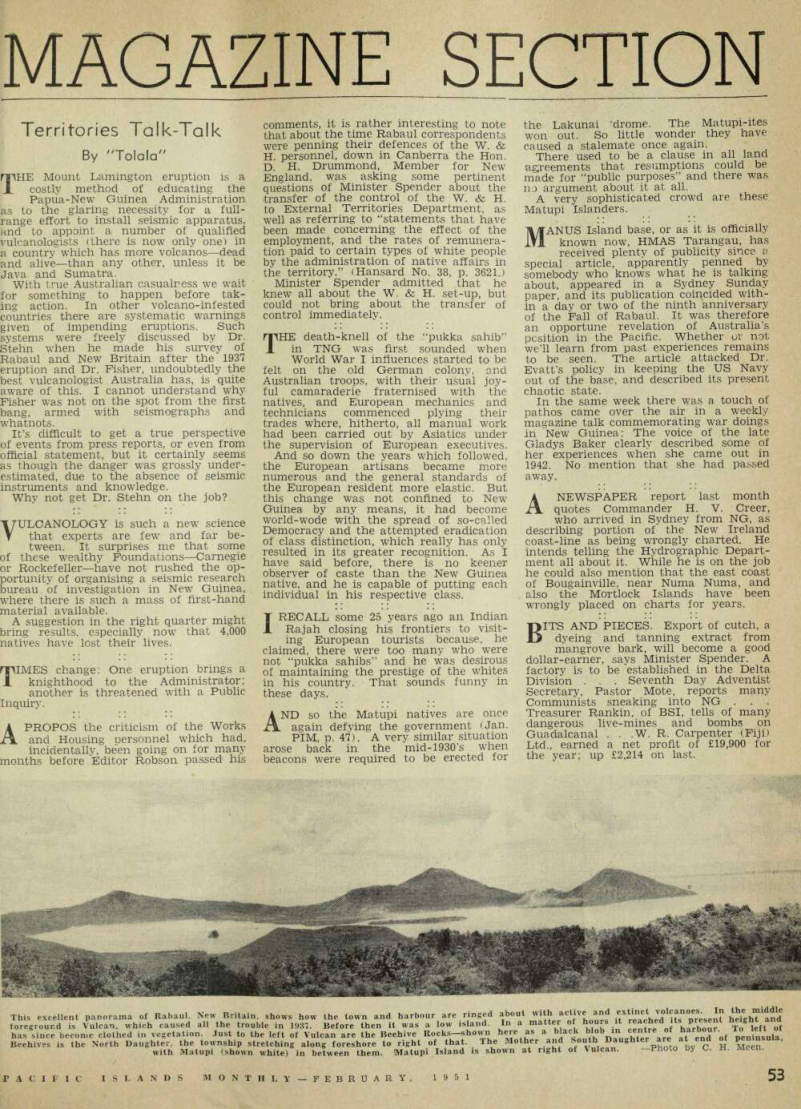
This excellent panorama of Rabaul. New Britain, shows how the town and harbour are ringed about with active and extinct volcanoes. In the middle foreground is Vulcan, which caused all the trouble in 1937. Before then it was a low island. In a matter of hours it reached its Present height and has since become clothed in vegetation. Just to the left of Vulcan are the Beehive Rocks—shown here as a black blob in centre of harbour. To left of Beehives is the North Daughter, the township stretching along foreshore to right of that. The Mother and South Daughter are at end of peninsula, with Matupi (shown white) in between them. Matupi Island is shown at right of Vulcan. Photo by C. H. Meen.