Warning ?
p. 14 · Read in the full issue
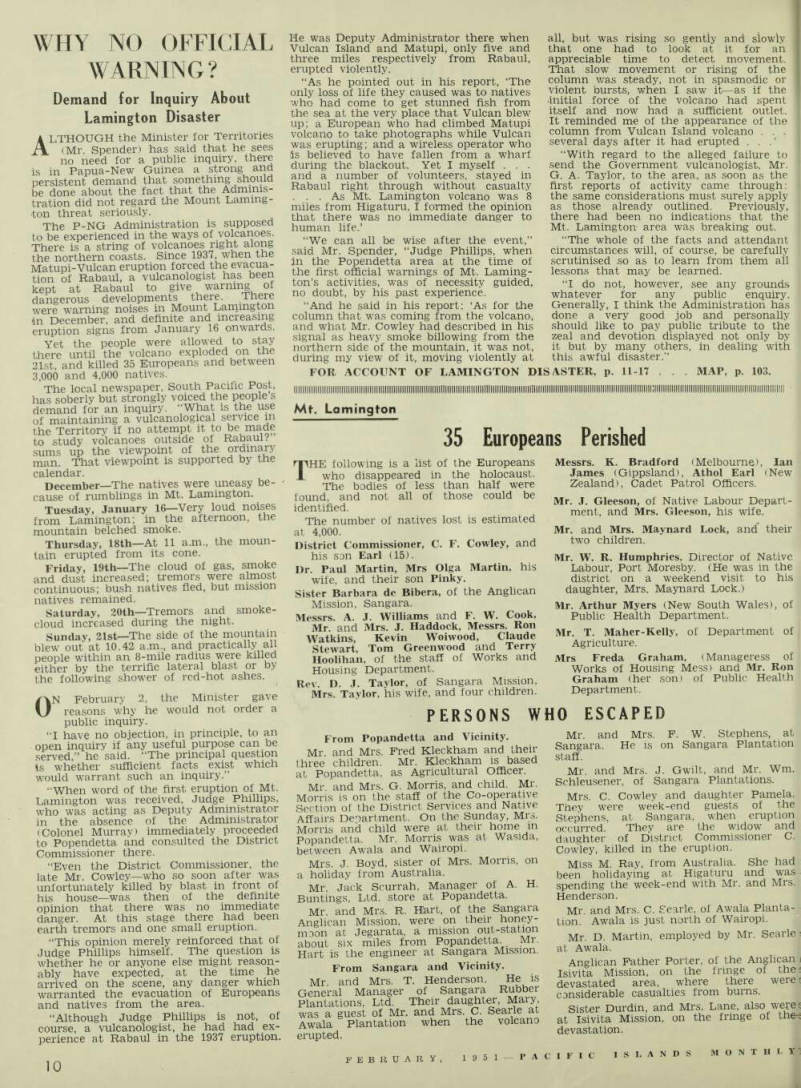
Why No Official
Demand for Inquiry About Lamington Disaster
ALTHOUGH the Minister for Territories (Mr. Spender) has said that he sees no need for a public inquiry, there is in Papua-New Guinea a strong and persistent demand that something should be done about the fact that the Adminis tration did not regard the Mount Laming ton threat seriously.
The P-NG Administration is supposed to be experienced in the ways of volcanoes.
There is a string of volcanoes right along the northern coasts. Since 1937, when the Matupi-Vulcan eruption forced the evacua tion of Rabaul, a vulcanologist has been kept at Rabaul to give warning of dangerous developments there. There were warning noises in Mount Lamington dn December, and definite and increasing eruption signs from January 16 onwards.
Yet the people were allowed to stay there until the volcano exploded on the 21st, and killed 35 Europeans and between 3,000 and 4,000 natives.
The local newspaper, South Pacific Post, has soberly but strongly voiced the people s demand for an inquiry. “What is the use of maintaining a vulcanological service in the Territory if no attempt it to be made to study volcanoes outside of Rabaul.-’ sums up the viewpoint of the ordinary man. That viewpoint is supported by the calendar.
December— The natives were uneasy be cause of rumblings in Mt. Lamington.
Tuesday, January 16 —Very loud noises from Lamington; in the afternoon, the mountain belched smoke.
Thursday, 18th— At 11 a.m., the moun tain erupted from its cone.
Friday, 19th— The cloud of gas, smoke and dust increased; tremors were almost continuous; bush natives fled, but mission natives remained.
Saturday, 20th— Tremors and smoke cloud increased during the night.
Sunday, 21st— The side of the mountain blew out at 10.42 a.m., and practically all people within an 8-mile radius were killed either by the terrific lateral blast or by the following shower of red-hot ashes.
ON February 2, the Minister gave reasons why he would not order a public inquiry.
“I have no objection, in principle, to an open inquiry if any useful purpose can be served,” he said. “The principal question is whether sufficient facts exist which would warrant such an inquiry.”
“When word of the first eruption of Mt.
Lamington was received, Judge Phillips, who was acting as Deputy Administrator in the absence of the Administrator (Colonel Murray) immediately proceeded to Popendetta and consulted the District Commissioner there.
“Even the District Commissioner, the late Mr. Cowley—who so soon after was unfortunately killed by blast in front of his house—was then of the definite opinion that there was no immediate danger. At this stage there had been earth tremors and one small eruption.
“This opinion merely reinforced that of Judge Phillips himself. The question is whether he or anyone else mignt reason ably have expected, at the time he arrived on the scene, any danger which warranted the evacuation of Europeans and natives from the area.
“Although Judge Phillips is not, of course, a vulcanologist, he had had ex perience at Rabaul in the 1937 eruption.
He was Deputy Administrator there when Vulcan Island and Matupi, only five and three miles respectively from Rabaul, erupted violently.
“As he pointed out in his report, ‘The only loss of life they caused was to natives who had come to get stunned fish from the sea at the very place that Vulcan blew up; a European who had climbed Matupi volcano to take photographs while Vulcan was erupting; and a wireless operator who is believed to have fallen from a wharf during the blackout. Yet I myself . . . and a number of volunteers, stayed in Rabaul right through without casualty . . . As Mt. Lamington volcano was 8 miles from Higaturu, I formed the opinion that there was no immediate danger to human life/ “We can all be wise after the event,” said Mr. Spender, “Judge Phillips, when in the Popendetta area at the time of the first official warnings of Mt. Laming ton’s activities, was of necessity guided, no doubt, by his past experience.
“And he said in his report: ‘As for the column that was coming from the volcano, and what Mr. Cowley had described in his signal as heavy smoke billowing from the northern side of the mountain, it was not, during my view of it, moving violently at
all, but was rising so gently and slowly that one had to look at it for an appreciable time to detect movement.
That slow movement or rising of the column was steady, not in spasmodic or violent bursts, when I saw it —as if the initial force of the volcano had spent itself and now had a sufficient outlet.
It reminded me of the appearance of the column from Vulcan Island volcano . . . several days after it had erupted . . .’
“With regard to the alleged failure to send the Government vulcanologist, Mr.
G. A. Taylor, to the area, as soon as the first reports of activity came through: the same considerations must surely apply as those already outlined. Previously, there had been no indications that the Mt. Lamington area was breaking out.
“The whole of the facts and attendant circumstances will, of course, be carefully scrutinised so as to learn from them all lessons that may be learned.
“I do not, however, see any grounds whatever for any public enquiry.
Generally, I think the Administration has done a very good job and personally should like to pay public tribute to the zeal and devotion displayed not only by it but by many others, in dealing with this awful disaster.”
FOR ACCOUNT OF LAMINGTON DISASTER, p. 11-17 . . . MAP, p. 103.