Magazine Section
p. 53 · Read in the full issue
Territories Talk-Talk
By "Tolala"
LAUNCHING into a New Year is always a step into the unknown that makes me retrospective. I allow myself, at this time, the pleasure of wallowing in memories of the past, and the happy, care-free days some 40 years ago when the Boer War was a memory and only a small cloud, in the phrase “Der Tag ” heralded War I.
Rabaul was a brand-new town; horses and sulkies and bullock carts rumbled over the broom-swept Avenue beneath the young Mango trees, and the big, yellow-funnelled NDL ships, plying be tween Sydney and Hong Kong, poked their noses almost into Namanula- Avenue as they tied up at the big, wooden wharf in the centre of the town.
My first Islands Christmas party was at Mioko, the New Guinea headquarters of the DH & PG, known as the Long handled firm (Deutsches Handels und Pflanzungsgesselschaft) of Samoa, and it was then that I met Caot. Peters, the black-bearded skipper of the sailing vessel Samoa, which recruited boys for planta tions in Samoa to supplement the Chinese coolies then working in that German colony.
It wa-3 a typical German Christmas; a big tree for Manager Hellfritz’ children, rich food, sparkling wines and the guests included August Engelhardt, the sun worshipper from the neighbouring island pf Kabakon. Mine hostess was wonder ing what he would (or would not wear) for, being a sun-worshipper, it was sacri lege for him to hide his body from his god. But for this occasion he donned a lava-lava and a white patrol jacket.
It was a happy gathering which lasted a couple of days.
MY mind travels on to the 1914 Christmas festivities which stand out as terminating a period of anxiety when we in Bougainville awaited the arrival of the Australian troops from Rabaul. For six months we had been without news and supplies, at a critical developmental period of the CPL estates of Soraken, Baniu, Teopa-sino and Arigua It was a relief to know that Australia had the whip-hand in the old German colony; it was a relief to have flour and sugar, tea and bottled sunshine in which to toast the New Year.
AND then there were seasonable festiv ities in pre-World War II Rabaul.
Parties by the dozen outstanding among them the Christmas-e/e ball at the Rabaul Club, the New Year “do” at the New Guinea Club, the extravagant pres ents given by the firms to their regular customers, the New Year dragons in Chinatown.
And so the memories go on until that Chnstmastide of ’4l, with Rabaul, depleted of its European women-folk, the Jap knocking at the door, the bulk-beer specially imported and tapped at the home of Banker Clark at an afternoon party, because of the black-outs and half the crowd in khaki, and none of us knew wha-t was waiting just around the corner It was the last Christmas party for too many.
And then, only the other day, there was another Christmas party high up in a massive stone building, overlooking the fay
busy Sydney streets. There were many old familiar faces, mostly women gath ered at the tables, and there was ’bottled sunshine for many a toast to the “Good Old Days,” and gay chatter and laughter but every now and then a faraway sad look came into a woman’s eye as the sight of an old acquaintance brought back so vividly the past, accentuating the absence of a loved one. But a. brave smile came again. Those New Guinea women who have suffered have learned, down the years, to cover their loss with a smile God bless everyone of them.
SO much for my retrospective interlude.
What of the prospect? Those South Sea. Islands, which were so safely tucked away from international brawls 40 years ago, have now become high-lights of global equilibrium; their isolation gone with the introduction of radio and plane.
And gone, too, much if not most, of their primitive charm. But here’s hoping for the best . . .
THE Children’s Christmas Party at the New Guinea Women’s Club on Dec ember 18, was, as usual, a great success with its lashings of presents and eats. It has now developed into a Chil dren’s Children’s Party for, naturally enough, the original children have all grown up. It is nine years since the evacuation. This fact but goes to show what a solid organisation the Club has become; Mrs. Foxcroft and her willing band of workers can feel well satisfied.
IN the midst of all the Australian Jubilee celebrations this year, and especially those marking the opening of Parlia ment on May 9, let it not be forgotten that May 9, 1951 is the thirtieth anniver sary of the inauguration of civil adminis tration in TNG. So the Territory has a double cause for celebrating the occasion.
IT is not inappropriate to recall that at the time that the Australian govern ment announced civil administration in TNG, it also stated that as £lm had been spent on New Guinea for military administration during 1914-20, the Terri tory ‘ must henceforth be self-supporting,”
And it certainly was—up to the Jap in vasion.
rpHE latest government expenditure in L P-NG, according to Minister Spender, will be £7m on hospitals to cater for some U million natives and 12.000 non natives. Another project spoken of not so long ago was a £7-8 million breakwater for the new capital site on New Britain.
Heaven alone knows what the estimate is for the Manus Naval Base; and then there is the annual administration running expenses of a mere £sm. It seems somewhat hay-wire to me.
REFUSING the US the right to retain its occupancy of Manus was one of the biggest blunders the Chifley gov ernment made. Thus a writer in the “Montreal Star” of recent date: “Americans make no secret of their be lief that Australia showed lack of com mon sense in refusing to let the US use Manus as a defence outpost.” That’s putting it lightly.
IT has been suggested that two native choirs be sent to Australia for the Jubilee celebrations this year. The Port Moresby message guardedly states that the cost would have to be met by the Commonwealth government (the Australian taxpayer) as territorial allow ance for the celebrations is only £5OO.
A good native choir, properly organised and a sound, commercially minded mana ger in charge, could make a very appre ciable profit touring Australia, without a shadow of a doubt.
IKNOW tha-t P-NG is beset with many problems, and there appears to be a surfeit of planners prepared to map out the Territory’s future, but what about re-appointing (electing would be better) a Legislative Council and let the people —black, yellow and white—have a say in some of the planning? It is a foregone conclusion that there would be a gov ernment majority, but such a chamber is a means of ventilating territorial needs and a chance for constructive criticism from all angles. Some of the Adminis trative demi-gods might not take too kindly to plain speaking, under cover of parliamentary privilege, but it would do them no harm. They have occupied the box-seat quite long enough.
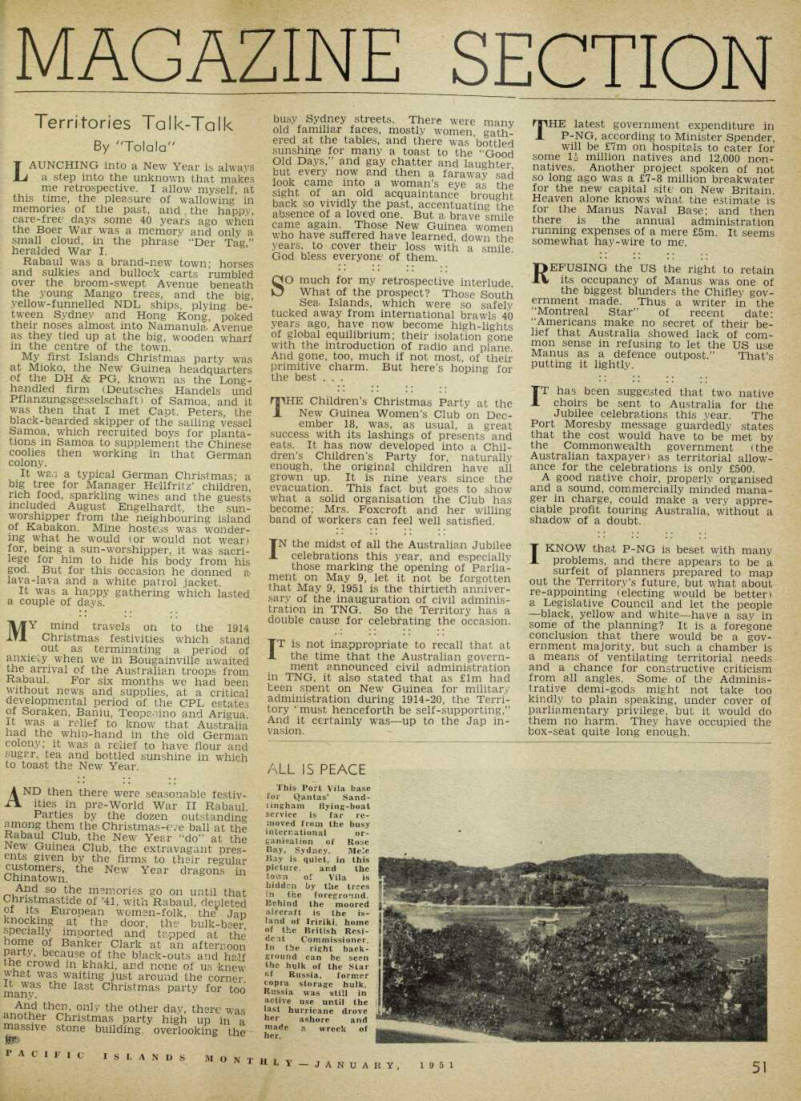
All Is Peace
This Port Vila base for Qantas’ Sand
ringham flying-boat
service is far re moved from the busy international or ganisation of Rose Bay, Sydney. Mele Bay is quiet, in this picture, and the town of Vila is bidden by the trees in the foreground.
Behind the moored aircraft is the is land of Iririki, home of the British Resi dent Commissioner.
In the right back ground can be seen the hulk of the Star of Russia, former copra storage hulk.
Russia was still in active use until the last hurricane drove her ashore and made a wreck of her.