Si. siif.
pp. 13-98 · Read in the full issue
Life On A Junk-Heap
In Rabaul
By R. W. Robson
The Town That Si. siif.
Rabaul, Oct. 20
THIS place, like Port Moresby and Lae is lousy with money; but, as in Moresby and Lae, I cannot see any sound economic basis for so much liveli ness and prodigality.
The chief product of New Britain, New Ireland and Bougainville—for which Rabaul is the trading centre—is copra* and, even admitting that production costs have increased fantastically, and that the planter, getting £4B Aub. per ton, is being deliberately robbed by Socialist Governments of a large proportion of the world price—there is a pretty profit in copra. But that does not explain the volume of money circulating in Rabaul.
It comes as well from the millions which Australia is frittering away on an unsystematised Administration; from the practically uncontrolled distribution of “war damage compensation” to natives* and from refugee money from Communist China, which has fled here to the safe keeping of the Chinese community.
However, why worry about the source of these welcome funds? The money is circulating, and every section of the com munity—except the unfortunate officials of the Administration—is having a very good time.
It is bothersome, however, to have a great deal of money, and not much to do with it. It is difficult to put up worth while buildings here, because the Admin istration has set its face generally against the re-building of Rabaul—it says that the town must be built 30 miles south ward, out of the range of the volcanoes.
One cannot engage in new enterprises, calculated to produce new wealth, because the Administration is reluctant to give land titles, or timber leases or anything else that is in any degree likely to in terfere with native rights.
Mr. Spender, a year ago, thought he had supplanted the Ward-Murray Socialist policy with an individualistic plan for the encouragement of private enterprise. Well, up to date, all his promises have been set aside or smothered by the Ward-Murray administrative set up, which does not appear to have changed much.
Quite a number of little, one-man businesses based on personal service or on distribution, have been established by Europeans and Chinese, and are flourish ing. But they are merely a growth on this phenomenal circulation of money.
They add nothing to the permanent pro ductive economy of the country. When
the country, sooner or later, is asked to live on its own resources, most of them will fold up.
SO the baffled traders—for it is in their hands that so much money is accu mulating—are generally living well, takmg plenty of expensive holidays South, and purchasing luxury goods.
You will see no finer cars anywhere than those owned by the Rabaul Chinese, and some Europeans. These calr-owners are literally all dressed up, with nowhere to go.
Their shining vehicles, beautifully sprung, have only two miles of bitumen road (Malaguna and Mango Avenues) on which to run; the other pot-holed roads, over which they roll like a yacht in a heavy sea, are few, and lead nowhere.
Enormous sums have been spent on roads and bridges by the Administration and by Works and Housing in this area since 1945, but the work does not seem to have been in line with any overall plan, and the result is dust and/or mud, un limited; while the mileage of really trafficable roads is very limited indeed.
TO those who knew the pre-war Rabaul, with its solid white buildings and shaded avenues, it must be explained that, between 1941 and 1945. the town was completely obliterated. The Japs put the better part of 200,000 men there, and made it their main advanced base for the attack on the Australia-Fiji-New Zealand line; and it therefore became the painful duty of our airmen to wipe it out.
In 1945, when Japan surrendered, there was nothing left of old Rabaul above the ground except some of the walls of Burns Philp’s new store, ditto the New Guinea Club, and a few blasted tree trunks where the avenues once were. The site of the once pretty town was so thoroughly pul verised that surveying was necessary to re-locate the streets and the boundaries of allotments.
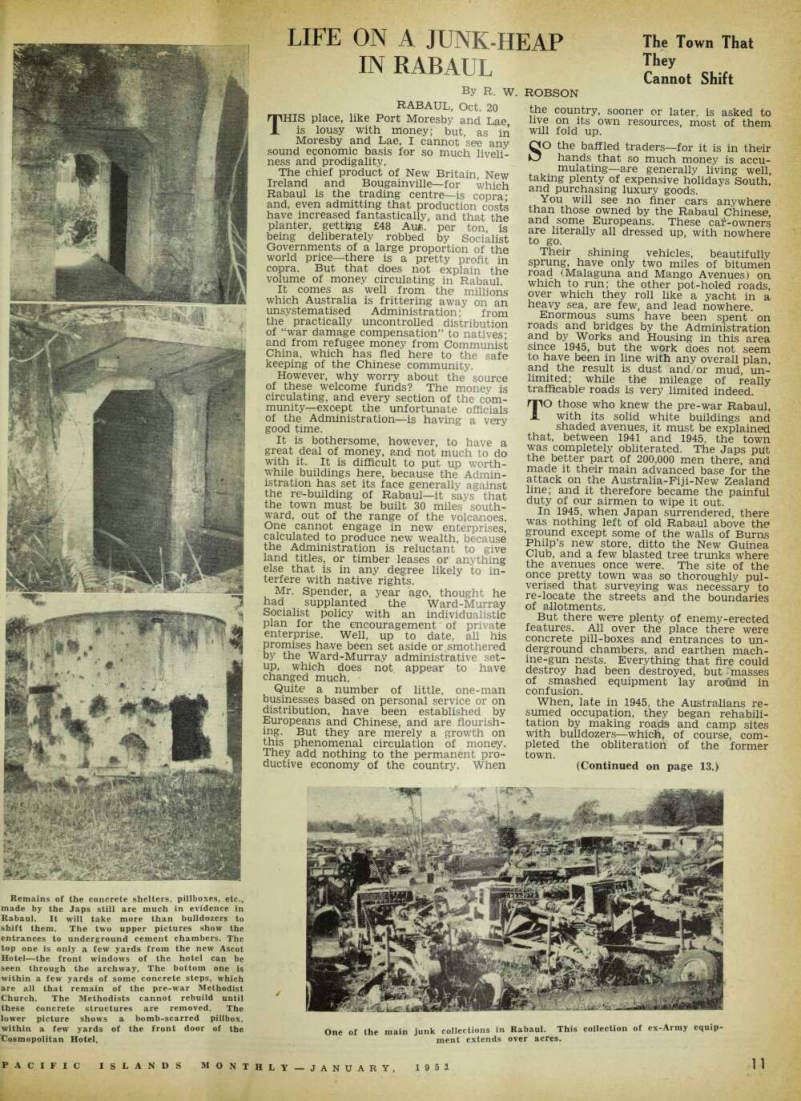
But there were plenty of enemy-erected features. All over the place there were concrete pill-boxes and entrances to un derground chambers, and earthen mach ine-gun nests. Everything that fire could destroy had been destroyed, but masses of smashed equipment lay around in confusion.
When, late in 1945. the Australians re sumed occupation, they began rehabili tation by making roads and camp sites with bulldozers—which, of course, com pleted the obliteration of the former town.
(Continued on page 13.)
Remains of the concrete shelters, pillboxes, etc., made by the Japs still are much in evidence in Rabaul. It will take more than bulldozers to shift them. The two upper pictures show the entrances to underground cement chambers. The top one is only a few yards from the new Ascot Hotel—the front windows of the hotel can be seen through the archway. The bottom one is within a few yards of some concrete steps, which are all that remain of the pre-war Methodist Church. The Methodists cannot rebuild until these concrete structures are removed. The lower picture shows a bomb-scarred pillbox, within a few yards of the front door of the Cosmopolitan Hotel.
One of the main junk collections in Rabaul. This collection of ex-Army equip ment extends over acres.
Then, with a speed which can be be lieved only by those who know the tropics, nature took a hand. Within months, the devastation was being clothed with a lusty growth of coarse grasses and young trees.
All the avenue trees which had not been destroyed sprouted new foliage. Today, when first glimpsed from a high plane, Rabaul looks much as it did in 1939.
It is when you enter the town, and see what is under or behind the vegetation that you get a shock. The Rabaul of 1950, strung out along the old street lines, is little more than a ramshackle village built on a heap of junk. Most of the trading houses have done their best, with the limited materials and help available; but, generally, there are few buildings constructed with a thought to either beauty or permanence.
HROM 1945 onwards, the non-official l population, led by the Chinese, literally fought its way back to this own site, in the teeth of official opposi ion.
When the invasion came, in 1942, the apital of New Guinea (Rabaul) was in •rocess of being abandoned to the ever estless volcanoes, and a new capital /as being officially built at Lae. At the nd of the war, officialdom said: “This is ur opportunity. We don’t need another apital—Port Moresby is it.” But Rabaul 3 wiped out. Let us build the new cabaul at Rapopo (near Kokopo, over 0 miles south).” It was a reasonable Tgument.
But Rabaul has the finest harbour in he South Pacific. There is no harbour t all at Rapopo, only a sheltered coast me. Deep water is far out from the hallow beach. Naturally, the European nd Chinese traders, hurrying like furies o get the benefit of the hungry post-war emand for copra, settled themselves tubbornly at the good port.
Undoubtedly, that trading community /ould have gone—however unwillingly—
traHon^hac/^ad°*Bu ffir ie nf viS« Ad^nis '
diately tT'sefcct
ft X nnTnd h i to shape T*,iV P Hwv.^i y fisi S A **?• bemg used -
Government ft So £ lalis !
Government had fastened the weak and Upon New Gumea, and that Administration was so pre-occupied with native welfare that it did nothing about Rabaul, except babble an whU?°M^ e Fd g dip j 0 .
While Mr. Eddie Ward and Colonel Murray were wasting precious months and years on reviewing the native labour regulations, and hamstringing private enter prise, and distributing “war damage compensation” to the natives, and trying to escape from the implications of the timber lease scandal, the Rabaul civilians— wearying of waiting on bumbling official-
clom—proceeded to re-establish Rabaul on SSo2? ** *" the Shad ° W ° £ the VOl ‘ Because of its lack of a port, Rapopo was not held in favour by the traders.
Experienced people say that there is at least one excellent port—and probably more—around Gazelle Peninsula P to the northwards: and that prompt official action in that direction woffid have rneant the abandonment of Rabaul. But official dom argues that a move north would be a move into the volcano line; while a move southwards would be a move away from it CJO, frowned upon by officialdom, Rabaul, O like Topsy, simply grew, more or less as it liked. From 1946 to 1949, people erected buildings—houses and stores—with
(Continued on page 95)
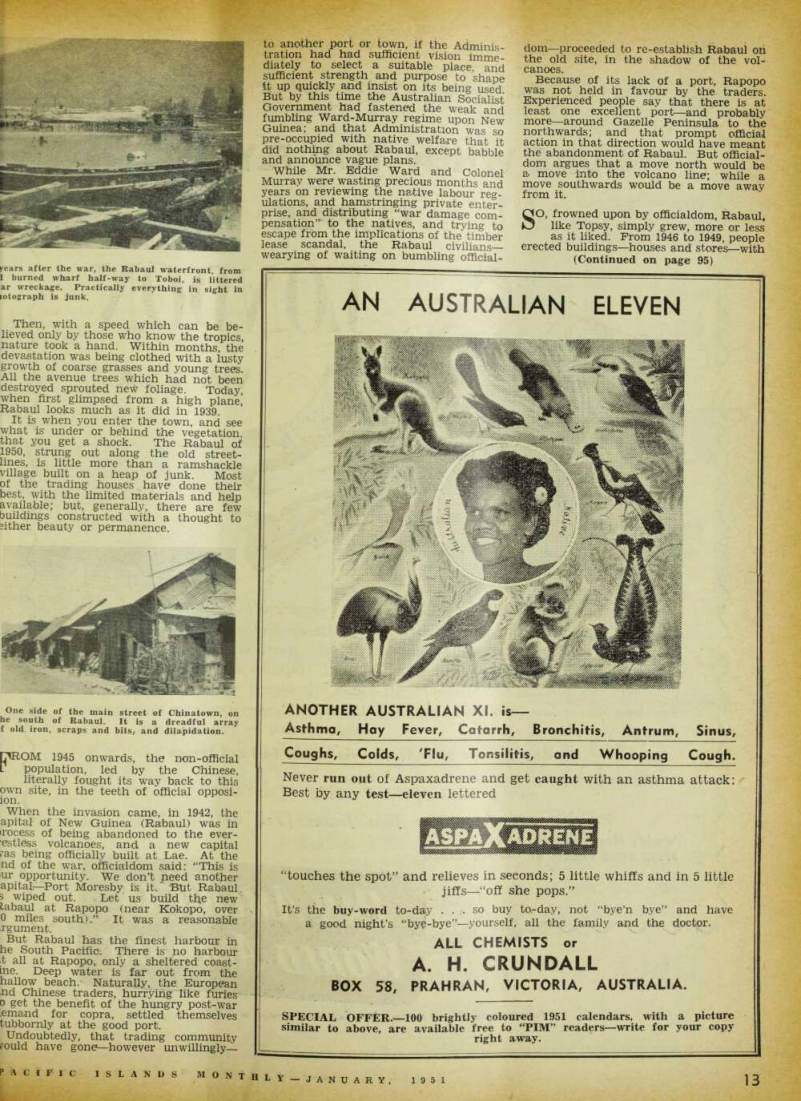
Years after the war, the Rabaul waterfront, from [?] burned wharf half-way to Toboi, is littered [?]ar wreckage. Practically everything in sight in photograph is junk.
One side of the main street of Chinatown, on the south of Rabaul. It is a dreadful array [?]f old iron, scraps and bits, and dilapidation.
/hatever they could lay hands upon, lerely to keep out the wea-ther. Official om growled and was not co-operative, ut did not seriously interfere.
By the end of 1949, Mr. Eddie Ward had scaped from the timber lease scandal, 11 pure and unsullied —but panting very luch from the effort, which had extended ver a year.
By now, he had “had” New Guinea, lanifestly, he lost interest in most of is plans for making Papua-New Guinea native Socialist paradise in the South leas. Private enterprise began to receive ome little encouragement.
So, during 1949, officialdom began to ive some practical help in the rehabil ;ation of Rabaul, and rebuilding began 0 ta-ke some formal shape. Streets were uilt and sealed, both Chinese and Euro eans were encouraged to put up fairly ood buildings, public services were im roved. This tendency was more marked rhen the new regime was introduced, in 950. Port Moresby, at intervals, still alks grandly about the construction of be new town at Rapopo. The road from t-abaul to Kokopo is so bad that I would ot face the journey, and have not seen be site at Rapopo; but I am assured that Tactically nothing has been done.
J7TTH new warehouses built by the big ff firms, a new hotel, neat new Chinese stores in and around the old China- Dwn, Rabaul is improved on what it was 1 1949; but it still is a caricature of the Id Rabaul. I have seen it at the end of ne of the worst droughts on record, rhen it is smothered in pumice-dust from he unsealed roads —dust which, as soon s the North-west season arrives, will turn o endless mud.
I am assured that a great amount of rar damage has been removed. But a ommunal effort of prodigious proportions ; needed still, if the town is to regain a ormal appearance. Everywhere one sees be concrete foundations of old buildings r the remains of concrete fortifications, r high mounds which were once earth ortifications. They mostly are covered nth vegetation, but you cannot walk wenty yards without seeing some evidence f war. These must be removed.
The harbour-front is incredible, even fter five years. Right from the old urned wharf, round to Malaguna, the oreshore still carries a litter of smashed stties, sunken barges, bombed ships.
Post-war Chinatown was built, out of very kind of ugly junk, along both sides f half a mile of bare road, on the outhern or Matupi side of the former own. It is a place of dreadful appear nce—not even a tree to hide it. The etter-class Chinese are now constructing reditable buildings on or near the site f old Chinatown; and this Hideous Half lile should presently disappear.
Between the Hideous Half-mile and latupi, where the airfield now is, and long the foreshore, one may see dozens f plane wrecks, peeping out of the unai and undergrowth.
Between the native markets and the lace where were the once-famous Botanic hardens —now entirely disappeared—there .re the “parks” where War Disposals chicles and equipment were once dis mayed in orderly rows. Here, again, is n incredible sight. Hundreds and hun reds of bulldozers and lorries, cranes and un-carriers and all sorts of powerful tiobile machines have been lying here ince 1946, slowly surrendering to the trop :al sun, rain and jungle. They say huge uantities have been sold and taken away, o make fortunes for innumerable shrewd nd deserving gentlemen; yet the sight f the stuff that remains is enough to
make any self-respecting economist sick on the stomach.
Just beyond the junk parks are the sides of the hills which lead over to Wunawa tung. They are honeycombed with the tunnels and storehouses made by the busy little Japs in their 3 1 years’ occupation; and they still are one of the wonders of this post-war area.
In this area-, as in most of the islands on which they settled in their southwards thrust, the Japs proceeded on the theory that, if they were to be driven out, their
enemies must come and dig them out, by frontal assault. They not only filled Rabaul and the surrounding hillsides with concrete chambers; they also had lines of fortifications in the forests of New Britain, extending far westward of Rabaul.
But all this colossal concrete work was useless. Douglas MacArthur’s forces w |nt leap-frogging away north, fom the Solomons and Australia; and the busy Japs of Rabaul and of scores of sma places, without air or sea help, were left to starve m their elaborate tunnels and concrete chambers, More than any other community in the South Pacific, the people of Rabaul should be Asia-conscious. In all this
junk, they see the evidence of Asiatk aggression. They see their neighbours in Chinatown reacting daily to the flood o< refugee money from Red China. Theii. back door is threatened by the Indone sians who want Dutch New Guinea; and the echoes of the conflict in Korea- reach them first. They are surrounded by mem ories of the hundreds of their townsfolk: who were sacrificed on the Montevideo Maru.
Yet they keep their chins up, and prac tise their well-known hospitality, and put their faith in the future of copra and timber. They suppose that some day the Administration will forcibly remove them, or they will be blown out of Simp sonhaven by some of Mount Mother’s satellites, or cha-sed away again by Asia tics. But, meanwhile, life goes on, and trade is booming, and one has now ac quired a taste for San Miguel beer —sc what the hell!
They are making life on their junk heap as comfortable as the deplorable conditions allow. The Administration at last has agreed that there must be a ‘ temporary” town in Rabaul, and is co operating accordingly in the matter ol providing roads and services. If Asia does not spill out across the world, the next five years in Rabaul should be much better than the last.