News Notes From Port Vila
pp. 79-82 · Read in the full issue

From Our Own Correspondent
VILA, November, 16.
THE opening ceremony for the observ ance of Armistice Day in Vila was the usual Remembrance Mass in the Roman Catholic Church at 9 a.m.
At 11 a.m. the Resident Commissioners, Mr. H. G. Flaxman and M. P. Anthonioz together with a returned soldier from the community, laid wreaths upon the Ceno taph overlooking Mele Bay.
Afternoon celebrations were of a less solemn nature when the first race meet ing held in the New Hebrides for some years attracted a large crowd. The course was the local air strip, built by the Ameri cans during the war and used now solely by Air France on its fortnightly visits to the capital.
An event which aroused much interest was the Ladies Race, won by Mrs. O’Ryan in a field of five contestants.
In the evening a ball was held at the Mathew Rossi Stade.
OUR new Resident Commissioner, Brig adier Judge H. G. Flaxman, is an expert in international law and a widely travelled man. He arrived in Vila some months ago and will now take up official residence on Iririki Island in Mele Bay following the departure from Vila of the retiring RC, Mr. R. D. Blandy. Until the appointment was announced, Mr.
Flaxman occupied the post of British Judge on the Joint Court.
THE recent visit of HMAS Culgoa to Port Vila provided occasion for a round of social and sport activities.
Under the command of Lieutenant Commander V. G. Jerran, the frigate arrived in the port on the morning of October 28. Tennis, football and basket ball teams from the ship were invited to play local teams and on the afternoon of their arrival a cricket team played a com bined Vila team.
Officers and men were entertained ashore at private homes and at the Vila club. To return the hospitality shown them, Lt. Commander Jerran and officers entertained 60 Vila residents at a cocktail party on board the vessel on the eve of its departure. Guests were shown around the vessel.
This goodwill visit of the Culgoa was noted for the excellent behaviour of the
men. It is hoped in Port Vila that the Culgoa will show the flag here aeain Thfrf wprp a fpw rm 7-71 ph , were a lew puzzled frowns and amusing incidents when Vila’s Anglo .. M r6 n Ctl P 9 was introduced to the old Canadian flirtation barn dance at the Jacques Tassy Tennis Club ball. Al though this particular ball was the second at which the music for the dance had
been Played, people were not familiar with this innovation.
The ball was a success and marked the end of the 1950 tennis season. Main event of the night was the presentation of the tr °P hies to the winners of the various club competitions.
While most Vila balls are notable only for the fact that the organisers seem bent on segregating the French people from the British the tennis rlnh’s nniirv of ignoring Nationality^ moved at thZ ball, the eagerness, willingness and ability of both French and British to mix in with one another. The precedent created could be adopted as standard,
(Continued on page 79.)
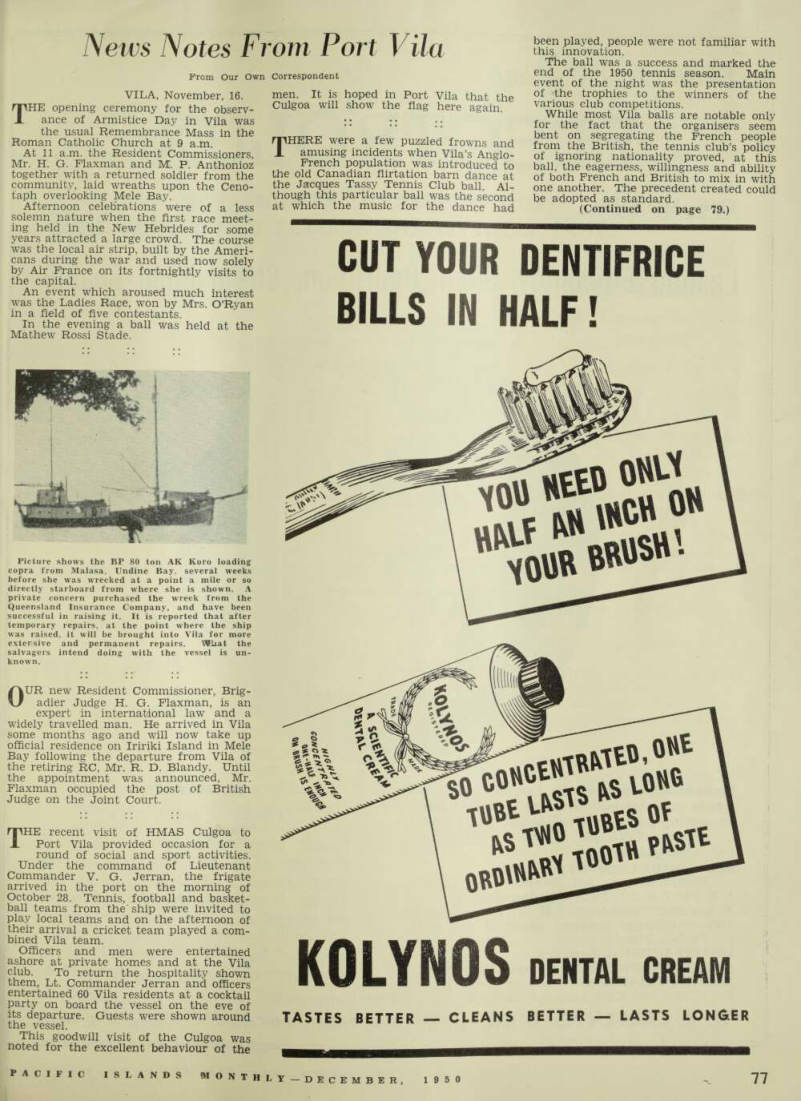
Picture shows the BP 80 ton AK Koro loading copra from Malasa, Undine Bay, several weeks before she was wrecked at a point a mile or so directly starboard from where she is shown. A private concern purchased the wreck from the Queensland Insurance Company, and have been successful in raising it. It is reported that after temporary repairs, at the point where the ship was raised, it will be brought into Vila for more extensive and permanent repairs. What the salvagers intend doing with the vessel is un known.
It had become the accepted practice to place all French guests at a ball at tables along one side of the hall, and all the British at tables the other side. No one seemed to know why—it is just the cus tom.
Anglo-French relations in Port Vila are extremely cordial, especially among the older residents, and any opportunity to further them should be seized upon.
Maybe this can be done by the barn dance, which belated as it may be, is in Vila to stay!
The Condominium water carrying ser vice of Vila has been hard pressed of late to keep pace with the urgent demand of residents for water to fill their tanks. With no rain for over a month, Vila’s household tanks have long been dry.
Optimistic housewives who thought October an ideal month (because of the advent of the change of seasons) to plant their gardens, have seen their seedlings sprout then wither —or not sprout at all.
There is no permanent water supply in the town, only rain water; and a regular supply of that is necessary to keep the tanks full. The once much talked-about water reticulation scheme is not so much talked about now-a-days. However, at the time of writing the appearance of the sky is promising and those who can read the signs predict rain within 24 hours.
Rain clouds which accumulated during the “drought” were always quickly disper sed or blown northward.
Rain will also be welcome to cool the atmosphere which for the past week has been as oppressive as the hot season which promises to be long and severe this year.
One commercial company recently re ported that its labour line had taken a rest for a day or so because it was “too hot to work!”
INDICATIONS of the manner in which the cost of living in the New Hebrides continues to soar is found in the recent circular sent around to members of the New Hebrides Club announcing an “extraordinary meeting” of members to discuss, among other things, an increase in monthly fees.
The very high cost of living in this Group is due mostly to the high cost of freight from Australia, the sole provider of the bare necessities of living in these islands.
The following is given as an indication to prevailing prices (in Australian cur rency) : Tinned fruit, 3/- tin; freezer cargo eggs 7/6 doz; freezer cargo butter, 5/9 lb.; tea! 8/6 to 8/9 lb.; last onions received, 1/- lb.; potatoes, 6d. lb.; flour, 7d. lb.; rice, 9d. lb’.
These are but a few items which are indispensable to the housewife and the prices listed are the lowest in town.
A recent noticeable increase was that in the price of English cigarettes. In a week they jumped from 3/6 to 4 7 3 a tin of 50.
Only about 20 members of the bride and bridegroom’s families were able to be accommodated in the tiny Bong Bong Church (NSW), for the marriage of Miss Jill Throsby to Mr. Peter Chauncy on October 6. The bride is the eldest daughter of Mr. and Mrs. Frank Throsby, of Throsby Park, Moss Vale, and the bride groom is the only son of the late Mr. A.
A. Chauncy, of Rabaul, and of Mrs. J.
Goldhill, of Point Piper. Miss Pamela Chauncy was one of the bridesmaids.
Two Councillors of the French Union, Madame Paule Malroux and Monsieur Charles Dumas, have arrived in New Cale donia, by Air France.
Mr. and Mrs. J, Pound who have spent the last four years in Rabaul, NG. arrived in Brisbane in November. Mr. Pound has been instructing natives in motor mech anics and Mrs. Pound opened RabauTs hrst and only post-war frock shop.
Mr. and Mrs. Robert Charon and Miss Roberte Charton, were in Sydney in October en route to Tahiti where Mr.
Charon is Consul for Norway. They have spent the last year travelling in America, Europe, Scandinavia and North Africa. ~ll J
Sister lima C. Townson, of the Anglican Mission, Papua, was the speaker at a Medical Mission service held at the Bris bane Congregational Church on Novem ber 19.
The Nickel Company ship Quebec has been loading a shipment of 3,000 tons of Iron ore from the Carenage Bay in New
Caledonia; and is also to load giobertite at Voh, for Australia. The island authorities faced with an adverse balance of trade, are anxious that the Common wealth should take iron ore exports from the vast limonite deposits on the Plaine des Lacs, formerly exploited to a limited extent only by the Japanese from the little port of Goro.