Old Timers
pp. 51-65 · Read in the full issue
A Staunch but Dwindling Company
By R. W. Robson
P. Moresby, Oct. 31.
THE Old-Timers —the German settlers, and the Britishers who established the Australian regime here between 1920 and 1930 —are becoming painfully few, and hard to find.
In Moresby, energetically establishing a brewery to cater for PNG’s insatiable thirst, I met Joe Bourke, who was the first police officer at Edie Creek, in the
Year One. Later, I enjoyed the hospi tality of his charm ing home in Wau, and heard the piquant story of how he kept Cecil Levien under restraint on a trumped-up charge of murder, while cer tain of the Old Gang tried to rush through certain plans relating to gold leases. Joe is still the pioneer; and Wau, staging a come-back as the Territory’s Number One hill and health station, needs him.
Up in Edie Creek, doing very well as tributers for NGG, I found our timeless friends, Norman and Mrs. Neale, the veteran Sutherland, and the incorrigibly
young Alice Bowring. Apart from their sluicing, and some good gold being got out of the old Day Dawn by a small party under Bob Franklin, Edie Creek is a ghost town.
Alec Malcolm and Ossie Ireland, of Wau who have had all their plans regarding timber leases thwarted by Departmental stubbornness, are now going tributing in the Gorge for NGG, and should do very well. NGG has changed its policy, and is now letting out its good country to experienced and trusted Old-Timers; and this may give a new lease of life to the “small” miners who were being driven out by high labour and other costs.
Some of the best of the old hands are being employed by NGG at Golden Ridges
where they now are tunnelling into a shoulder of the mountain on a huge plan (based on cyaniding) which may give startling results. The re-establishment of the mill is far advanced.
ANOTHER of the timeless Old Timers, W. R. McConnon, is getting almost sensational results from his Koranga
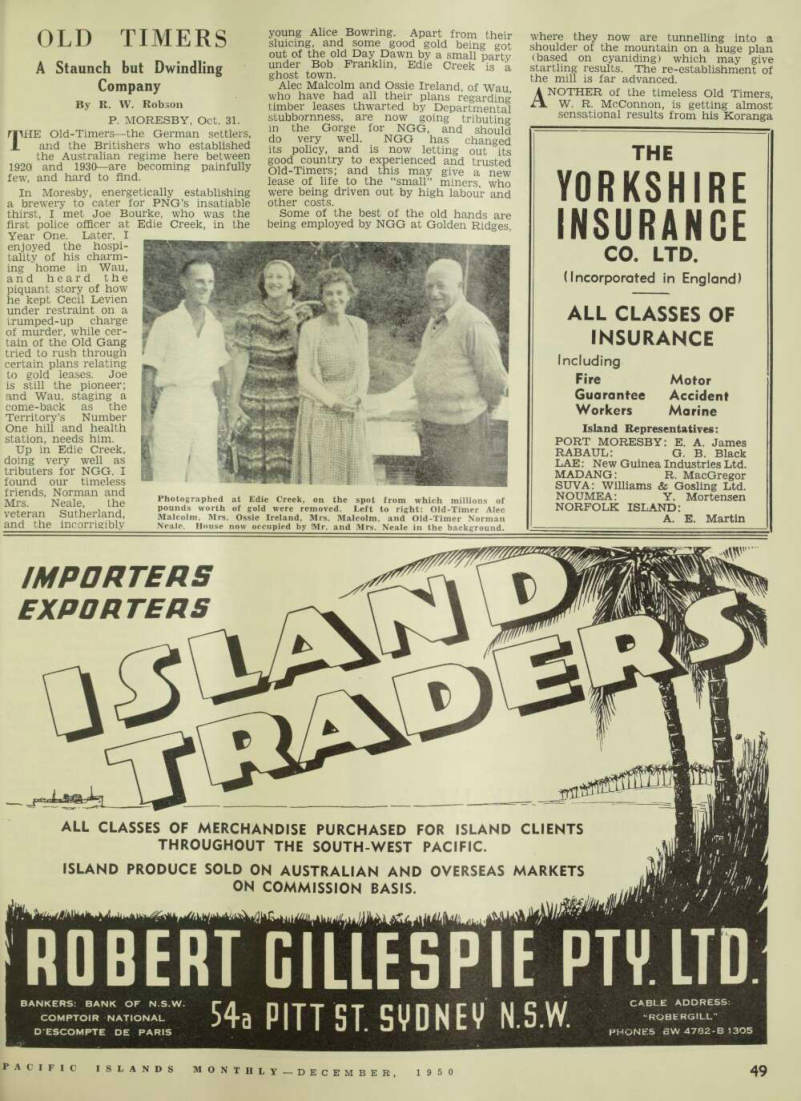
Photographed at Edie Creek, on the spot from which millions of pounds worth of gold were removed. Left to right; Old-Timer Alec Malcolm. Mrs. Ossie Ireland, Mrs. Malcolm, and Old-Timer Norman Neale. House now occupied by (Mr. and Mrs. Neale in the background.
Sluicing, tributing for NGG. Apart from BGD, Koranga has been one of the most consistent money-makers in the Terri tory, always under McConnon’s direction.
He now presides, like a gum-booted patriarch, over a very well-equipped town ship of contented workers —Wau’s main suburb. Already, his enormous nozzles have despatched a couple of mountains down the Bulolo to Lae, and two more mountains, reckoned to be full of gold, are soon to melt away and follow.
As I strolled with Mac around his do main, he casually picked up an enamel basin from under a house. It seemed to be filled with black sand. It was a clean up from some race “down the creek,” brought in by some trusted boys, and there were 30 or 40 ounces there, worth about £lO per ounce. No one up here worries about a little thing like that. I thought of Sydney’s heroes, Dugan and Mears murdering bank managers for a roll of bank notes.
Down in The Gorge, I found Norman Wilde, still getting gold out of the turgid stream for the Cliff side outfit; while a couple of hundred yards away his fellow Old Timer, Bob Day, with a hundred natives, was blasting and straightening the ever-perilous road, now a busy freight ing highway.
Just around the corner, in the mouth of Edie Creek, old Tex Thomas’s courageous widow is working his gold lease, with satisfactory results.
SURVEYING the vast BGD establish ment in the Bulolo Valley, it was hard to believe that this had all been wiped out in 1942-3, and entirely restored since 1945 —an achievement worthy of this model American-Australian company.
The main concerns of the much respected manager, Mr. Lars Bergstrand, were the establishment of a new timber industry, right alongside his huge gold dredging organisation, and the restoration of one of the big. deep-digging dredges, sunk many months ago in a curious accident. A large slice of bank collapsed into the water; the resulting wave turned the floating dredge right over. After solv ing some very complex engineering diffi culties, the dredge has been turned over and set back on its own floating bottom, and is now being re-conditioned.
This Bulolo timber industry is going to develop as a big thing for the gold com panies, and for Wau. It was described in November PIM.
Driving down the Wau-Labu road with Alec Malcolm in his tireless jeep, I had word of some of a few old hands fossick ing around the Baiune and Watut, but they are pitifully few. They came back hopefully enough in 1945-46. but the Ward-Murray attack on private en terprise created for them conditions which were intolerable, and many have drifted away.
Ned Rowlands and the Wilson Brothers are still hanging on in that new gold area at the back of Wabag, in the High lands —the area in which the new Ade laide concern, Goldmines of New Guinea Ltd., is showing an interest. Mr. J. C.
Coldham, for the company, has been in there lately.
Near Mumeng—up in the high grass lands, between Bulolo and Labu —I met Mick Leahy energetically farming 600 acres; and I learned that, with equal energy and optimism, Jim Leahy is farm ing near Garoka, and Danny Leahy near Hagen—surely the Pacific’s outstanding example of a family of brothers, after pioneering a gold industry, turning to and are pioneering a pastoral industry.
I have taken it upon myself to compile the history of these almost legendary Leahy Brothers, and it is published in the - Magazine Section, this issue.
IN a house at the back of Lae, quite by accident, I came upon Bill Money (one of Edie Creek’s original Big Six) and S. A. Webb, who was an official at Lae over 20 years ago. Although a shrewd business man, Bill Money remains socially unpredictable. He told me stories which, if hosed for a week, would not be admitted to the vicar’s tea-table.
Jim Taylor (who, as a DO, was asso ciated with the Leahys in the discovery of the Highlands) is now a private farmer in the Highlands, out Chimbu way. No one likes him any more—rightly or wrongly they blame him for the Native Labour Ordinance, which Socialist Eddie Ward used to flay the New Guinea “capitalists.”
“Yorkie” Booth, with a white beard and a dog the size of a house, was living in Mrs. Stewart’s hotel in Lae. After three decades in and around the Morobe field, Yorkie has retired to a more leisurely life.
His most treasured possession is a file of official correspondence, showing that 20 years ago he was seeking permission to cut, and raft down the rivers, the Bulolo pine and cedar for which everyone is now scrambling. Unfortunately, prescience doesn’t pay dividends.
At Garoka, in the Highlands, I met J. Wilton, another Old Timer of the Gold fields. He is doing a good job as boss of road construction works. He took a little time off to give me, in simple Gold fields language, his views on Highlands labour; and he sent kind regards to the old fossickers everywhere.
OUT on the Rai Coast, and in Rabaul and Bougainville, I was back among the Old Timers of the coconuts. As I listened to their chorus on subjects re lated bitterly to labour and costs and prices, there seemed to be a great many of them; but that was only because they
have lost none of their ancient capacity for giving tongue against oppression and misunderstanding. Actually, one missed that area affected by the Montevideo Maru tragedy, which destroyed 300 civilians I was delighted to meet Jock Maclean of Rangarere plantation—in from the Bainings to welcome home his son and new daughter-in-lav/. Jock—whose up right carriage still bears testimony to many once familiar faces—especially in the old goldfields days, and fossicked far
afield before he adopted the coconut palm. He was cut off by the Jap in vasion; but, eventually, after great hard ships, he escaped via New Ireland, Buna and the Owen Stanleys. In New Ireland, he was associated with young Con Page and others (who were murdered by the Japs) and he says the lives of himself and others were saved by the heroism and hospitality of Mrs. Schultze and her sister
(Continued on page 63)
—both of whom later died on their plan tations during the Jap occupation.
I found a very interesting Old Timer in the housekeeper at the Rabaul hotel —Mrs. Frost, who came to New Guinea as long ago as 1924, with her late husband, a steamer-captain. Their son now is an aviation engineer with Qantas. Mrs.
Frost has held various Territories jobs, before and since the war, and is esteemed by both young and old Territorians. She is headed for Wau soon, to reside in cold air with her old friend Mrs. Bowring, at Edie Creek.
I SUPPOSE I must include among the Old Timers men like Ned O’Brien, Middleton, Bliss, Schilling, E. J.
Wauchope, of Madang, Chipper and Stokie, of Rabaul, and Fred Archer, Jimmy Joyce, and Jack Ellis, of Bougainville; but they are so energetic and tireless to-day in bringing the lowly coconut to market that they seem part of the modern bustle.
You haven’t seen a human dynamo in action until you have met John Stokie coming along a Rabaul avenue in full war-paint (khaki overalls and digger hat); and the spectacle of Jack Chipper, simultaneously directing sawmilling, lightering, engineering, motor vehicle re habilitation, building, and what-not, while tearing from place to place in a shining car, suggests nothing of age or decrepi tude.
Still, they all belonged to the Time Be fore; and every one of them, I think, did yeoman service in the jungles during the black years, with the best of the main land’s Old Timers.
Perhaps because I am myself now a grave and reverend seigneur, and because I cannot find much preoccupation with New Guinea’s future in the lighthearted messes where most of the Time Behinds
mmt‘u'atfon“ulf’mu S t h look tee Old Timers for practical help in getting these Territories back onto the road to real progress and economic equilibrium.
POSTSCRIPT — In Moresby on mv home Iteamed that ■two more nf?h. S “'ra SUS on D H m the Eastern who wrote copiously in the PIM about the old JfK-Lnnn Anff P o e J, cy on i?« i j? er 27) who came t° the Papuan goldfields 30 years ago ’ ana was one 01 Captain Pitch’s first staff merL J „ Mr. and Mrs. R. C. Duane left Niue by the Maui p o ma f e recently and will spend several months m Zealand.