More Artifacts
p. 20 · Read in the full issue
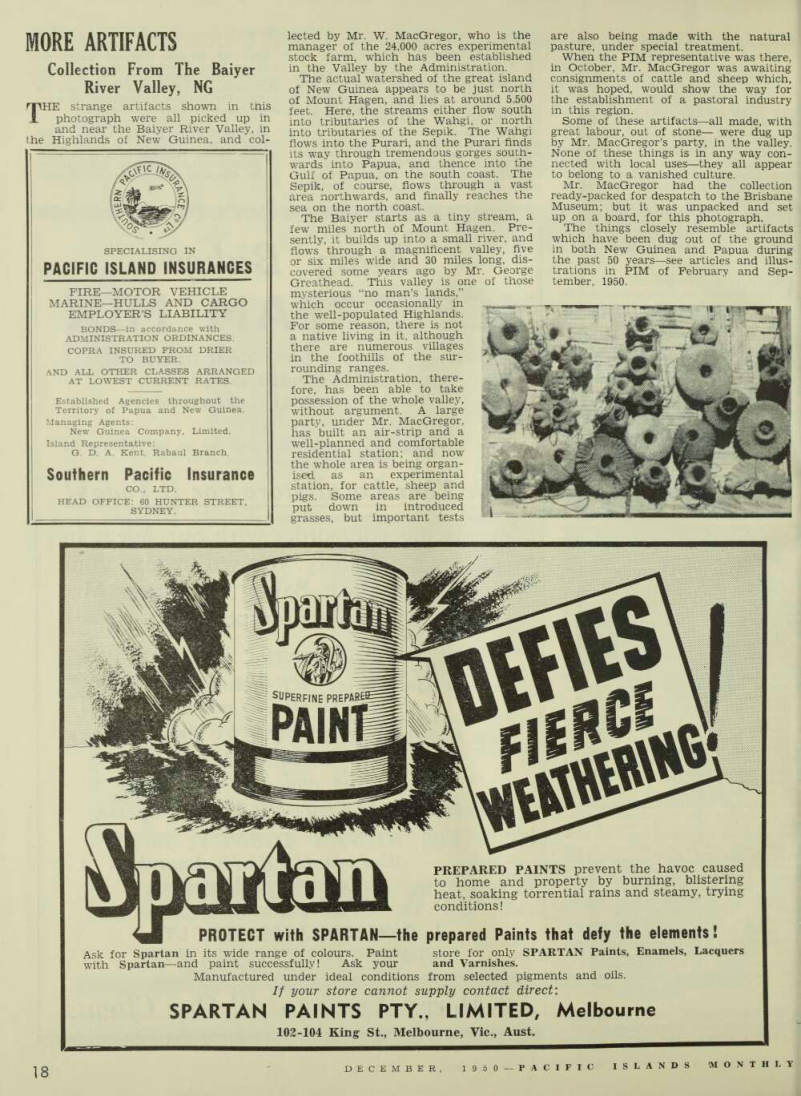
Collection From The Baiyer River Valley, NG
THE strange artifacts shown in this photograph were all picked up in and near the Baiyer River Valley, in the Highlands of New Guinea, and col
lected by Mr. W. MacGregor, who is the manager of the 24,000 acres experimental stock farm, which has been established in the Valley by the Administration.
The actual watershed of the great island of New Guinea appears to be just north of Mount Hagen, and lies at around 5.500 feet. Here, the streams either flow south into tributaries of the Wahgi, or north into tributaries of the Sepik. The Wahgi flows into the Purari, and the Purari finds its way through tremendous gorges south wards into Papua, and thence into the Gulf of Papua, on the south coast. The Sepik, of course, flows through a vast area northwards, and finally reaches the sea on the north coast.
The Baiyer starts as a tiny stream, a few miles north of Mount Hagen. Pre sently, it builds up into a small river, and flows through a magnificent valley, five or six miles wide and 30 miles long, dis covered some years ago by Mr. George Greathead. This valley is one of those
mysterious “no man’s lands,” which occur occasionally in the well-populated Highlands.
For some reason, there is not a native living in it, although there are numerous villages in the foothills of the sur rounding ranges.
The Administration, there fore, has been able to take possession of the whole valley, without argument. A large party, under Mr. MacGregor, has built an air-strip and a well-planned and comfortable residential station; and now the whole area is being organ ised, as an experimental station, for cattle, sheep and pigs. Some areas are being put down in introduced grasses, but important tests
are also being made with the natural pasture, under special treatment.
When the PIM representative was there, in October, Mr, MacGregor was awaiting consignments of cattle and sheep which, it was hoped, would show the way for the establishment of a pastoral industry in this region.
Some of these artifacts —all made, with great labour, out of stone— were dug up by Mr. MacGregor’s party, in the valley.
None of these things is in any way con nected with local uses—they all appear to belong to a vanished culture.
Mr. MacGregor had the collection ready-packed for despatch to the Brisbane Museum; but it was unpacked and set up on a board, for this photograph.
The things closely resemble artifacts which have been dug out of the ground in both New Guinea and Papua during the past 50 years—see articles and illus trations in PIM of February and Sep tember, 1950.