Some Notes hy the Wayside—ll
pp. 13-98 · Read in the full issue
FROM R. W. ROBSON IN NEW GUINEA
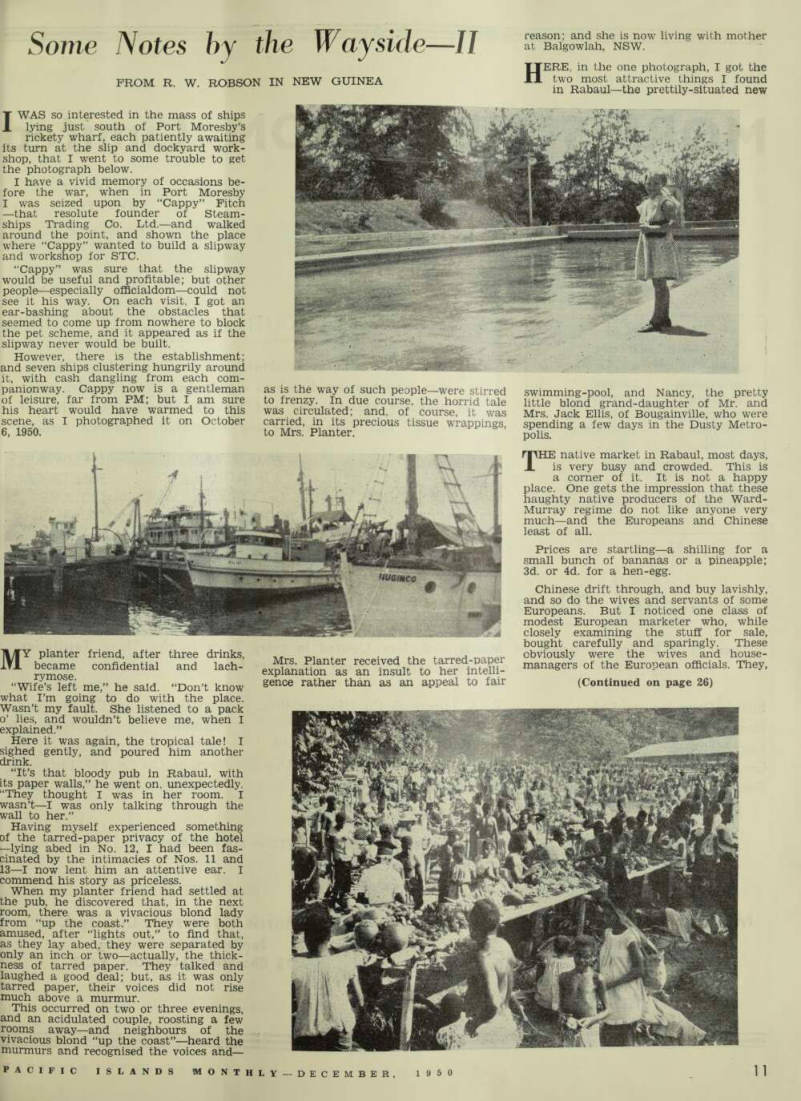
I WAS so interested in the mass of ships lying just south of Port Moresby’s rickety wharf, each patiently awaiting its turn at the slip and dockyard work shop, that I went to some trouble to get the photograph below.
I have a vivid memory of occasions be fore the war, when in Port Moresby I was seized upon by “Gappy” Fitch —that resolute founder of Steam ships Trading Co. Ltd.—and walked around the point, and shown the place where “Gappy” wanted to build a slipway and workshop for STC.
“Gappy” was sure that the slipway would be useful and profitable; but other people—especially officialdom—could not see it his way. On each visit, I got an ear-bashing about the obstacles that seemed to come up from nowhere to block the pet scheme, and it appeared as if the slipway never would be built.
However, there is the establishment; and seven ships clustering hungrily around it, with cash dangling from each com panionway. Gappy now is a gentleman of leisure, far from PM; but I am sure his heart would have warmed to this scene, as I photographed it on October 6, 1950.
MY planter friend, after three drinks, became confidential and lach rymose.
“Wife’s left me,” he said. “Don’t know what I’m going to do with the place.
Wasn’t my fault. She listened to a pack o’ lies, and wouldn’t believe me, when I explained.”
Here it was again, the tropical tale! I sighed gently, and poured him another drink.
“It’s that bloody pub in Rabaul, with its paper walls,” he went on, unexpectedly.
“They thought I was in her room. I wasn’t —l was only talking through the wall to her.”
Having myself experienced something of the tarred-paper privacy of the hotel —lying abed in No. 12, I had been fas cinated by the intimacies of Nos. 11 and 13 —I now lent him an attentive ear. I commend his story as priceless.
When my planter friend had settled at the pub, he discovered that, in the next room, there was a vivacious blond lady from “up the coast.” They were both amused, after “lights out,” to find that, as they lay abed, they were separated by only an inch or two —actually, the thick ness of tarred paper. They talked and laughed a good deal; but, as it was only tarred paper, their voices did not rise much above a murmur.
This occurred on two or three evenings, and an acidulated couple, roosting a few rporns away—and neighbours of the vivacious blond “up the coast” —heard the murmurs and recognised the voices and—
as is the way of such people—were stirred to frenzy. In due course, the horrid tale was circulated; and, of course, it was carried, in its precious tissue wrappings, to Mrs. Planter.
Mrs. Planter received the tarred-paper explanation as an insult to her intelli gence rather than as an appeal to fair
reason; and she is now living with mother at Balgowlah, NSW.
HERE, in the one photograph, I got the two most attractive things I found in Rabaul —the prettily-situated new
swimming-pool, and Nancy, the pretty little blond grand-daughter of Mr. and Mrs. Jack Ellis, of Bougainville, who were spending a few days in the Dusty Metro polis.
THE native market in Rabaul, most days, is very busy and crowded. This is a corner of it. It is not a happy place. One gets the impression that these haughty native producers of the Ward- Murray regime do not like anyone very much—and the Europeans and Chinese least of all.
Prices are startling—a shilling for a small bunch of bananas or a pineapple; 3d. or 4d. for a hen-egg.
Chinese drift through, and buy lavishly, and so do the wives and servants of some Europeans. But I noticed one class of modest European marketer who, while closely examining the stuff for sale, bought carefully and sparingly. These obviously were the wives and house managers of the European officials. They,
(Continued on page 26)
amid this orgy of loose money and high spending, have to conform to a fixed income that is* always one long hop behind the cost-of-living figure. I thought they generally looked tired and harassed; but, of course, I cheered myself up with the spectacle of all those prosperous native co-operatives, concerning whom such glowing reports go out to the Trusteeship Council.
My mind somehow kept returning to memories of the old, pre-war native market, to which one carried a bunch of trade tobacco and, for the equivalent of a few pence, bought excellent fruit and vegetables from smiling natives who seemed glad to see one. The more I see of the Ward-Evatt-Murray plan for “freeing the natives from exploitation,” the less I like it.
UPON this well-weathered board, sel up at a road intersection just soutl of the re-built town of Wau, are in scribed these words; — Wau —Around this Airfield, and t< the South and East, in the Wau Valley Australian soldiers fought a desperati defensive battle against a Japanesi Force which advanced from Salamaus through Wandumi.
It was on January 27, 1943, that Cap tain W. Sherlock, in charge of a Kangi force watching the Black Cat and Crysta Creek tracks (on the eastern side of th Bulolo Valley, facing Wau) found them
selves in contact with numerous Ja patrols, who had appeared suddenly an mysteriously. Only later was it leame that some thousands of Japs had gc through on the old Wandumi track, bel ween the Black Cat and the Crysh Creek tracks, which had been cut by tb Germans, and long since forgotten an overgrown.
Sherlock sacrificed his men —and h own life—in a successful effort to hold tt Japs long enough to allow the Kangas 1 organise their defences in the Bulol Valley, in front of Wau. On the 29tl American transport planes brought Auj tralian troops from Moresby in onto Wa airfield, and they reinforced our bendir line.
But the Japs were thrusting strong: across the valley on the morning ( January 30, and our position was vei critical, when big planes from Papua b( gan to unload Australian artilleryme with 25-pounders. They went straigl into action, at the edge of the airfield, ar in a few hours the Japs were smashed ar retreating—one of the most dramatic n cidents of the Pacific War.
Now, the only sign of it is this plai board, and the wrecks of a few plan< peeping out of the kunai, here and ther ADO Seale, in charge of this district, trying to induce someone to replace tl hoarding with a worth-while and pe: manent memorial.
THIS impressive structure, in the Lalo Valley near the airstrip, north-ea of Moresby, is all that remains no to remind the casual traveller that, on a few short years ago, the better 200,000 troons were spread all across tn arid region, getting ready to deal wii the Jap menace on the other side of tl Owen Stanley ranges.
This wartime shelter-shed now hous Mr. Tom Flower’s main sawmill. I brings the logs in, in big lorries, some or 12 miles, from rapidly dwindling lease and the saws are kept busy. There are i stacks of timber at the mill. Moresby hunger for building material of any ki| is so great that the green timber literal is sold before it is off the saw-bench, di
livered before it is dry, and nailed into position before it gets a chance to curl.
THE three pictures (p. 87) give some idea of what is happening to the goldmin ing industry of the Bulolo Valley. Both Bulolo Gold Dredging, Ltd., and New Guinea Goldfields, Ltd., have put in large log-hauling and sawmilling installations, with the idea that the increasing business of producing pine and cedar timber shall compensate them for the dwindling pro duction from their gold leases, now being worked out.
In the top picture is some of the pine, cut ready for shipment by BGD, in fulfil ment of a huge order for cell separators placed in New Guinea by Australian manufacturers of storage batteries. In Australia, these beams are cut down into thin separators.
The second picture shows some of the sawn timber, at one of the mills, ready for use in pre-fabricated houses, now being supplied to various towns in New Guinea
(Continued on page 87)
_.? atu . J ir La J a S H k “ na ’ Secretary of Pn P rn^p bri tf y T *2 H £ nolulu in September, en route to Lake Success where he was advisor to the UK delegation. In Honolulu, he was described in a the^^onies* 8 in S thp tB R?r ° f ? C 1 es m the Fijian Government.
Miss Lily Mansell, daughter of Mr and H - L Mansell of Suva. Fiji! who has been in the employ of the British Em bassy in Washington, DC, USA, for the past 15 months has returned to her home f ° r a f6W months holiday, before return mg to Honolulu where she is to marry Ens. Arthur S. Schlofman Jr. USN.
Papua to overcome the tragic house shortage.
The third photo shows pine logs just brought out of the gullies of the Wau Creek by NGG Ltd., and being prepared for transport to the mill at Wau.
Some of those great Bulolo pines will produce 10,000 super feet of sawn timber.
Many go up to 250 and 270 feet. BGD cut one that, from the ground to its top most branch, measured 293 feet.
THIS is the hotel at Mumeng, high up on the grassland country, between Lae and the Wau-Bulolo area. The idea of providing Lae folk with a cool week-end seemed quite good, but some how the Lae folk prefer to remain in
Lae and swelter. However, the motor drivers on the long weary haul between Lae and Bulolo, when they break their journey there for a cold beer, bless the name of Mark Schultz, who built the modest pub.
THE beer consumed annually in Papua- New Guinea totals some fantastic number of gallons—about 350,000. It is not draught beer —it is all carried in in bottles. That quantity of beer would require well over a million bottles.
Held in high esteem when full, bottles, when empty, are more or less a pain in the neck. No one thinks it worth while to transport them back to the hungry bottle-markets of cooler climes. So they just naturally form useless and growing
Empties—No one wants them, now.
mountains around the back premises of the tropical hotels.
Photo shows one section of the pile that may be seen at the edge of the jungle near the Hotel Cecil in Lae, New Guinea.
TJOUSEWIVES of Moresby, if they had their way, might add another medal to the several decorations acquired by Captain Bobby Gibbes in the 1939-45 un pleasantness. One of the planes of Gibbes
Sepik Airways now flies regularly to Garoka, loads up with the very fine pota toes and cabbages produced in the High lands, and drops down over the central mountains into Moresby, where the fresh food is very welcome.
The plan seems to be economic; but, whether the profits are there or not, Bobby Gibbes probably will continue the service, because of his love for the High lands, and his eagerness to do something towards the development of the new country. He has joined the small but notable band of farmers in the Highlands and, at his place near Hagen, he is ex perimenting, to see whether he can pro duce passion-fruit on a payable basis. It is largely a matter of transport and pre servation. There is a huge market for the pulp in Australia, if it can be got there in satisfactory condition.
The plane in this picture had just been loaded with cabbages by these primitive “Chimbus.” Their costume consisted of a woven fringe in front, and a tail-piece of fresh green leaves.
IP one wanted to be fanciful, one might call New Guinea the Land of the Dy ing Jeep. The jeep is one of the few good things that Papua-New Guinea got out of the war. There are hundreds— thousands —of them, all over the Terri tory; and they seem to have been made for just the kind of rough transport most in demand here.
This is the Wau golfers’ modest club house on a Saturday afternoon; and, of the 10 vehicles patiently waiting there for
the end of 19th hole ceremonies, no less than nine were Jeeps.
Incidentally, while this is the smallest, it probably is the prettiest golf-course in the Islands. They have just acquired land alongside, which they have named the Eric Feldt Reserve (in honour of a former notable official who still is held in
(Continued on page 0(5.)
high regard) and, when they get it licked into shape, they will have a 9-holes course.
The jeeps are becoming aged, battered and decrepit, and there seems to be no adequate provision for their maintenance, renewal and replacement. The jeep, one of the most useful tools these Territories ever had, seems destined to become a war time memory. I presume jeeps are still being built; but the Nabobs of our time say we may not sell our gold and copra for dollars, and so we cannot have any more jeeps.
THIS little picture, taken in Madang in mid-October, illustrates what the critics mean when they say the coastal shipping service in New Guinea is falling down on the job. The main trouble is not so much the little ships themselves, as the fact that the wharves are not numerous or big enough to accommodate the little ships, when they come in loaded with cargo, eager to discharge and get away.
On this occasion, in Madang, the stores behind this wharf were bulging with copra—evidently, some vessel from over seas was overdue. Meanwhile, half a dozen small ships were lying in the pic turesque little port, awaiting their turn at the discharge wharf and, as shown here, piling up three deep.
THE WD Millionaires, they call them m New Guinea —and there are quite a lot of them. WD stands for War Disposals.
When the Army departed, the two Ter ritories were simply littered with wealth.
Gold and coconuts have made many men rich; but—if they could but have seen it —these riches were as nothing to what has been gathered up by the bright lads who got in early on the War Disposals goods.
Papua-New Guinea is absorbing any thing from three to seven millions a year of Australian taxpayers’ funds. Much of that call on Australia could have been avoided if only those Disposals goods had been sold to the Administration at the same prices as they were sold to speculators, and the Administration had re-sold piece meal. As it was, they were more or less given away, and shrewd gentlemen from everywhere made fortunes. Some of the fortunes stayed in New Guinea, but most of them emigrated.
Here, picked up in passing, is an example. I noticed, at Tom Flower’s saw mill, a small mountain of galvanised wire rope. Mr. Flower bought some discarded naval apparatus—huge nets, or something like that—for a few pounds; for another few pounds he had the connections un screwed: and the resulting rolls of wire rope—very handy in all kinds of industry is worth a great deal of money.