1951 Copra Price Rises 10 Per Cent.
pp. 9-10 · Read in the full issue
Growers Being Fleeced Over ‘Stabilisation,’ Taxation And Sterling Devaluation
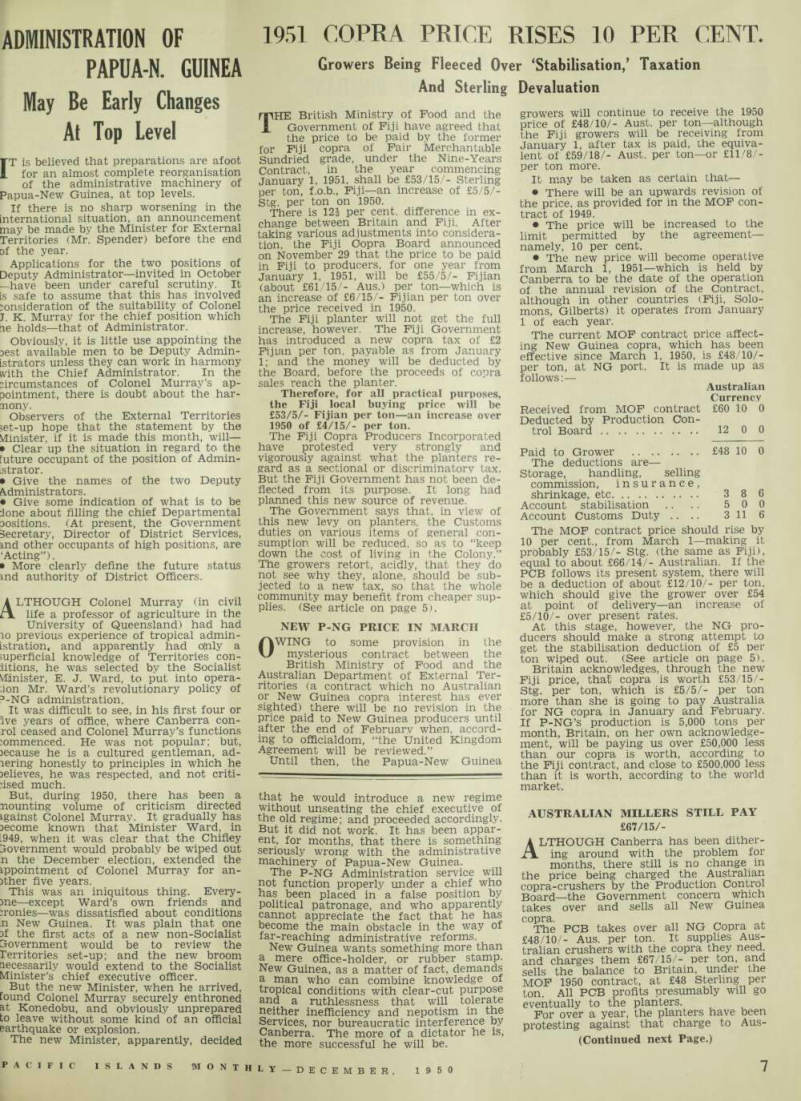
THE British Ministry of Food and the Government of Fiji have agreed that the price to be paid by the former for Fiji copra of Pair Merchantable Sundried grade, under the Nine-Years Contract, in the year commencing January 1, 1951, shall be £53/15/- Sterling per ton, f.0.b., Fiji—an increase of £5/5/- Stg. per ton on 1950.
There is 12i per cent, difference in ex change between Britain and Fiji. After taking various adjustments into considera tion, the Fiji Copra Board announced on November 29 that the price to be paid in Fiji to producers, for one year from January 1, 1951, will be £55/5/- Fijian (about £6l/15/- Aus.) per ton —which is an increase of £6/15/- Fijian per ton over the price received in 1950.
The Fiji planter will not get the full increase, however. The Fiji Government has introduced a new copra tax of £2 Fijian per ton, payable as from January 1; and the money will be deducted by the Board, before the proceeds of copra sales reach the planter.
Therefore, for all practical purposes, the Fiji local buying price will be £53/5/- Fijian per ton—an increase over 1950 of £4/15/- per ton.
The Fiji Copra Producers Incorporated have protested very strongly and vigorously against what the planters re gard as a sectional or discriminatory tax.
But the Fiji Government has not been de flected from its purpose. It long had planned this new source of revenue.
The Government says that, in view of this new levy on planters, the Customs duties on various items of general con sumption will be reduced, so as to “keep down the cost of living in the Colony.”
The growers retort, acidly, that they do not see why they, alone, should be sub jected to a new tax, so that the whole community may benefit from cheaper sup plies. (See article on page 5).
New P-Ng Price In March
OWING to some provision in the mysterious contract between the British Ministry of Food and the Australian Department of External Ter ritories (a contract which no Australian or New Guinea copra interest has ever sighted) there will be no revision in the price paid to New Guinea producers until after the end of February when, accord ing to officialdom, “the United Kingdom Agreement will be reviewed.”
Until then, the Papua-New Guinea
growers will continue to receive the 1950 price of £4B/10/- Aust. per ton—although the Fiji growers will be receiving from January 1, after tax is paid, the equiva lent of £59/18/- Aust. per ton—or £ll/8/per ton more.
It may be taken as certain that— • There will be an upwards revision of the price, as provided for in the MOF con tract of 1949. • The price will be increased to the limit permitted by the agreement— namely, 10 per cent. • The new price will become operative from March 1, 1951—which is held by Canberra to be the date of the operation of the annual revision of the Contract, although in other countries (Fiji, Solo mons, Gilberts) it operates from January 1 of each year.
The current MOP contract price affect ing New Guinea copra, which has been effective since March 1, 1950, is £4B/10/per ton, at NG port. It is made up as follows: —
The MOF contract price should rise by 10 per cent., from March I—making it probably £53/15/- Stg. (the same as Fiji), equal to about £66/14/- Australian. If the PCB follows its present system, there will be a deduction of about £l2/10/- per ton, which should give the grower over £54 at point of delivery—an increase of £5/10/- over present rates.
At this stage, however, the NG pro ducers should make a strong attempt to get the stabilisation deduction of £5 per ton wiped out. (See article on page 5).
Britain acknowledges, through the new Fiji price, that copra is worth £53/15/- Stg. per ton, which is £5/5/- per ton more than she is going to pay Australia for NG copra in January and February.
If P-NG’s production is 5,000 tons per month, Britain, on her own acknowledge ment, will be paying us over £50,000 less than our copra is worth, according to the Fiji contract, and close to £500,000 less than it is worth, according to the world market.
Australian Millers Still Pay
£67/15/- ALTHOUGH Canberra has been dither ing around with the problem f9r months, there still is no change in the price being charged the Australian copra-crushers by the Production Control Board —the Government concern which takes over and sells all New Guinea copra.
The PCB takes over all NG Copra at £4B/10/- Aus. per ton. It supplies Aus tralian crushers with the copra they need, and charges them £67/15/- per ton, and sells the balance to Britain, under the MOP 1950 contract, at £4B Sterling per ton. All PCB profits presumably will go eventually to the planters.
For over a year, the planters have been protesting against that charge to Aus
(Continued next Page.)
Australian Currency Received from MOF contract £60 10 0 Deducted by Production Control Board 12 0 0 Paid to Grower £48 10 0 The deductions are— Storage, handling, selling commission, insurance, shrinkage, etc 6 3 8 Account stabilisation 5 0 0 Account Customs Duty .. .. 3 11 6
tralian millers of £67/15/-, and pointing out that the value of the copra, accord ing to the free world market (see. for example, the Bank of New Zealand’s London produce circular of October 6) is between £9O and £lOO Sterling per ton.
Why should the NG producers thus be forced to subsidise the Australian coco nut consumers, millers and exporters? But Canberra has done nothing.
The Australian copra-millers now are howling because the removal of ration ing from Australian butter has brought about a sharp decline in the sales in Australia of margarine. Hitherto, Aus tralia—in justice to the NG growers— would not allow the millers to export to the world’s free market, much of the oil and margarine got from the cheap NG copra. But now the millers say they can not sell their products in Australia—they want the ban lifted.
The Australian Government should lift it —but, in fairness to the NG producers, it should make the millers pay world parity for their copra.
Poor Copra In Bsi
Honiara, Dec. 4.
THE Secretary to the Solomon Islands Government has announced that complaints have been received from the Minister of Food, in London, regard ing the quality of two recent shipments to the UK. These shipments were car ried in different holds from copra des patched by other Territories and compared most unfavourably with the latter copra.
The Solomons copra is unequivocally de scribed as bad. The main faults are dust, sand and dirt mixed in with the copra, and bad cooking, which has resulted in burning.
Strict inspection and grading at the main ports of shipment, Honiara and Yandina, followed this criticism, and a considerable amount of copra has been rejected by the Copra Board’s agents.
It is realised that, during the immediate post-war period, any copra was better than none; but growers have now been asked to make every effort to improve quality, otherwise a new price for a lower grade may be introduced.