New Guinea’S New Highland Labour
pp. 79-81 · Read in the full issue
Some Big Employers Are Critical
From R. W. Robson
Rabaul, Oct. 25
AS I stood in the hallway of the nearly finished Ascot Hotel, in Rabaul, talk ing to Manageress Dorothy Stewart, I noticed four very intent boys laying tables in the dining-room. They put forks and glasses and salt-cellars carefully upon the tables, and then a white assistant swept them away, and they did it all over again.
“A new sort of chess game?” I asked.
“Those are Chimbus being trained as waiters,” said Miss Stewart.
Everyone here calls the Highlanders Chimbus. Actually, the new contract labour comes from four or five of the great valley systems—but mainly from Benna Benna, Garoka, Chimbu and Hagen. How ever, to the coastal employer, they are all Chimbus.
“I got some of them this week,” said Miss Stewart. “Bit dumb, but willing enough. Got up at daylight this morning, and scrubbed ’em.”
I had just come from the Highlands.
Most of the natives there know no lingo but their own (of which there are scores of varieties); they have never even seen in side a European’s house; and their normal dress comprises a few woven strings hang ing in front of the abdomen, plus a liberal smearing of pig-grease, to keep out the cold of the nights.
“Two boys helped me,” said Miss Stewart. “We had a drum of hot water, plenty of soap and scrubbing brushes, and we got off a lot of grease. We told them they had to wash like that every morning, and don clean calicoes.”
I examined the new waiters. They never took their eyes off the salt cellars and forks, and their healthy skins literally shone.
It might seem to non-Territorians to be a pretty grim set-up for a new dining room; taut they do not know Dorothy Stewart.
SINCE the Highlands labour was made available to the PNG employers nearly a year ago, the better part of 10,000 native men have been sent out (nearly all by air) under a system closely organised and supervised by the Adminis tration.
The Administration generally selects the men, and sees that they are healthy and inoculates them against diseases to which they may be exposed on the coast, and makes them available to approved employers. The employers, generally through agents, engage as many men as they want for one year (counting from day of departure to day of return), and in most cases transport them by plane.
Air transport is enormously costly; but it is forced upon employers because, by any other means, the already inadequate year’s service (product of the Ward- Murray regime) is seriously reduced.
When they reach their place of employ ment, the Highlanders usually need a good deal more training and instruction than the more sophisticated salt-water folk who have been in contact with Euro peans. They have seen cars and jeeps on the Highlands, and planes; but the sea, and all that goes upon it, and machinery, and streets, and so forth, are all entirely new.
They “shake down” more quickly on the plantations than in the ports and on the mines—probably because there life is less complex; but all need a period of
“shaking down”—and that is an exaspera tion to the employer, who has got them for only a year, anyway, and (taking fees and air fares and what not into con sideration) at very heavy cost.
AS an experiment, the introduction of this Highland labour has not been an unqualified success. But it did fill the gap when every employer in New Guinea and Papua was crying out for labourers, and there was talk even of bringing in labour from Asia. One effect of introducing the “Chimbus” has been to stir the coastal natives out of their lethargy. Some employers say that it now
is easier to engage salt-water natives.
The net result is clear: While employers are complaining, none are saying now that they cannot get labour at all.
Some employers, who have been patient and painstaking, have had very good re sults from their Highlanders. Others — Carpenters, at Madang, and BGD, at Bulolo, among them —have sent them back
to the Highlands, before the expiry of the year, as “hopeless.” The majority have grumblingly made the best possible use of them. Few praise them. Most employers say that they are “dumb”—which is not surprising, in the circumstances.
In course of time, as this very raw labour comes back on a second contract, with some knowledge of the European and his ways, the standard of service should improve. But, under the condi tions established by the Ward-Murray regime, it is very costly labour; and a very small shift in prices or revenues would make it uneconomic.
WHEN they are returned, the High landers are received at the District Offices, and sent into quarantine compounds for a fortnight, to guard against the introduction of coastal diseases to the crowded inland valleys.
About 300 have now returned. Gen erally, they do not retain their pay in our currency. They either spend it at once in the trade stores, or change it into cowrie and gold-lip shell, the regular currency of the Highlands natives.
There are a very few Europeans funning farms and plantations in the Highlands, and most of them have trade stores. As the thousands of time-expired labourers return to the Highlands (and the trickle back is now becoming a stream) the busi ness of changing their money into trade and shell will become pretty important.
The Chinese trade store —a feature of the landscape all over the Territory, ex cept Papua—has not yet appeared in the Highlands, One application for land for a Chinese trade store at Garoka is in. and will be granted. Many people are anxious to keep the Chinese traders out of the Highlands; but, under Trusteeship prin ciples and laws, that may not be done.
Thera are perhaps a million people in these great upland valley systems, be tween the Ramu and the western border.
Already, they have discarded the stone axes for the iron tomahawk, and the fire stick for the kerosene lantern. Old traders see a great new market opening here. But the Highlanders, as yet, have not much to offer in exchange, except labour.
There is some uncertainty about the future purchase by the French Army, for use in Indo-China, of New Caledonian tinned beef. The position is that this beef, of which some 130 tons is usually bought annually in this way, is being seriously undercut by tinned beef from Madagas car. The latter product is, however, alleged to be of an inferior quality.
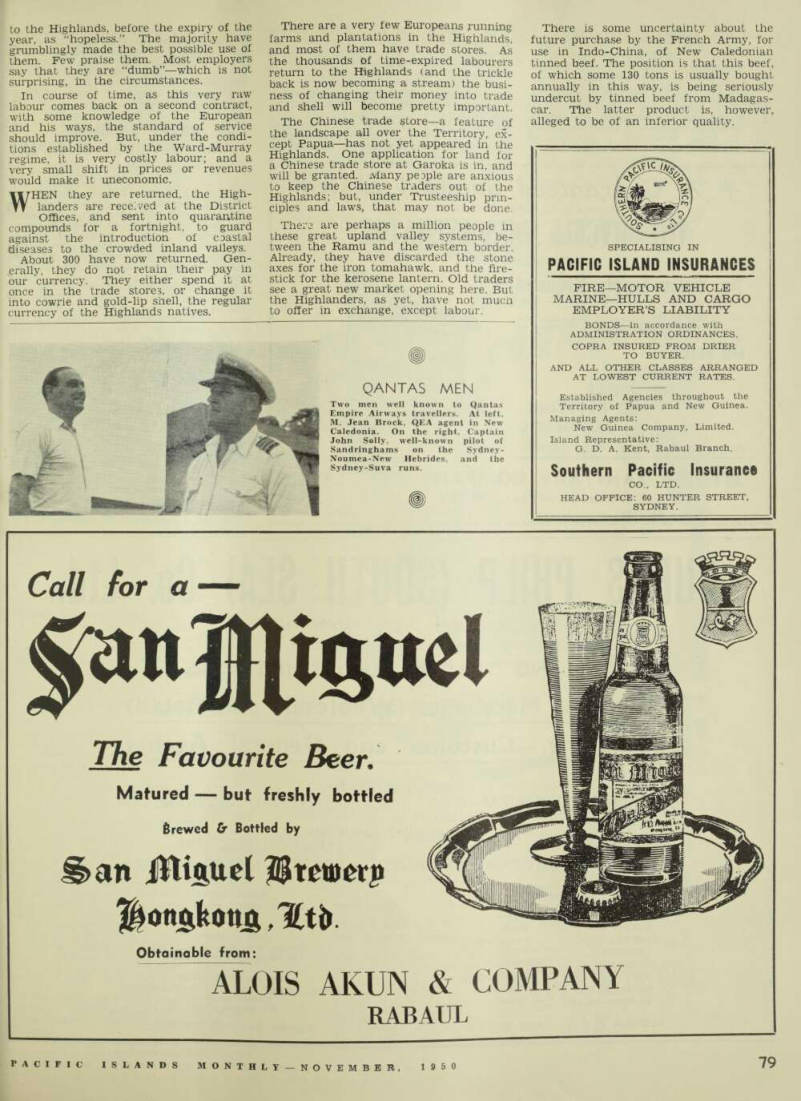
Qantas Men
Two men well known to Qantas Empire Airways travellers. At left, M. Jean Brock, QEA agent in New Caledonia. On the right, Captain John Solly, well-known pilot of Sandringhams on the Sydney- Noumea-New Hebrides, and the Sydney-Suva runs.