Magazine Section
pp. 59-60 · Read in the full issue
Territories Talk-Talk
By "Tolala"
WHENEVER I read the present-day banner head-lines, referring to women going off into the jungles of New Guinea to face this and that and other sensational danger, I think of the real hardships which were endured by the women of New Guinea 40 or 50 years ago.
I am sure that they might be pardoned if they registered a silent chuckle as they read of the present-day missionary European women going out to work among primitive New Guinea tribes, and such remarks as “two young American women, who have never been away from home, will tramp through some of New Guinea s wildest country to a primitive village 8,000 ft. above sea ...”
I feel quite sure that these present-day missionaries do not seek such blah-blah from a sensational Press, but it gives one to think what a small amount of praise has ever been given to those women who arrived there half a century ago when there were no “uncontrolled areas,’’ no air services and teleradio com munication: when transport by sea was made in dirty, becalmed windjammers, and shanks’ pony was the only land transport available. No motors, no aero planes.
There are still a few Roman Catholic mission sisters in the Territory who can look back on 50 years of NG life, but one seldom reads about them in the daily press, nor do they desire it.
I wonder what head-lines were given to the wives of Dr. George Brown and the Rev. Benjamin Banks when they left for New Britain and the Duke of York group back in 1875? * * ALL roads, of course, led to Melbourne for the Cup at the beginning of this month, and amongst the travellers I noted an old NG trio in the persons of Messrs. Vic Pennefather, Tex Roberts and Ted Taylor, than which it would be hard to find a better combination. All three were well-known identities in TNG as early as First War days when Vic and Ted were in the AN & MEF and Tex with AWA. Much water has flown under the bridge (it doesn’t matter which one) since those days, but Time has dealt kindly with them all.
Time has, indeed, a kind touch upon old Islanders. I have often noticed that white residents of both sexes, who have lived for any length of time in the Islands, wear far better than their brothers and sisters domiciled in the more temperate climes. Whence comes this Elixir of Youth amongst the so-called hazards of the tropics? Perhaps no trams, or trains, or hurly-burly of the city.
ANGLICAN circles are all agog these days with His Grace the Archbishop of Canterbury visiting within the Commonwealth. I was impressed with a remark he made over the air on his arrival at Perth, when he explained that one of the reasons for the Council of Churches was to obviate misunderstand ings with the natives in mission work. He mentioned the confusion, born of the various denominations, working amongst the native races and the need for a com mon approach.
If the Council of Churches is really sincere in an endeavour to eliminate the
stupendous confusion which the varied Christian dogmas occasion in native minds, and His Grace can put a stop to this self-same confusion, then his visit to Australasia will not have been in vain.
I have always pointed out the adverse effects of the varied brands of Christianity foisted upon the primitive native mind. and the sectarian feuds which arise out of the differences in dogma, and I am of the opinion that if the various Christian missionizing sects cannot carry on their work amicably, and in a Christlike manner, then their activities should be controlled by some outside body, in order that the peaceful propaganda of the Good Word may be assured amongst the native peoples who are urged to throw overboard their age-old traditions and creeds for the white man’s spiritual doctrine.
His Grace might even peruse some of the old TNG Supreme Court files of cases which came before it as a result of some of the denominational strife on the mainland of NG in the 1930’5. He would have plenty of material then to place before the Council of Churches.
ACCORDING to a London message, natives in the Belgian Congo who last month were accused of murder, claimed that their victim’s death was the result of their own fear of being canned as corned beef for export to Europe! The whole business started when a Belgian canning factory used, as a trade-mark, a picture of a native’s head on the label ... Reminds me of a time down in Faisi (BSD when a gang of boys became frightened at the sight of a long sea snake coiled up amongst a heap of coconuts on a wharf, awaiting shipment. They refused to touch the nuts, until in desperation, I scoffed at their fears and told them it was as harmless as the salmon they ate from the tin They believed me, but a few days later boycotted all tinned fish, as they had conceived the idea that tinned fish was sea snake' Tinned fish sales went
off alarmingly, until the position was clarified.
There is quite a good story—and a true one, I believe—told about some early New Britain natives who had received as pres ents, tins of the usual “bulamakau’ from a schooner, anchored off-shore to buy copra and trepang. Next morning the chief and some of his head-men formed a deputation to the skipper lodging a complaint about the “bulamakau.” It was definitely no good on the palate, they said. The skipper could not understand, but made further enquiries which showed that the natives had torn off the labels on the tins, eaten them and thrown the tins away! « * * T , „ OENATOR Roy Kendall seems to be O getting quite a good hearing in the Senate and his movements are being watched with a degree of interest by NG residents, who knew him before the war as Captain Kendall, more particularly of the “Induna Star,” a vessel on which he did an exceptionally good job during the eruption at Rabaul in 1937. He was speaking recently in the Senate on the need for border patrols between TNG and the Dutch portion in order to police “Indonesian” infiltration. He also advo cated “putting value back in the Senate” which cost about £250,000 per annum to run, although many Senators did not know the subjects on which they were speaking, and this led to personal abuse and vilification during their hour and a half s speech, * * * , , . T AM glad to see that the Rabaul RSL 1 is registering a protest against native units for defence without a thorough examination of the whole set-up. This may seem strange to some of the Rah- Rah boys who acclaim the native a “Fuzzy Wuzzy Angel,” but the more exper ienced Islanders know how necessary it is for native units to be directly under the control of men accustomed to handling natives, and with a knowledge of native
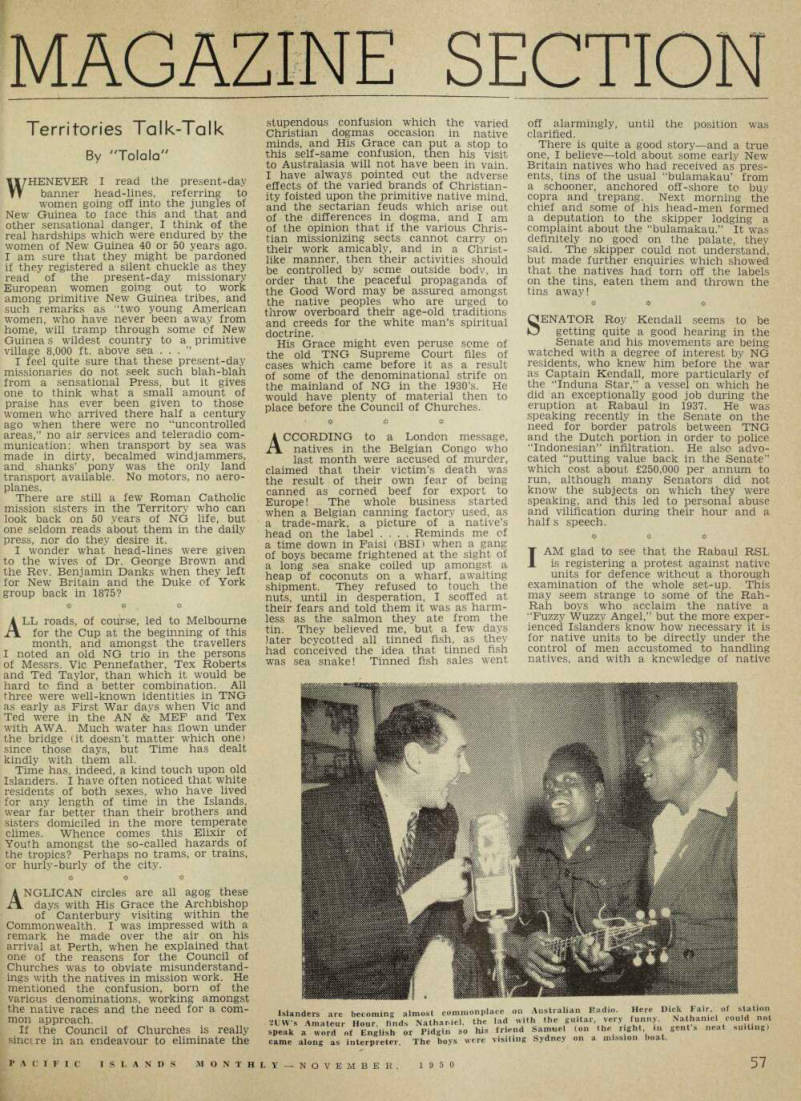
Islanders are becoming almost commonplace on Australian Radio. Here Dick Fair station 2UW's Amateur Hour finds Nathaniel, the lad with the guitar, very funny. Nathaniel could not speak a word of English or Pidgin so his friend Samuel (on the right, in gents neat suiting) came along as interpreter. The boys were visiting Sydney on a mission boat.
psychology, and particularly how it works in war-time. There are many boys who make excellent members of patrols. But it is a dangerous task selecting them with out knowledge of their individual back ground. I saw too many one-time trusted police-boys doing dirty work for the Japs in the last War, and they got away with it when our troops returned in ’45. There was little discrimination shown between the loyal and the disloyal native, and that is not as it should have been.
MORE trouble with the “Hello” people on the exchange in Rabaul (accord ing to Oct. PIM p. 37). What a pain-in-the-ear those “Hello” boys used to be. Perhaps with some cause, for the majority of them were mission-trained, and every now and again the Master’s patience wore thin, and references were made to the’parentage of the switchboard operator. Before the war, however, the solution was solved by the employment of easy-to-look-at Asiatic girls, whose voices alone were balm to the ear of an impatient subscriber. (Do you remember the soft female voice that came from Saigon?) Female operators working around the clock is the only solution unless they overcome the humidity factor and instal automatics.
“’PANIC in the Place” (Oct. PIM p. 59) X was quite an apt description of native window-dressing, but if the writer of such tales insists on using native terms, such as “luluai’ instead of Chief, I wish he or she would spell it correctly.
If no attempt is made to adhere to the original spelling of such words the general reader will get a confused idea of New Guinea etymology. One word, in par ticular, which has been generally mutil ated from its original spelling is “lava lava” (mis-spelt “lap-lap”). It comes from Fiji, and because of the Melanesian tendency to clip the vowel it is now al most generally accepted as “lap-lap”— which is not correct, unless usage has made it so. Then there is “pul-pul” the incorrect method of pronouncing “pur nur” —the word for a “flower ’ in the Blanche Bay dialect. The corruption comes from the tendency amongst many natives to confuse their consonants, the “r” becoming an “1”.
BITS and Pieces. Gone to her rest is Mrs. Evelyn Una Hore-Lacy, who made many friends in TNG who will mourn her passing at Bong Bong, NSW, on October 26. She had but recently re turned from a trio to England and arrived in the Dominion Monarch ... Margaret Cilento, the clever red-haired daughter of Sir Raphael and Lady Cilento, has won an art scholarship to the Academic des Beaux-Arts of LTnstitut de France in Paris. She is the first Australian art student to receive this honour. We can expect to hear big things of this lass . . . . Capt. A. W. R. McNicoll, a son of the late Sir Walter and Lady McNicoll. has been appointed Deputy Chief of the Naval Staff, Melbourne ... Another McNicoll, Fred, was married last month in Melbourne to Myra, second daughter of Mrs. E. L. Warne, of Eltham. Victoria . . . . A son was born last month to Mr. and Mrs. Stuart Allan, of the Gilberts . . . . the Rev. F. R. Bishop, well-known to old Rabaul residents, but living in England for many years now, was married on October 20 to Miss Hilda Hampshire, at Tisbury, Salisbury Plain. He is rec tor of St. John’s Church, Bath ...
Pamela, second daughter of the late G.
J. Handley and Mrs. H. Handley (of NG) was married on October 28 at Den iliquin to Mr. John Lamb.