To Pitcairn in
pp. 27-29 · Read in the full issue
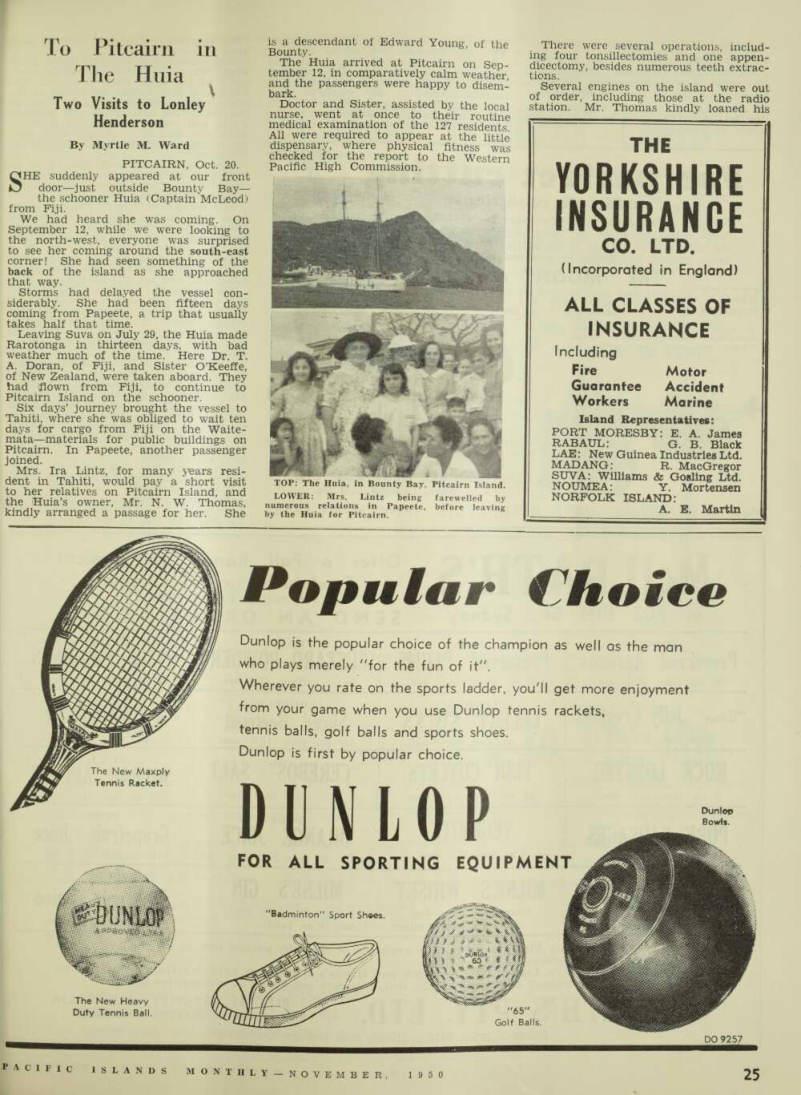
The Huia Two Visits to Lonley Henderson
By Myrtle M. Ward
Pitcairn, Oct. 20.
SHE suddenly appeared at our front door —just outside Bounty Bay— the schooner Huia (Captain McLeod) from Fiji.
We had heard she was coming. On September 12, while we were looking to the north-west, everyone was surprised to see her coming around the south-east corner! She had seen something of the back of the island as she approached that way.
Storms had delayed the vessel con siderably. She had been fifteen days coming from Papeete, a trip that usually takes half that time.
Leaving Suva on July 29. the Huia made Rarotonga in thirteen days, with bad weather much of the time. Here Dr. T.
A. Doran, of Fiji, and Sister O’Keeffe, of New Zealand, were taken aboard. They had tflown from Fiji, to continue to Pitcairn Island on the schooner.
Six days’ journey brought the vessel to Tahiti, where she was obliged to wait ten days for cargo from Fiji on the Waite mata —materials for public buildings on Pitcairn. In Papeete, another passenger joined.
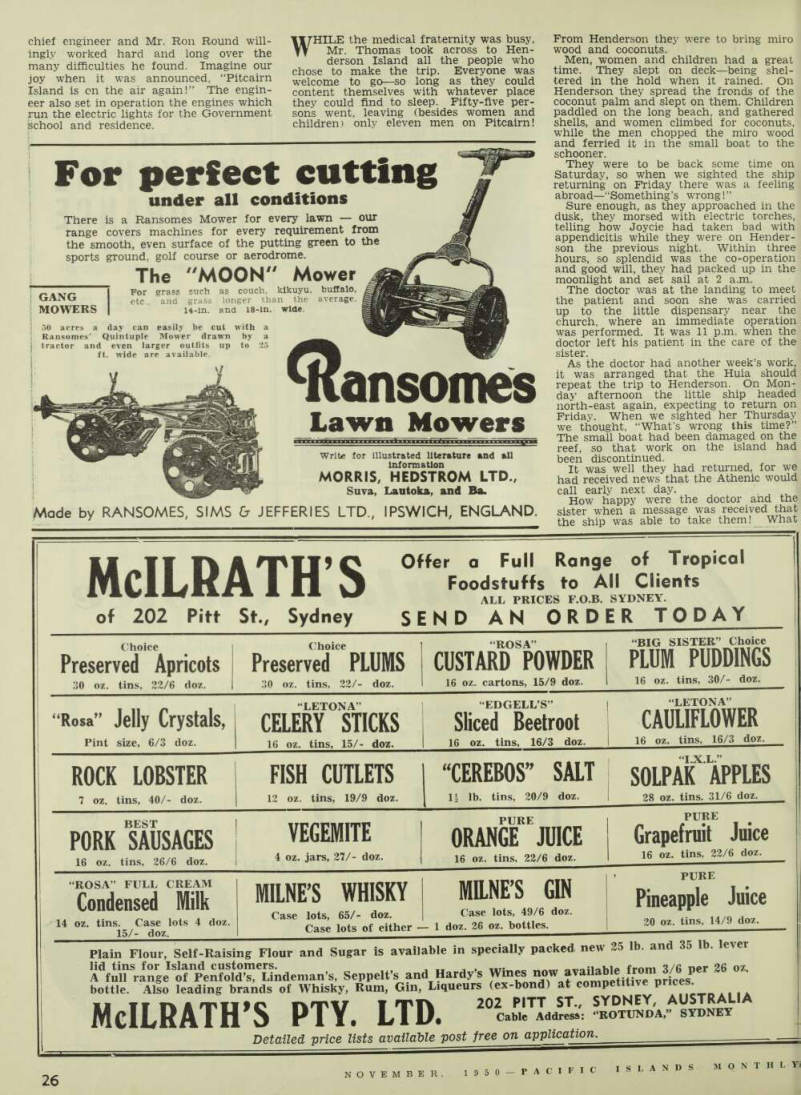
Mrs. Ira Lintz, for many jr'ears resi dent in Tahiti, would pay a short visit to her relatives on Pitcairn Island, and the Huia’s owner, Mr. N. W. Thomas, kindly arranged a passage for her. She
is a descendant of Edward Young, of the Bounty.
The Huia arrived at Pitcairn on Sep tember 12, in comparatively calm weather and the passengers were happy to disem bark.
Doctor and Sister, assisted by the local nurse, went at once to their routine medical examination of the 127 residents All were required to appear at the little dispensary, where physical fitness was checked for the report to the Western Pacific High Commission.
There were several operations, includ ing four tonsillectomies and one appen dicectomy, besides numerous teeth extrac tions.
Several engines on the island were out of prder, including those at the radio station. Mr. Thomas kindly loaned his
LOWER: Mrs. Lintz being farewelled by numerous relations in Papeete, before leaving by the Huia for Pitcairn.
chief engineer and Mr. Ron Round will ingly worked hard and long over the many difficulties he found. Imagine our joy when it was announced, “Pitcairn Island is on the air again!” The engin eer also set in operation the engines which run the electric lights for the Government school and residence.
WHILE the medical fraternity was busy, Mr. Thomas took across to Hen derson Island all the people who chose to make the trip. Everyone was welcome to go—so long as they could content themselves with whatever place they could find to sleep. Fifty-five per sons went, leaving (besides women and children) only eleven men on Pitcairn!
From Henderson they were to bring miro wood and coconuts.
Men, women and children had a great time. They slept on deck —being shel tered in the hold when it rained. On Henderson they spread the fronds of the coconut palm and slept on them. Children paddled on the long beach, and gathered shells, and women climbed for coconuts, while the men chopped the miro wood and ferried it in the small boat to the schooner.
They were to be back some time on Saturday, so when we sighted the ship returning on Friday there was a feeling abroad—“Something’s wrong!”
Sure enough, as they approached in the dusk, they morsed with electric torches, telling how Joycie had taken bad with appendicitis while they were on Hender son the previous night. Within three hours, so splendid was the co-operation and good will, they had packed up in the moonlight and set sail at 2 a.m.
The doctor was at the landing to meet the patient and soon she was carried up to the little dispensary near the church, where an immediate operation was performed. It was 11 p.m. when the doctor left his patient in the care of the sister.
As the doctor had another week’s work, it was arranged that the Huia should repeat the trip to Henderson. On Mon day afternoon the little ship headed north-east again, expecting to return on Friday. When we sighted her Thursday we thought, “What's wrong this time?”
The small boat had been damaged on the reef, so that work on the island had been discontinued.
It was well they had returned, for we had received news that the Athenic would call early next day. .
How happy were the doctor and the sister when a message was received that the ship was able to take them! What
if they did have to leave at midnight to embark on the Athenic at 3 a.m.!
They would have a safe and comfortable trip to New Zealand, on their way home to Fiji.
The little Huia, now freed of respon sibility for the doctor, made preparations to leave immediately. It was a big job to get water and fresh food out to the ship but at last it was accomplished.
Many friends and relatives accompanied Mr. Theodore Young to the ship, where he bade farewell to his sister, Mrs. Lintz.
A public meeting expressed to Mr. Thomas and his company our thanks for many favours, especially the trip to Henderson.
As the little Huia lay at anchor out side Bounty Bay, it was interesting to make comparison with the famous old Bounty. While the Bounty had a length of 90 feet, the Huia was 115. Bounty’s beam was 20 feet, Huia’s 25. The Bounty carried a crew of 45, while Huia managed with 10 (sometimes 9).
Mr. Thomas said there was a possibility that the Huia would be sold on the return trip. If not, they had some further trips planned: a cargo of 1,300 drums from Auckland to Suva, cement to Raro tonga, copra to Auckland. The Huia might enter the Australian timber run, carrying hardwood to New Zealand and softwood back to Australia.
When they got back to Suva they would have travelled 6,500 miles. Auckland to Auckland would total 11,000. We wish that the little craft might continue for many more thousands.