Some Notes by the Wayside
pp. 13-90 · Read in the full issue
FROM R. W. ROBSON IN NEW GUINEA
MY first impression, on reaching Port Moresby, was that I had entered a roaring, wide-open mining town out of the American movies.
Natives swarmed everywhere—not the quiet, slow-moving people of before the war, but screeching lorry-loads of labourers hurrying hither and yon; im pudent-looking boys loitering on the foot paths; groups of natives sitting under the shade trees, drinking out of up-ended bottles of “creaming soda.”
All about the little town empty bottles lay in the gutters. Down south, such bottles are worth 3d.; but, to these happy children of the Ward-Murray regime, 3d. is not worth worrying about.
Everywhere, there is an air of commer cial liveliness and prosperity—the result of spending millions of the Australian taxpayers’ money, another million of oil search money, and another few scores of thousands (God knows how much!) on “native war damage compensation.”
Much of this money naturally finds its way through ordinary commercial chan nels, to commerce’s great content; but a very large proportion circulates first among the natives. As natives, in money matters, are like children, all this loose currency simply trickles off along the line of least resistance —which, of course, is the trade store and the lollipop shop.
Those shrewdheads who have gone out to specially cater for native tastes have reaped and are reaping fortunes.
LAE, risen Phoenix-like from the ashes of 1942-44, was all new to me. At Qantas’ most excellent new mess, in the new town on the terrace, I got a taxi with a native driver, and said “Bums Philp.”
Driver; “No savvy.”
Me (loudly); “Burns Philp.”
Driver (looking sour): “No savvy.”
Me; “Dammit, Burns Philp—down there”—waving generally towards the beach area.
Driver went down the hill, along past the new hotel, and away in the direction of Finschhaven.
I sensed something wrong, stopped the taxi beside a couple of Europeans and said: “I’m a stranger here. I want Burns Philp’s store. This idiot doesn’t seem ever to have heard of them. Can you direct him for me?”
They grinned. “Beepees,” they said. The driver, with a wooden face, went back to the beach area and the assembly of tem
porary buildings which house BP's stores He saw nothing funny in the incident.
THIS morning (October 20) there came into Rabaul port, from back of be yond somewhere, a small Govern ment boat, with a small complement of European passengers, and a small and irate Welsh skipper, who had lost his den tal plate, and who lisps, anyway.
“I belong to Perthy Thpender’th con thituenthy,” he declaimed, thumping the binnacle, “and I’m writing to Perthy right away about how we are treated on thethe boath.”
It appears that he cannot get a cook, even for himself, let alone his passengers.
He cannot get the little ship’s linen washed, because wash-boys, as a species, have disappeared under the Ward-Murray regime. And the quality of the food with which his ship had been supplied was something he could not describe ade quately without his teeth. He particularly resented the fact that he was compelled by regulations to charge his passengers 45/- each.
“Look what I’ve had to give the poor bathtardth,” he cried, pointing dramatic ally to his cookhouse, and his weary looking passengers. “They call this a thervith! I’m telling Perthy all about it.”
So if the Hon. P. C. Spender, Minister
for External Territories, is met on his re turn from the world’s councils by a letter from a constituent in Rabaul, full of Welsh expletives, and critical of Shipping- Control, he will know how it originated.
When I left, the skipper was apolo gising, on behalf of the Shipping Board, to the “poor bathtardth.”
I AM still gasping over my laundry bill at the hotel in Rabaul. The little lot comprised exactly 16 articles, including handkerchiefs and other small things. The charge was 10/6, and the articles were only half washed and ironed.
I thought longingly of Fiji, where Indian laundrymen do the job so quickly and competently, at a third of the price.
Ten minutes after paying that bill, I walked through Rabaul’s native market.
The stuff generally was of poor quality, but the prices were extraordinary—l/- for a small bunch of bananas, or a pineapple, for instance.
I got a new respect for the harassed women trying to keep house within the budget, in this dusty junk-heap of a town.
POSTSCRIPT: Later, in Port Moresby, a native wash-boy demanded 12/- for washing and ironing three shirts, two shorts, two pairs stockings, one long pants, and a couple of small things. I give up!
PPS: Am I wrong in supposing there is a fortune waiting for the enterprising person who takes a washing machine, or machines, to Moresby, Lae, Rabaul, etc., and really tackles a most urgent problem by providing a good and dependable “laundrette” service?
Socially, The
Europeans are divided sharply.
Those who lived here before World War II have little in common with the large numbers of younger folk who have come crowding in under the Ward- Murray regime. The two classes are usually called the Befores and the Be hinds.
The Befores, of course, can see noth ing good in the post-war set-up of uncontrolled and in efficient labour, spoiled and cheeky natives, incredibly
(Continued on page 33.)
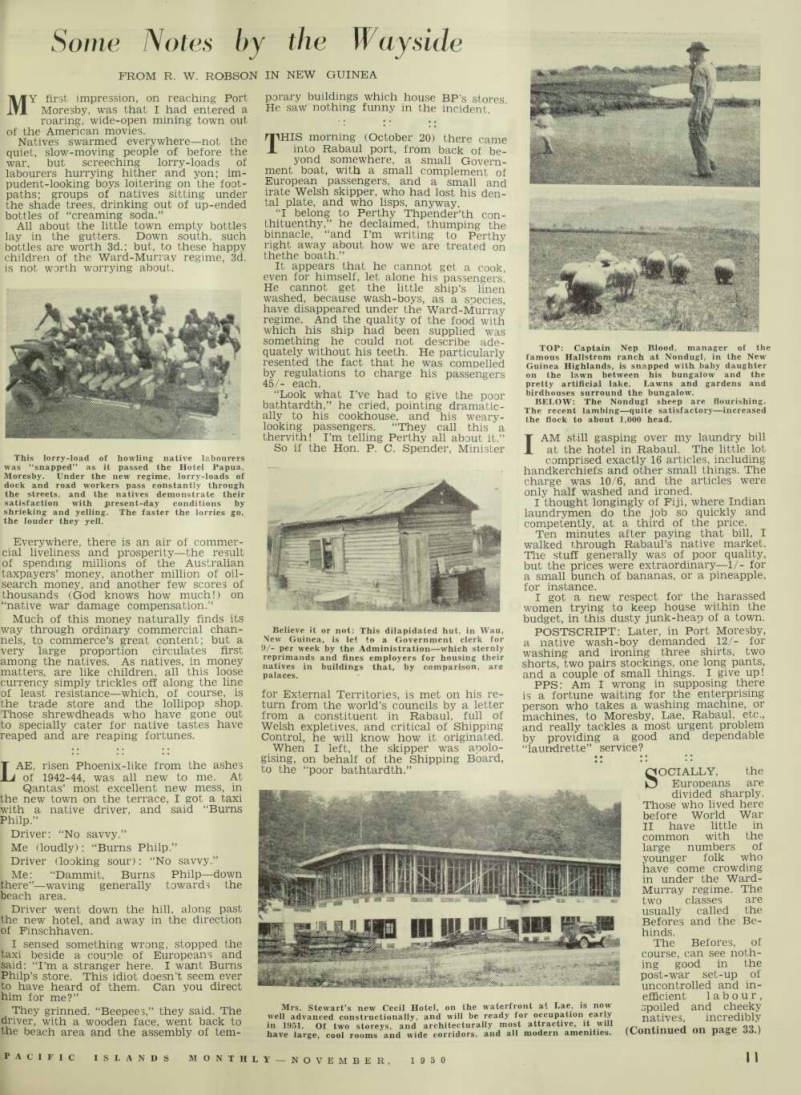
This lorry-load of howling native labourers was “snapped” as it passed the Hotel Papua, Moresby. Under the new regime, lorry-loads of dock and road workers pass constantly through the streets, and the natives demonstrate their satisfaction with present-day conditions by shrieking and yelling. The faster the lorries go. the louder they yell.
Believe it or not: This dilapidated hut, in Wau, New Guinea, is let to a Government clerk for 9/- per week by the Administration—which sternly reprimands and fines employers for housing their natives in buildings that, by comparison, are palaces.
Mrs. Stewart’s new Cecil Hotel, on the waterfront at Lae, is now well advanced constructionally, and will be ready for occuparion early in 1951. Of two storeys, and architecturally most attractive, will have large, cool rooms and wide corridors, and all modern amenities.
TOP: Captain Nep Blood, manager of the famous Hallstrom ranch at Nondugl, in the New Guinea Highlands, is snapped with baby daughter on the lawn between his bungalow and the pretty artificial lake. Lawns and gardens and birdhouses surround the bungalow.
BELOW: The Nondugl sheep are flourishing.
The recent lambing—quite satisfactory—increased the flock to about 1,000 head.
expensive works and transport, and official indifference to private enterprise.
The Behinds, knowing nothing of the times before 1940, have little sympathy with the belly-aching of the Befores.
They cannot appreciate the fact that these Territories are riding on an economic pie-crust of extreme fragility, which may collapse at any time; and they care less. Hundreds and hundreds of young men and women, brought up here by the Administration and the big com panies, live in messes, enjoy the life reasonably well, and count the days until they can get away South on leave. They are not in the least concerned with the future of this huge country. They have no pioneering spirit.
My sympathies naturally are with the Befores, who regard New Guinea as their own country, and passionately desire to see its development and growth. But the Befores are ageing; and if there is to be a future for Europeans here, we must look to the Behinds.
ABOUT the most depressing thing I saw in the Territories was in the native hospital in Rabaul, in front of the nine wards labelled respectively with the names of Administrators: Wisdom, McNicoll, Griffiths and Murray; Hubert Murray, MacGregor, Scratchley, and so on.
There, dumped down on the roadway, were a score of 44-gallon drums, filled with water from a peripatetic water-cart.
Out from the wards which house the sick and the maimed and the confined, came a steady trickle of natives with cups, enamel basins, and beer-bottles, which they filled from the drums.
Believe it or not, that is the big hospi tal’s water supply. One tank runs a supply through a pipe to the operating theatre. All the rest of the hospital in mates scramble through the dust, with hand receptacles, for all the water wanted for washing and drinking.
Having witnessed countless thousands being wasted on Ward-Murray “welfare” projects, I am tempted to comment bitterly on the Rabaul native hospital’s water supply. But the facts speak for themselves —in fact, they scream.
The incredible “Works and Housing” come into this picture. Seven months ago, when the former Jap prisoners’ camp was taken over as a native hospital, the officer in charge informed W & H that
The new wharf, just completed at Lae, New Guinea, after years of labour. All previous wharves have been destroyed by the of the Markham River; but this one, tucked away snugly in Milford Haven, right alongside the mouth of the Markham, and about 1½ miles from Lae town, looks like standing up.
he had a good water supply. An electric pump lifted water from a well to the surface; a Diesel lifted it higher and put it under pressure.
“Good,” said W & H, happily. “We’ll check it over.”
They took the Diesel away for an over haul; and it never came back. They sent men down the well to fix the electric pump; and it has not functioned since.
For six months, in the worst drought
Rabaul lias known in 50 years, the hospi tal has been carrying its water in panni kins.
BEST-KNOWN lady in Lae is Yorkie Booth’s Great Dane, Bonnie. She is the only female in that bustling metropolis who associates on terms of great friendship and mutual goodwill with every class and colour—she is welcomed
in natives’ taxis and managerial offices and reserved official bungalows. She really is a nice dog.
They say at the Hotel Cecil—where they unitedly cater for her awesome appetite— that Bonnie’s melancholy expression is the result of a completely thwarted life.
She is the only Great Dane in New Guinea, and goes everlastingly mateless.
Scores of other—and much smaller— canines demonstrate their friendliness; but Bonnie’s face, as she looks them over, expresses something that no typewriter could spell.
IF you would like to become Heinz minded in the liquor world, you should become a beer drinker in Papua-New Guinea. I never before have seen about 57 varieties of bottled beer assembled in one thirsty country.
Once upon a time—before the Chifley- McGirr geniuses put Australia in economic thraldom to the Reds—PNG was a natural market for Australian bottled beer. Sydney lagers provided the unit
Bonnie, Mr. Yorkie Booth’s friendly Great Dane, Is probably the best-known lady in Lac
water towns; while the goldfield centres literally floated on a sea of Victorian Bitter.
To-day, believe or not, it is practically impossible to get Australian beer. So, as the place is lousy with money, and the demand for beer puts even the Sydney six o’clock rush into shadow, the alert traders have done their buying abroad.
There are bottled beers here from prac tically every country in the Sterling area.
Except in Moresby (where the shrewd BP management doles it out at 1/4 per middy) the drinkers buy the beer at from 3 6 per bottle, and help themselves; and the total consumption is enormous.
In Moresby, they take it as it comes. In Wau and Lae, they favour Becks, a lager from Germany. In Rabaul. at, the moment, everyone is drinking San Miguel, a palat able light beer from Hongkong. But their fancies change with the moon—next month, the Dutch, or the English, or the Danish, or the Roumanian will be getting a turn.
IjV J. WAUCHOPE, of Madang, wants J some information to explain the ex traordinary behaviour of some young coconuts on his plantation.
The plantation was severely shot about during war operations on the north coast.
Mr. Wauchope’s tidy mind was offended by the spectacle of bare stumps of bomb blasted palms, so he tried to fill the gaps by planting young palms close beside the old stumps. To his surprise, these young palms grew nearly as fast again as palms planted normally, and threaten to begin bearing in rather more than half the time of normal palms. ‘‘Why do they do that?” asks Mr. Wau chope. “They’ve knocked some of our theories kite-high.”
SOME young folks in these Territories express their divine discontent with the tropical life by growing beards.
People of the Time Before don’t like beards, much.
Motor-driver Frank Staunton brought a beautiful specimen, long and fair and silky, into the bar of the Hotel Cecil in Lae. while I was there. He was talking over his shoulder to someone when Mrs.
Stewart came in, and examined the “grass” disdainfully.
Then—she was lighting a lamp—she applied a match. The beard flared, and the lad lost half his hirsute beauty. It did not matter—the hair of his head falls
in golden ringlets to his shoulders. Thev call him “Christ.”
In the course of the ensuing good fellowship. I heard the lad make use of the word “lorana,” which is the greeting in the Cook Islands. Thus I identified one of the engineers who last year brought that new ship down from Singapore for A. B. Donalds —they travelled via Sydney.
Auckland and Rarotonga. Staunton, a member of a well-known Victorian family, has a marine engineer’s ticket, and
has been wandering all over the world. I do not know why he should be in New Guinea, growing hair and driving trucks: but it is typical of post-war restless youth.
IN 1942-44. at colossal cost, the Aus tralian Army built a road through the backbone of New Guinea—from Bull dog, on the Lakekamu, near the Gulf of Papua, over the mountain gorges, to a
(Continued on page 85)
Mr. and Mrs. W. R. Humphries and the bungalow they built, on a hill-top in a glorious situation overlooking the lagoon, about 3 miles east of Port Moresby. Mr. Humphries, now the oldest officer of DO status in New Guinea, has had the thankless job of Director of Native Labour —a post which will probably be abolished when the new Ordinance comes into force shortly.
point in the valley behind Edie Creek— that is, the next valley system westward of the Bulolo.
It was built, presumably, as an in surance against a Jap occupation of the Bulolo area. If he had established him self there, a road through from Bulldog would have bothered him. When the Jap failed, and departed, the Lakekamu road fell into disuse.
Recently a party from Wau —including Old Timer Joe Bourke, ADO Seale and Surveyor Owers—walked over the road, from Edie Creek, to within 18 miles of Bulldog. They report that it has been rapidly overgrown, and is blocked in places by landslides —in one place, there is a slide 500 yards long. Their unanimous report: “A hopeless maintenance job.”
IHAD a pleasant, mellow evening with the staff of a big native hospital; and they were induced to tell me some thing of their errors.
One man—a skilled surgeon—went on duty in the operating theatre. They brought to him a young woman, suitably prepared for an appendix operation. He studied the carded record —a clear case of appendicitis. So, as he expressed it, “I whipped out the appendix—a neat job.”
But when the lady’s husband visited her, he seemed discontented. He could not quite see how an ulcerated leg could be helped by “cut im belly belong im.”
The horrified staff found that the case cards had got mixed—that particular patient was in for special leg treatment.
No harm done —it was a good appendix job.
The other incident was really funny.
A 12-years-old boy was found to have venereal disease. One official takes a serious view of this kind of thing among native youngsters, and tries to eradicate infectious agencies. So, when he heard Df this case, he had the boy sent to his Dffice, and gave him a lecture, and then ne demanded the name of his girl friend, rhe youngster was reluctant—even stub born —in giving away the lady’s name; out, under severe pressure, he finally yielded up the required information.
Medical orderlies brought the lass into Dhe hospital, and she resented the sub sequent proceedings, and was vociferous md indignant. Moreover, she appeared :o be perfectly healthy.
The puzzled officer sent again for the ooy—and another boy appeared. He was :he real culprit. There had been an jrror—the conscientious official had third iegree’d the wrong boy! lITHEN walking off the Bulolo at Bris ▼ T bane some time ago, Mrs. Alice Bowring, Edie Creek goldminer, saw i queue. Having wartime habits, and as suming it was part of the disembarkation Jeremony, she joined the queue. She was near the head when she learned it was a lueue to buy tickets in an Interstate Lot tery; so she decided to go on in and buy i ticket.
She was next to the window when a rough and tough lorry-driver forced his svay in in front of her. She only laughed. ‘Probably he’s in a real hurry—we’re not,” she told her friend.
When the Bulolo got to Moresby, an excited radio officer told her that her ticket had won the first prize—£ls,ooo.
There were fun and games that evening in Moresby.
Mrs. Bowring says the whole £15,000 has been invested in her mining property at Edie Creek.
RESPONSIBLE people are concerned about the increase in drinking and gambling among the natives in the Rabaul district —evils inseparable from the distribution of too much money among
primitive and uncultured folk.
The Missions, who have been appealed to for help, say the growing drunkenness is due to three things—the sale of case lots of liquor to natives by certain Euro
peans; the direct sale of liquor to natives by Chinese trade stores; the distillation of spirits from bananas and similar things by the natives themselves—an art taught to them by the Japanese.
“Difficult thing to deal with—especially when we do not get the co-operation of all classes,” said one missionary director.
“We could get more help from the Chinese traders to whom licences have been given to sell liquor. To whom do the Chinese traders sell liquor, if not to natives?”
PROSPECTIVE travellers are always asking the PIM: “What is the hotel accommodation like in New Guinea?”
Here is the answer: PORT MORESBY. —Two modern hotels - -both good. The Papua Hotel has all the
amenities and is very Well managed, and at present is the best in the Territories.
LAE—The Hotel Cecil is a large estab lishment arranged in temporary ex-Army buildings, about two miles out in the jungle. Lacks amenities. Mrs. Flo Stewart is now building her large and very modern Hotel Cecil on the waterfront and, if plans are fully carried out, it will be the biggest and most attractive hotel in the SW Pacific. Should be ready early in 1951. Qantas travellers can now be ac commodated in very comfortable bunga lows, with all mod. cons., at Qantas mess in Lae.
WAU.—Rooms badly designed and lack amenities: but otherwise the Wan Hotel is well conducted by Mr. and Mrs. Ireland.
MADANG.—Boardinghouse, made of native materials, conducted by Mrs. Pitt,
who achieves won ders in the way of cooking and comfort in the face of in credible difficulties.
RABAUL.—Cosmo politan Hotel, con ducted by Bert Gaskin, has provided accommodation, and a social rallying place, in the face of great natural handi caps, for three years.
It is a huge shed like building, divided into rooms by pa?er walls, and it echoes every sound; but, be ing right on the waterfront, it is the coolest place in the town area. Ascot, Hotel, goodlooking, with all mod. cons.,
accommodating 40. just been built by Arthur Browne and is being managed by Dorothy Stewart. It will rank, pending completion of Lae Hotel, close to the Papua Hotel in Moresby. As soon as Ascot Hotel was opened (November) the Cos mopolitan Hotel was partially closed for internal reconstruction.
MUMENG. —Built at a height of 3,000 feet, half-way on the Lae-Wau road, by Mark Schultz, in the belief that coastal residents would run up there for a cool weekend. Quite a good hotel, but de pends almost entirely on the road traffic, which is not heavy.
It is catch-as-catch-can in the other Territories centres—which means that you generally plant yourself on the long-suff ering District Officers. (Continued Next Page)
Front view of the newly-opened Ascot Hotel, Rabaul, New Guinea, which has accommodation for about 35 people, with all modern conveniences. It is one of the very few modern buildings in Rabaul, where the Government, trying to induce a general shift to Rapopo. has discouraged new construction.
AS 1 travelled over the Wau-Lae road (I have written about the road and the Markham bridge problem in another article) I recalled the fierce controversy of the ’thirties.
The Wau-Bulolo goldmining community, sick of paying high air-freights, demanded a road, either direct over the mountains to Salamaua, or via the Buangs to Lae or Salamaua. The airways people, supported by many engineers, contended that it could not be done economically—that the
cost of building and maintenance would be so heavy that road freighting could not compete against the then prevailing air freight of 3d. per pound.
Finally, the Administration doubled the royalty on gold, and announced that the additional revenue thus raised would be used for the building of a road. Time passed, nothing was done, and the exas perated miners were preparing to put in the road themselves, with their own boys and shovels, when the war came.
The Army built the road via Snake River (generally north of the Buangs) and it is now in constant use.
But what has become of the road building fund created in the late thirties by a special tax on the gold-producers?
The bureaucrats should not be allowed to get away with that.