£10,000 for Manki Village
p. 12 · Read in the full issue
More Waste In New
Guinea
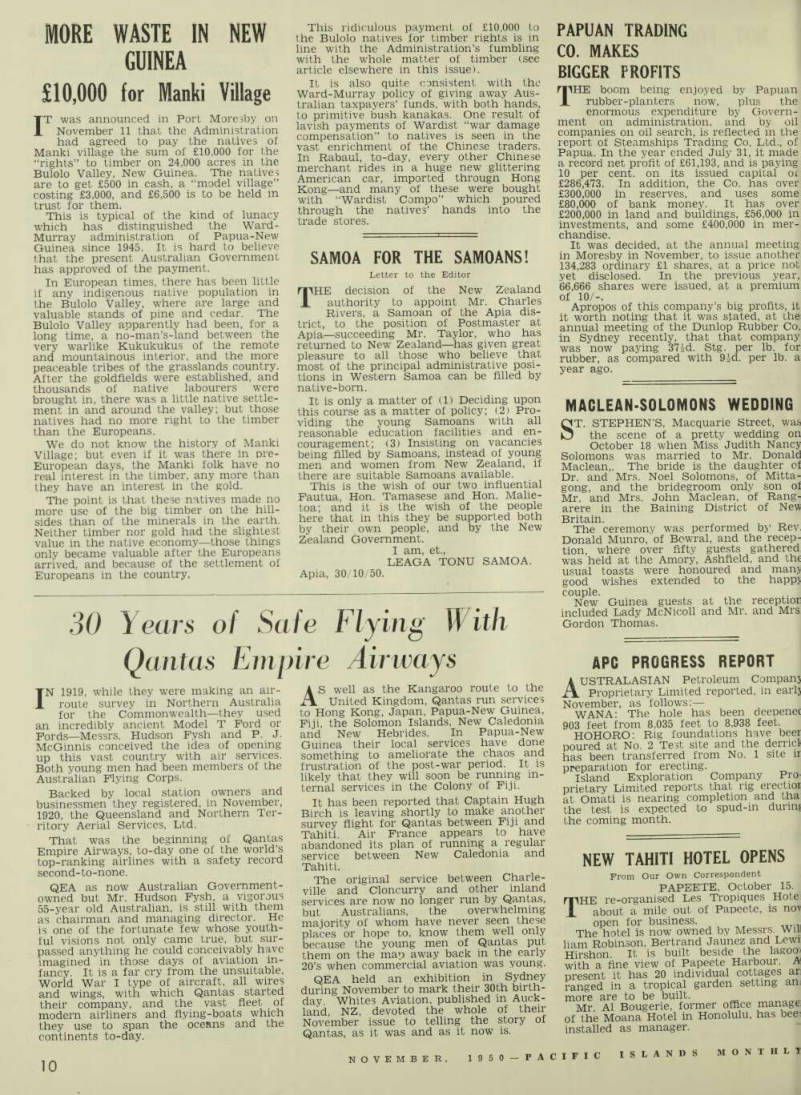
IT was announced in Port Moresby on November 11 that the Administration had agreed to pay the natives of Manki village the sum of £lO,OOO for the “rights” to timber on 24,000 acres in the Bulolo Valley, New Guinea. The natives are to get £5OO in cash, a “model village” costing £3,000, and £6,500 is to be held in trust for them.
This is typical of the kind of lunacy which has distinguished the Ward- Murray administration of Papua-New Guinea since 1945. It is hard to believe that the present Australian Government has approved of the payment.
In European times, there has been little if any indigenous native population in the Bulolo Valley, where are large and valuable stands of pine and cedar. The Bulolo Valley apparently had been, for a long time, a no-man’s-land between the very warlike Kukukukus of the remote and mountainous interior, and the more peaceable tribes of the grasslands country.
After the goldfields were established, and thousands of native labourers were brought in, there was a little native settle ment in and around the valley; but those natives had no more right to the timber than the Europeans.
We do not know the history of Manki Village; but even if it was there in pre- European days, the Manki folk have no real interest in the timber, any more than they have an interest in the gold.
The point is that these natives made no more use of the big timber on the hill sides than of the minerals in the earth.
Neither timber nor gold had the slightest value in the native economy—those things only became valuable after the Europeans arrived, and because of the settlement of Europeans in the country.
This ridiculous payment of £lO,OOO to the Bulolo natives for timber rights is in line with the Administration’s fumbling with the whole matter of timber (see article elsewhere in this issue).
It is also quite consistent with the Ward-Murray policy of giving away Aus tralian taxpayers’ funds, with both hands, to primitive bush kanakas. One result of lavish payments of Wardist “war damage compensation” to natives is seen in the vast enrichment of the Chinese traders.
In Rabaul, to-day, every other Chinese merchant rides in a huge new glittering American car, imported through Hong Kong—and many of these were bought with “Wardist Compo” which poured through the natives’ hands into the trade stores.