N. Guinea?
p. 10 · Read in the full issue
Next Move In Dutch
Delegates for the Hague
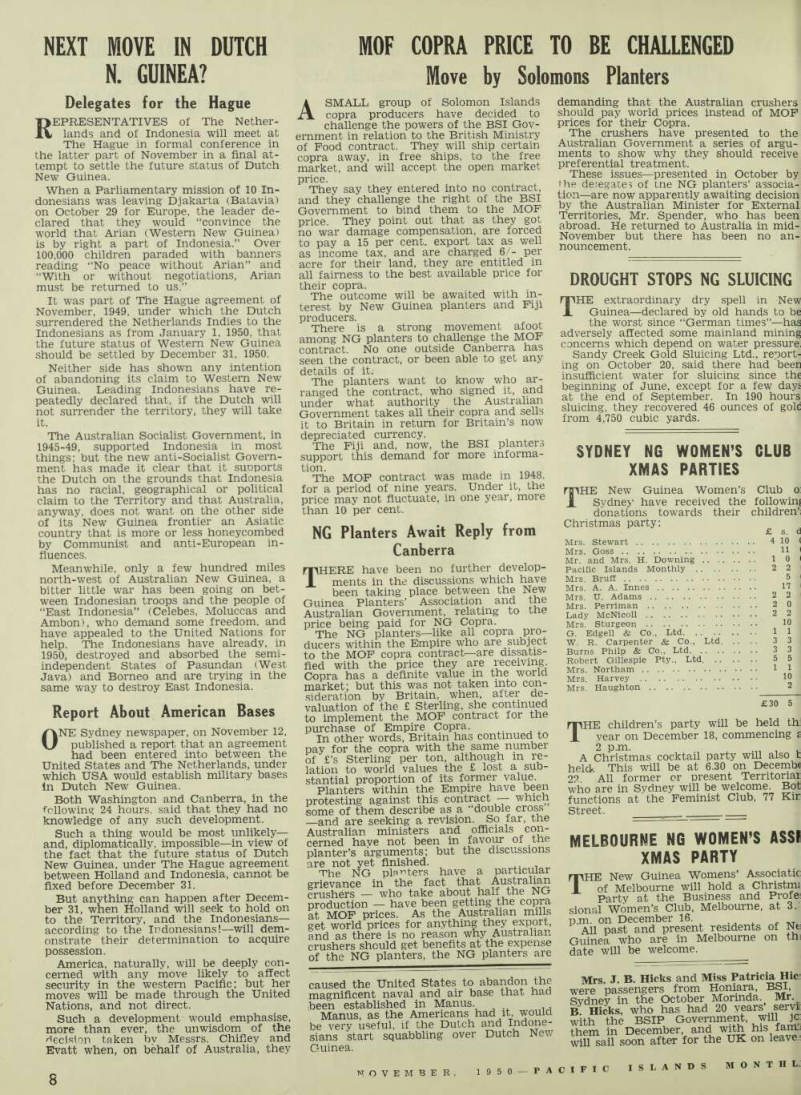
Representatives of The Nether lands and of Indonesia will meet at The Hague in formal conference in the latter part of November in a final at tempt to settle the future status of Dutch New Guinea.
When a Parliamentary mission of 10 In donesians was leaving Djakarta (Batavia) on October 29 for Europe, the leader de clared that they would “convince the world that Arian (Western New Guinea) is by right a part of Indonesia.” Over 100,000 children paraded with banners reading “No peace without Arian” and “With or without negotiations, Arian must be returned to us.”
It was part of The Hague agreement of November, 1949, under which the Dutch surrendered the Netherlands Indies to the Indonesians as from January 1, 1950, that the future status of Western New Guinea should be settled by December 31, 1950.
Neither side has shown any intention of abandoning its claim to Western New Guinea. Leading Indonesians have re peatedly declared that, if the Dutch will not surrender the territory, they will take it.
The Australian Socialist Government, in 1945-49, supported Indonesia in most things; but the new anti-Socialist Govern ment has made it clear that it supports the Dutch on the grounds that Indonesia has no racial, geographical or political claim to the Territory and that Australia, anyway, does not want on the other side of its New Guinea frontier an Asiatic country that is more or less honeycombed by Communist and anti-European in fluences.
Meanwhile, only a few hundred miles north-west of Australian New Guinea, a bitter little war has been going on bet ween Indonesian troops and the people of “East Indonesia” (Celebes, Moluccas and Ambon), who demand some freedom, and have appealed to the United Nations for help. The Indonesians have already, in 1950, destroyed and absorbed the semi independent States of Pasundan (West Java) and Borneo and are trying in the same way to destroy East Indonesia.
Report About American Bases
ONE Sydney newspaper, on November 12. published a report that an agreement had been entered into between the United States and The Netherlands, under which USA would establish military bases in Dutch New Guinea.
Both Washington and Canberra, in the following 24 hours, said that they had no knowledge of any such development.
Such a thing would be most unlikely— and, diplomatically, impossible—in view of the fact that the future status of Dutch New Guinea, under The Hague agreement between Holland and Indonesia, cannot be fixed before December 31.
But anything can happen after Decem ber 31, when Holland will seek to hold on to the Territory, and the Indonesians— according to the Indonesians! —will dem onstrate their determination to acquire possession.
America, naturally, will be deeply con cerned with any move likely to affect security in the western Pacific; but her moves will be made through the United Nations, and not direct.
Such a development would emphasise, more than ever, the unwisdom of the decision taken bv Messrs. Chifley and Evatt when, on behalf of Australia, they
caused the United States to abandon the magnificent naval and air base that had been established in Manus.
Manus, as the Americans had it, would be very useful, if the Dutch and Indone sians start squabbling over Dutch New Guinea.