Harold Cooper.
p. 103 · Read in the full issue
An Impression of Harold Cooper.
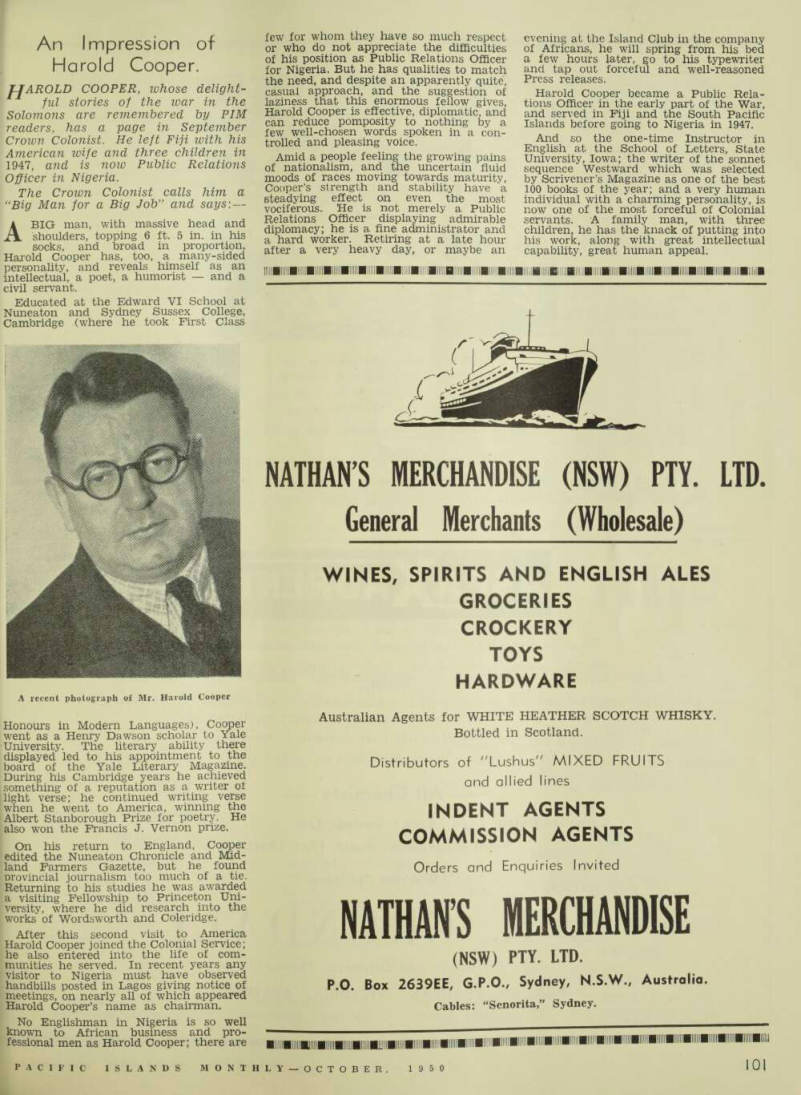
TJAROLD COOPER, whose delight ful stories of the war in the Solomons are remembered by PIM readers, has a page in September Crown Colonist. He left Fiji with his American wife and three children in 1947, and is now Public Relations Officer in Nigeria.
The Crown Colonist calls him a <( Big Man for a Big Job” and says : A BIG man, with massive head and shoulders, topping 6 ft. 5 in. in his socks, and broad in proportion, Harold Cooper has, too, a many-sided personality, and reveals himself as an intellectual, a poet, a humorist and a civil servant.
Educated at the Edward VI School at Nuneaton and Sydney Sussex College.
Cambridge (where he took First Class
Honours in Modem Languages), Cooper went as a Henry Dawson scholar to Yale University. The literary ability there displayed led to his appointment to the board of the Yale Literary Magazine.
During his Cambridge years he achieved something of a reputation as a writer of light verse; he continued writing verse when he went to America, winning the Albert Stanborough Prize for poetry. He also won the Francis J. Vernon prize.
On his return to England, Cooper edited the Nuneaton Chronicle and Mid land Farmers Gazette, but he found provincial journalism too much of a tie.
Returning to his studies he was awarded a visiting Fellowship to Princeton Uni versity, where he did research into the works of Wordsworth and Coleridge.
After this second visit to America Harold Cooper joined the Colonial Service; he also entered into the life of com munities he served. In recent years any visitor to Nigeria must have observed handbills posted in Lagos giving notice of meetings, on nearly all of which appeared Harold Cooper’s name as chairman.
No Englishman in Nigeria is so well known to African business and pro fessional men as Harold Cooper; there are
few for whom they have so much respect or who do not appreciate the difficulties of his position as Public Relations Officer for Nigeria. But he has qualities to match the need, and despite an apparently quite, casual approach, and the suggestion of laziness that this enonnous fellow gives, Harold Cooper is effective, diplomatic, and can reduce pomposity to nothing by a few well-chosen words spoken in a controlled and Dleasina voice troliea ana pleasing voice.
Amid a people feeling the growing pains of nationalism, and the uncertain fluid moods of races moving towards maturity, Cooper’s strength and stability have a steadying effect on even the most vociferous. He is not merely a Public Relations Officer displaying admirable diplomacy; he is a fine administrator and a hard worker. Retiring at a late hour after a very heavy day, or maybe an
evening at the Island Club in the company of Africans, he will spring from his bed a few hours later, go to his typewriter and tap out forceful and well-reasoned Press releases.
Harold Cooper became a Public Rela tions Officer in the early part of the War, and served in Fiji and the South Pacific Islands before going to Nigeria in 1947. * . .. .. , And so the one-time Instructor in English at the School of Letters, State University, Iowa; the writer of the sonnet sequence Westward which was selected by Scrivener’s Magazine as one of the best 100 books of the year; and a very human individual with a charming personality, is now one of the most forceful of Colonial servants. A family man, with three children, he has the knack of putting into his work, along with great intellectual capability, great human appeal.
A recent photograph of Mr. Harold Cooper