Tropicalities
pp. 63-64 · Read in the full issue
EVEN New Guinea is cashing in on the Australian wool boom (maybe even adding to the “price spiral”). Non dugl Romney Marsh sheep have been shorn and a bale of their wool has been sold at auction in Sydney. We do not know how much it brought.
The sheep were flown to the Central New Guinea Highlands a couple of years ago for Mr. E. J. Hallstrom. They are held in trust for the natives of the area and it was hoped that the sheeo would raise their standard of living—at least give them something more to keep out the cold than a few yards of string mesh.
The sheep are reported to have become acclimatised and to be doing well.
AUSTRALIA may get her timber from the Bulolo Valley after all. Mr. Mc- Adam, secretary of the Papua-New Guinea Forest Department said recently that his department could cut 10 million super feet of klinki pine annually from the Bulolo Valley for the next 50 years— and make some of it available for Aus tralia.
Mr. McAdam gave evidence in the famous New Guinea Timber Lease cases of a year or so ago—cases which involved this same timber —and in which Mr. E.
J. Ward, then Minister for External Ter ritories, Mr. Jock Garden. Harcourt Garden, Mr. Ray Parer, the late Edward Farrell and the Brisbane timber firm of Hancock and Gore also made appear ances.
Mr. Ward was proved (by Royal Com mission) to have had nothing to do with the events that led up to the scandal; Mr. Jock Garden went to jail for three years for forgery; Jock Garden, Harcourt Garden and Ray Parer were found not guilty of conspiracy to defraud Hancock and Gore; and Edward Farrell, pleading ill-health, escaped trial.
THE long-run Broadway musical, South Pacific (which is based on James Michener’s Pulitzer Prize-winning novel, Tales from the South Pacific) is having an effect, it is said, on American fashions. Hawaiian and Polynesian fashions and prints with Chinese motifs and rich African designs are the vogue.
South Pacific was not, of course, set in Hawaii or Polynesia or China or Africa — but in the New Hebrides (mostly). That is of little importance to the fashion de signers, nor does it alter the fact that the play is a world beater having col lected a round dozen awards of various kinds. But it is not likely that the musi cal version has much resemblance to real life in the Hebrides. (Although Australia has not yet seen the play, African prints are fashionable there too —one shop advertises them as “African prints made in France.” If you are interested—they look like tapa cloth from Fiji and some parts of Polynesia.) JAMES A. MICHENER has written an other novel (The Fires of Spring) the English edition of which has re cently been published. The story is set in America.
Mr. and Mrs. Michener, who did a thorough job of touring the South West Pacific, Polynesia and Australia last year, are now back in Pennsylvania. An article which Mr. Michener has written about Australia will appear in the November is sue of the American magazine Holiday.
FIJIAN authorities have decided that Fiji is unlikely to have a “champion eater” to make any sort of showing against the amazing record of a Maori whom the New Zealand Press has lately claimed as the Dominion’s champion.
The only possible contender, it is said, is Isimeli, nicknamed Bulumakau. of Ra, a 45-years-old descendant of a line of sub stantial eaters. At different stages in his career, Isimeli has been a warder at the Suva Gaol and ship’s cook in the cutter Tui Valavala. A meal of a dozen tins of bully beef is not unusual for him, and on a famous occasion he was given a brisk telling-off by the captain of the Tui Vala vala for stowing away three days’ supply of beef at a single sitting.
In 1947 he cleaned up a 40 lb. tin of biscuits, helped down by tea, at Levuka, but his most notable feat was at Taveuni, where he disposed of a whole roasted cow and a sizable quantity of dalo (taro) in
short time.-
s.
TWO sections of the community are traditionally permitted to wear beards—sailors and artists. There fore, our friend Brett Hilder, skipper of Burns Philp’s Morinda and painter of watercolours, is doubly entitled to have one.
No mere woman—or none I have known—admit to admiring beards, as
such, so I leave that subject alone, but when they are red they are certainly eye
catching.
I first met artist/mariner Hilder before the war in Rabaul. He was skipper of BP’s small Maiwara and had only an academic interest in art. But he had a red beard because, I was told, he was young for a ship’s captain, and the beard made him look “more experienced.”
Maybe this was so. Soon came the war and as a Naval reservist he was called up and seconded to the RAAF as naviga tion instructor at Point Cook, near Mel bourne. Later, the secondment became a permanent transfer. One day I had an appointment to meet him on the corner of a Melbourne street. Expecting a red bearded Naval officer, it rocked me to be accosted by a beardless youth in Air
Force blue. Apparently the Junior Service frowns on beards so the whiskers had been sacrificed to King and country.
It was about this time that he began to paint. Occasionally he used Tilly, his wife, and me as models with results so excruciating that we resigned. But hav ing once taken up a paint brush he evi dently determined to paint well or nerish, and he pursued this course as several years previously he had ruthlessly tracked and nailed down his Extra Master’s ticket.
Somewhere along the years since then, in the intervals of operational flying in the Pacific and Indonesia, and later still, when he was back at sea, it was sud denly apparent that he was painting well and getting even better.
BRETT HILDER is a gift to journalists —he looks like a good story, and he is one. He received more publicity over his exhibition of Pacific Islanders in watercolours, successfully ended in Sydney recently, than most men get when they die —that’s pretty good in a country where you generally have to be dead or imported to be appreciated.
He seems to like publicity—in “a nice way.” Publicity hunters usually get round rather fast to saying; “I don’t care a thing for publicity, personally, but . . .” I have never heard our bearded friend say that; he laughs about it, but I think he likes it.
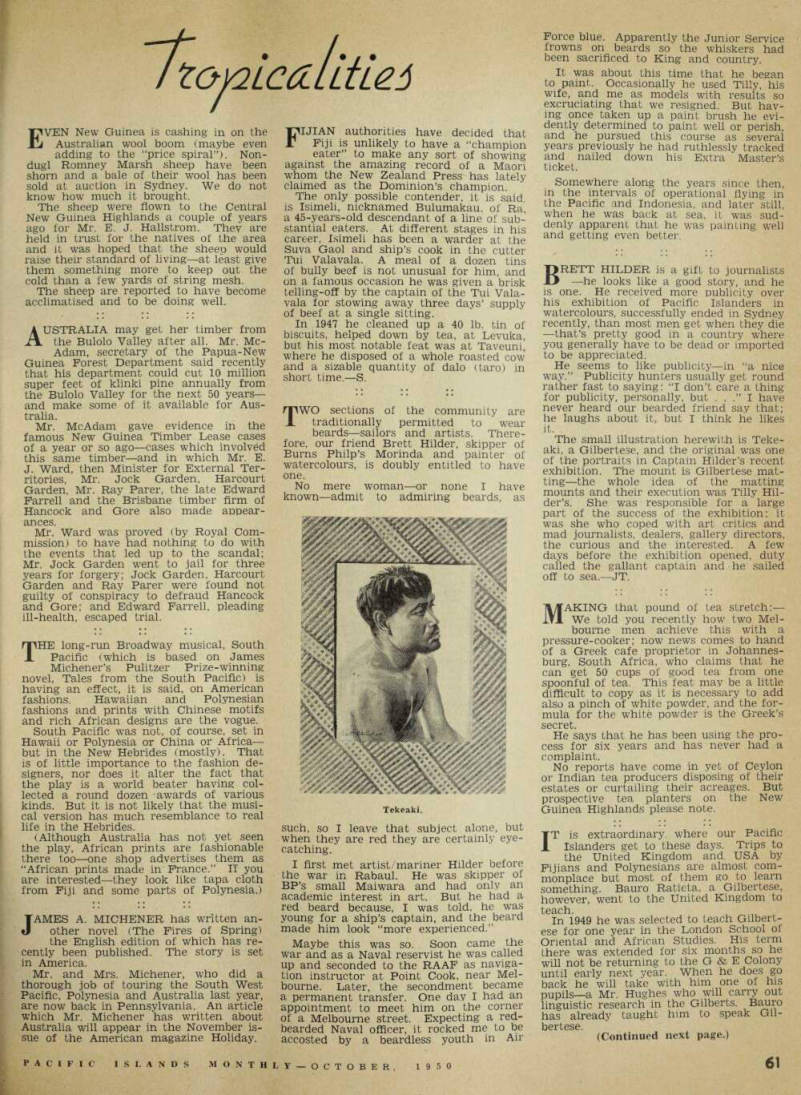
The small illustration herewith is Teke aki, a Gilbertese, and the original was one of the portraits in Captain Hilder’s recent exhibition. The mount is Gilbertese mat ting—the whole idea of the matting mounts and their execution was Tilly Hil der’s. She was responsible for a large part of the success of the exhibition: it was she who coped with art critics and mad journalists, dealers, gallery directors, the curious and the interested. A few days before the exhibition opened, duty called the gallant captain and he sailed
off to sea.
JT.
MAKING that pound of tea stretch;— We told you recently how two Mel bourne men achieve this with a pressure-cooker; now news comes to hand of a Greek cafe proprietor in Johannes burg, South Africa, who claims that he can get 50 cups of good tea from one spoonful of tea. This feat may be a little difficult to copy as it is necessary to add also a pinch of white powder, and the for mula for the white powder is the Greek’s secret He says that he has been using the pro cess for six years and has never had a complaint.
No reports have come in yet of Ceylon or Indian tea producers disposing of their estates or curtailing their acreages. But prospective tea planters on the New Guinea Highlands please note.
IT is extraordinary, where our Pacific Islanders get to these days. Trips to the United Kingdom and USA by Fijians and Polynesians are almost com monplace but most of them go to learn something. Bauro Ratieta, a Gilbertese, however, went to the United Kingdom to In 1949 he was selected to teach Gilbert ese for one year in the London School of Oriental and African Studies. His term there was extended for six months so he will not be returning to the G & E Colony until early next year. When he does go back he will take with him one of his pupils—a Mr. Hughes who will carry out linguistic research in the Gilberts. Bauro has already taught him to speak Gil bertese. (Continued next page.)
Tekeaki.
Apart from his work at the School, Bauro Ratieta has not been idle during his time in Britain. He has given two BBC broadcasts, completed a lecture tour of the Midlands, South Wales and Scot land; obtained a distinction in English in the Cambridge Lower Certificate and is now studying mathematics, history, economics and law; and he represented the G & E at the opening of “Colonial Month” in London.
As a youngster he attended King George V School at Tarawa, became clerk in the Gilbert and Ellice Islands Colony Service, was promoted to Assistant District Officer in 1945 and became Public Relations Offi cer in 1948.
SOMETIMES a little dash of humour can brighten up the end of a sultry Suva day and the followng incident rather appealed to me.
A friend of mine invariably answers his office phone by grabbing the receiver and yelling “Robinson” in a very loud voice.
A little while ago he engaged an old Indian to do the odd chores around the office, such as sweeping out, cleaning win dows, etc.
On this particular afternoon I rang my friend rather late in the day and he must have left the office, for instead of his double forte baritone answering me, a squeaky little Indian voice stammered
“Robinson.”-