Otto Soltwedel
pp. 35-36 · Read in the full issue
War-Rent Life Ends in Germany At 61
ALL New Guinea old-timers will learn with regret that Otto Soltwedel died in Laubach-Oberhessen, American Zone of Germany, on September 23 (his 61st birthday).
“Solty”—as he was generally known — was only 23 years old when, as a young engineer with a good German degree in
mining, he went out to what was then German New Guinea. Within a couple of years, World War I broke out, and Mr.
Soltwedel was among the German nationals who, late in 1914, were taken to Australia. He spent four years in in ternment, and then returned to New
Guinea now under Australian administra tion.
During the ensuing 20 years, “Solty” lived in many parts of New Guinea. He engaged in trading, planting, bird-of paradise exporting, and especially mining.
He was a typical pioneer—big, strong, re sourceful, and a good mixer—and he was always held in high regard by the British.
He was best known in the mining field, where his practical knowledge was much respected.
When World War II came, Mr. Solt wedel was on the point of visiting Ger many, which he had not seen for 36 years.
Instead, he was taken to internment in Australia, where he spent another six weary years. After the war, he expected to return to New Guinea which he re garded as his own country. But, while other men of German nationality were al lowed to go back. Soltwedel was held in Australia, kicking his heels, for no less than three years.
His many Australian friends tried re peatedly to get permission for him to go to New Guinea. Among other things, they wanted him on account of his knowledge of minerals —he was thought to know the location of certain radio-active lodes. But those two Socialist Ministers of unhappy memory—Mr. Ward and Mr. Caldwell— would neither allow Soltwedel to go, nor give any adequate reason for his deten tion. They sheltered themselves behind “Judge Simpson’s report”—that secret and portentous document which officialdom has kept hidden all these years.
Finally, Scltwedel’s friends insisted: “Tell us whac you have against Solt wedel. We have known him for very many years and trust him. If we are satisfied that you really have something, we shall say no more about the matter.”
The reply of the Australian Socialist dictators was simply to ship Soltwedel away to Germany in 1949.
Soltwedel, back in a country completely strange to him, went to a nephew who had been some years with him in New Guinea, as a miner, at Sandy Creek and Waria. He could get no employment, and lived for a while op “unemployed relief.”
Finally, he got a job fro mthe Americans, as a technical translator. He still hoped to return to New Guinea, and his friends had appealed to the new non-Socialist Government in Australia, with every hope of success, when word came that he had
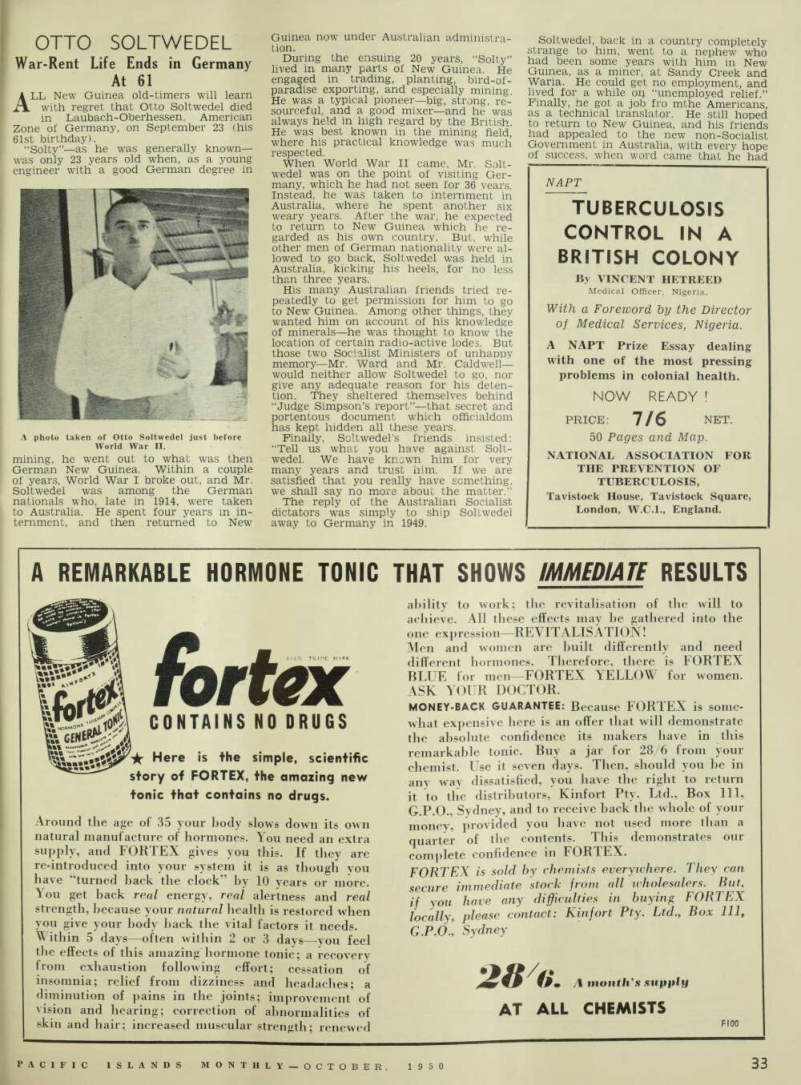
A photo taken of Otto Soltwedel just before World War II.
died, after a long and serious illness.
Poor old “Solty”! Out of his 40 years of adult life, no less than 15 were spent in internment or semi-internment. Typical of the tragic life of the German national of his generation.—RWß.