New Tarawa Memorial Victims
p. 11 · Read in the full issue
of Jap Sadism
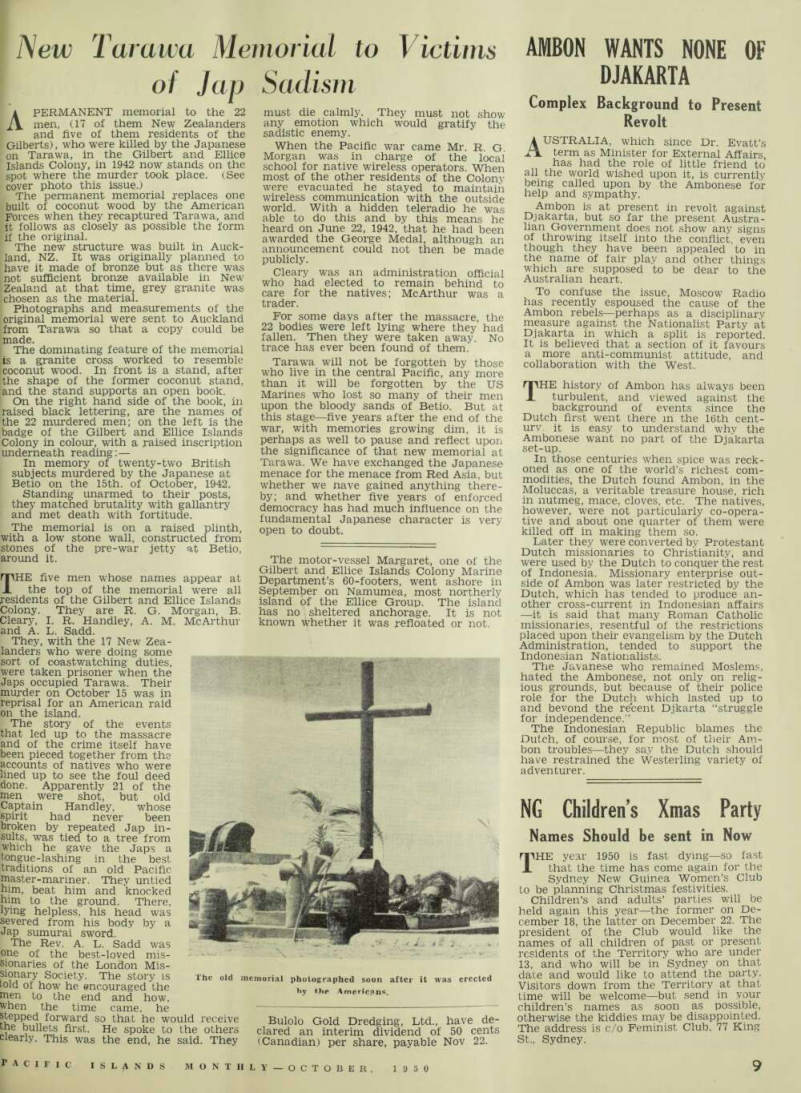
A PERMANENT memorial to the 22 men, (17 of them New Zealanders and five of them residents of the Gilberts), who were killed by the Japanese on Tarawa, in the Gilbert and Ellice Islands Colony, in 1942 now stands on the spot where the murder took place, (See cover photo this issue.) The permanent memorial replaces one built of coconut wood by the American Forces when they recaptured Tarawa, and it follows as closely as possible the form if the original.
The new structure was built in Auck land, NZ. It was originally planned to have it made of bronze but as there was not sufficient bronze available in New Zealand at that time, grey granite was chosen as the material.
Photographs and measurements of the original memorial were sent to Auckland from Tarawa so that a copy could be made.
The dominating feature of the memorial is a granite cross worked to resemble coconut wood. In front is a stand, after the shape of the former coconut stand, and the stand supports an open book.
On the right hand side of the book, in raised black lettering, are the names of the 22 murdered men; on the left is the badge of the Gilbert and Ellice Islands Colony in colour, with a raised inscription underneath reading:— In memory of twenty-two British subjects murdered by the Japanese at Betio on the 15th. of October, 1942.
Standing unarmed to their posts, they matched brutality with gallantry and met death with fortitude.
The memorial is on a raised plinth, with a low stone wall, constructed from stones of the pre-war jetty at Betio, around it.
THE five men whose names appear at the top of the memorial were all residents of the Gilbert and Ellice Islands Colony. They are R. G. Morgan, B.
Cleary, I. R. Handley, A. M. McArthur and A. L. Sadd.
They, with the 17 New Zea landers who were doing some sort of coastwatching duties, were taken prisoner when the Japs occupied Tarawa. Their murder on October 15 was in reprisal for an American raid on the island.
The story of the events that led up to the massacre and of the crime itself have been pieced together from the accounts of natives who were lined up to see the foul deed done. Apparently 21 of the men were shot, but old Captain Handley, whose spirit had never been broken by repeated Jap in sults, was tied to a tree from which he gave the Japs a tongue-lashing in the best traditions of an old Pacific master-mariner. They untied him, beat him and knocked him to the ground. There, lying helpless, his head was severed from his body by a Jap sumurai sword.
The Rev. A. L. Sadd was one of the best-loved mis sionaries of the London Mis sionary Society. The story is told of how he encouraged the men to the end and how, when the time came, he
stepped forward so that he would receive the bullets first. He spoke to the others clearly. This was the end, he said. They
must die calmly. They must not show any emotion which would gratify the sadistic enemy.
When the Pacific war came Mr. R. G Morgan was in charge of the local school for native wireless operators. When most of the other residents of the Colony were evacuated he stayed to maintain wireless communication with the outside world. With a hidden teleradio he was able to do this and by this means he heard on June 22, 1942, that he had been awarded the George Medal, although an announcement could not then be made publicly.
Cleary was an administration official who had elected to remain behind to care for the natives; McArthur was a trader.
For some days after the massacre, the 22 bodies were left lying where they had fallen. Then they were taken away. No trace has ever been found of them.
Tarawa will not be forgotten by those who live in the central Pacific, any more than it will be forgotten by the US Marines who lost so many of their men upon the bloody sands of Betio. But at this stage—five years after the end of the war, with memories growing dim, it is perhaps as well to pause and reflect upon the significance of that new memorial at Tarawa. We have exchanged the Japanese menace for the menace from Red Asia, but whether we nave gained anything there by; and whether five years of enforced democracy has had much influence on the fundamental Japanese character is very open to doubt.
The motor-vessel Margaret, one of the Gilbert and Ellice Islands Colony Marine Department’s 60-footers, went ashore in September on Namumea, most northerly island of the Ellice Group. The island has no sheltered anchorage. It is not known whether it was refloated or not.
Bulolo Gold Dredging, Ltd., have de clared an interim dividend of 50 cents (Canadian) per share, payable Nov 22.
The old memorial photographed soon after it was erected by the Americans.