More About the F'ei
p. 10 · Read in the full issue
Banana
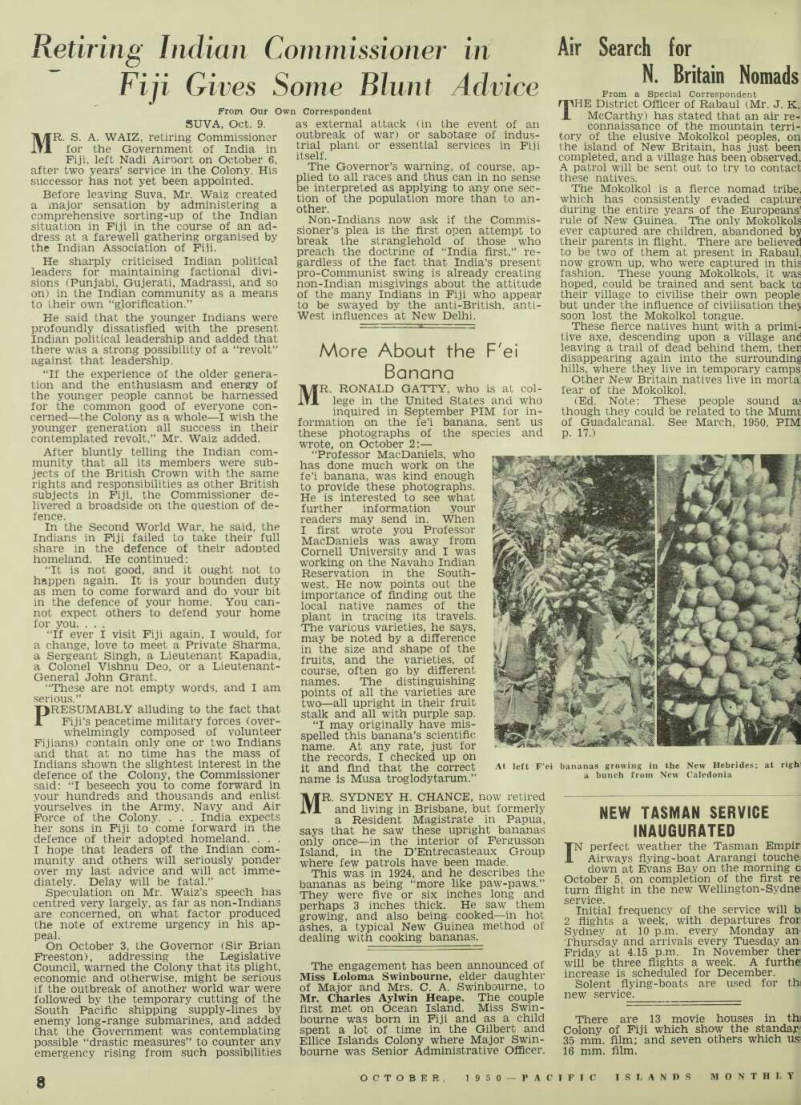
MR. RONALD GATTY, who is at col lege in the United States and who inquired in September PIM for in formation on the fe’i banana, sent us these photographs of the species and
wrote, on October 2:— “Professor Mac Daniels, who has done much work on the fe’i banana, was kind enough to provide these photographs.
He is interested to see what further information your readers may send in. When I first wrote you Professor Mac Daniels was away from Cornell University and I was working on the Navaho Indian Reservation in the South west. He now points out the importance of finding out the local native names of the plant in tracing its travels.
The various varieties, he says, may be noted by a difference in the size and shape of the fruits, and the varieties, of course, often go by different names. The distinguishing points of all the varieties are two —all upright in their fruit stalk and all with purple sap.
“I may originally have mis spelled this banana’s scientific name. At any rate, just for the records, I checked up on it and find that the correct name is Musa troglodytarum.”
MR. SYDNEY H. CHANCE, now retired and living in Brisbane, but formerly a Resident Magistrate in Papua, says that he saw these upright bananas only once—in the interior of Fergusson Island, in the D’Entrecasteaux Group where few patrols have been made.
This was in 1924, and he describes the bananas as being “more like paw-paws.”
They were five or six inches long and perhaps 3 inches thick. He saw them growing, and also being cooked —in hot ashes, a typical New Guinea method of dealing with cooking bananas.
The engagement has been announced of Miss Loloma Swinbourne, elder daughter of Major and Mrs. C. A. Swinbourne, to Mr. Charles Aylwin Heape. The couple first met on Ocean Island. Miss Swin bourne was born in Fiji and as a child spent a lot of time in the Gilbert and Ellice Islands Colony where Major Swin bourne was Senior Administrative Officer.