Sabotaged?
pp. 7-8 · Read in the full issue
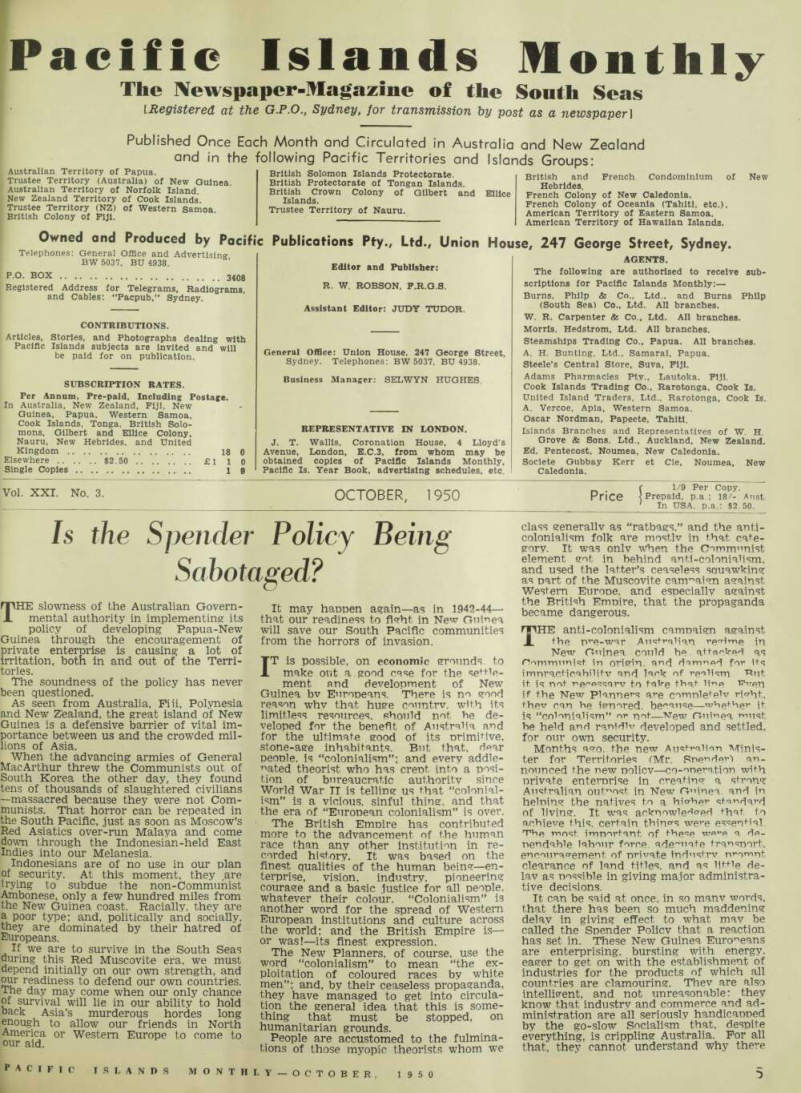
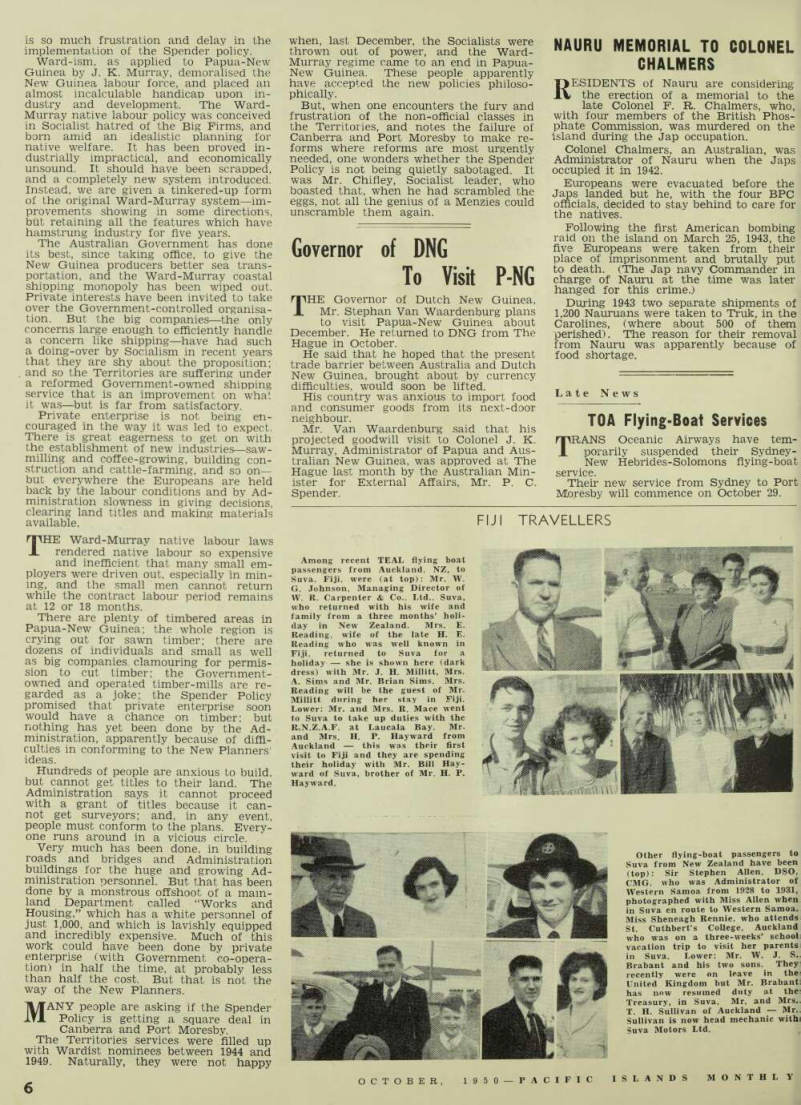
Is the Spender Policy Being Sabotaged?
THE slowness of the Australian Govern mental authority in implementing its policy of developing Papua-New Guinea through the encouragement of private enterprise is causing a lot of irritation, both in and out of the Terri tories.
The soundness of the policy has never been questioned.
As seen from Australia, Piii, Polynesia and New Zealand, the great island of New Guinea is a defensive barrier of vital im portance between us and the crowded mil lions of Asia.
When the advancing armies of General MacArthur threw the Communists out of South Korea the other day, they found tens of thousands of slaughtered civilians —massacred because they were not Com munists. That horror can be repeated in the South Pacific, just as soon as Moscow’s Red Asiatics over-run Malaya and come down through the Indonesian-held East Indies into our Melanesia.
Indonesians are of no use in our plan of security. At this moment, they are trying to subdue the non-Commuhist Ambonese, only a few hundred miles from the New Guinea coast. Racially, they are a poor type; and, politically and socially, they are dominated by their hatred of
Europeans.
If we are to survive in the South Seas during this Red Muscovite era, we must depend initially on our own strength, and our readiness to defend our own countries.
The day may come when our only chance of survival will lie in our ability to hold back Asia’s murderous hordes long enough to allow our friends in North America or Western Europe to come to our aid.
It may happen again—as in 1942-44 that our readiness to fight in New Guinea will save our South Pacific communities from the horrors of invasion.
IT is possible, on economic grounds to make out a good case for the sece rnent and development of New Guinea bv Europeans. There is no good reason whv that huge countrv. with its limitless resources, should not he de veloped for the benefit of Australia and for the ultimate good of its primitive, stone-age inhabitants. But that, dear people, is “colonialism”; and every addle nated theorist who has crept into a posi tion of bureaucratic authority since World War II is telling us that “colonial ism” is a vicious, sinful thing, and that the era of “European colonialism” is over.
The British Empire has contributed more to the advancement of the human race than any other institution in re corded history. It was based on the finest qualities of the human being—en terprise, vision, industry, pioneering courage and a basic justice for all people, whatever their colour. “Colonialism” is another word for the spread of Western European institutions and culture across the world: and the British Empire is— or was! —its finest expression.
The New Planners, of course, use the word “colonialism” to mean “the ex ploitation of coloured races by white men”; and, by their ceaseless propaganda, they have managed to get into circula tion the general idea that this is some thing that must be stopped, on humanitarian grounds.
People are accustomed to the fulmina tions of those myopic theorists whom we
class geuerallv as “ratbags,” and the anti colonialism folk are mostlv in that cate gory. It was only when the C'ummmist element got in behind anti-coloniahsm, and used the latter’s ceaseless scmawking as nart of the Muscovite campaign against Western Eurone. and especially against the British Empire, that the propaganda became dangerous.
THE anti-colonialism campaign against the n r e-war Anstrq.iian in New Guinea could be attacked as P'>mmnni<!t In origin, and damned fo** its imnracticahilitv and lack of realism 'Rut, it, ia not ngppaaarv to take thq,t ii*v> if the New planners are comnletelv right, thev nan he ignored, because—whether it is “colonialism” or not—New Guinea *nust, he held and ranidiv developed and settled, for our own security.
Months ago. the new Australian Minis ter for Territories (Mr. Snenderl an nounced the new policy—co-oneration with private enterprise in creating a strong Australian outnost in New Guinea. and in helning the natives to a higher standard of living. It wa.s acknowledged that to achieve this, certain things we r e essential.
The rnnst, irnn'vrtant of these warp q de nendahie labour force, adequate transport, encouragement of private industrv nromnt clearance of land titles, and as little de lav as nossihle in giving major administra tive decisions.
It can be said at once, in so manv words, that there has been so much maddening delay in giving effect to what mav be called the Spender Policy that a reaction has set in. These New Guinea Europeans are enterprising, bursting with energy, eager to get on with the establishment of industries for the products of which all countries are clamouring. Thev are also intelligent, and not unreasonable: they know that industry and commerce and ad ministration are all seriously handicapped by the go-slow Socialism that, despite everything, is crippling Australia. For all that, they cannot understand why there
is so much frustration and delay in the implementation of the Spender policy.
Ward-ism, as applied to Papua-New Guinea by J. K. Murray, demoralised the New Guinea labour force, and placed an almost incalculable handicap upon in dustry and development. The Ward- Murray native labour policy was conceived in Socialist hatred of the Big Firms, and born amid an idealistic planning for native welfare. It has been proved in dustrially impractical, and economically unsound. It should have been scrapped, and a completely new system introduced.
Instead, we are given a tinkered-up form of the original Ward-Murray system—im provements showing in some directions, but retaining all the features which have hamstrung industry for five years.
The Australian Government has done its best, since taking office, to give the New Guinea producers better sea trans portation, and the Ward-Murray coastal shipping monopoly has been wiped out.
Private interests have been invited to take over the Government-controlled organisa tion. But the big companies—the only concerns large enough to efficiently handle a concern like shipping—have had such a doing-over by Socialism in recent years that they are shy about the proposition; and so the Territories are suffering under a reformed Government-owned shipping service that is an improvement on what it was—but is far from satisfactory.
Private enterprise is not being en couraged in the way it was led to expect.
There is great eagerness to get on with the establishment of new industries—saw milling and coffee-growing, building con struction and cattle-farming, and so on— but everywhere the Europeans are held back by the labour conditions and by Ad ministration slowness in giving decisions, clearing land titles and making materials available.
THE Ward-Murray native labour laws rendered native labour so expensive and inefficient that many small em ployers were driven out, especially in min ing, and the small men cannot return while the contract labour period remains at 12 or 18 months.
There are plenty of timbered areas in Papua-New Guinea; the whole region is crying out for sawn timber; there are dozens of individuals and small as well as big companies clamouring for permis sion to cut timber; the Government owned and operated timber-mills are re garded as a joke; the Spender Policy promised that private enterprise soon would have a chance on timber; but nothing has yet been done by the Ad ministration, apparently because of diffi culties in conforming to the New Planners' ideas.
Hundreds of people are anxious to build, but cannot get titles to their land. The Administration says it cannot proceed with a grant of titles because it can not get surveyors; and, in any event, people must conform to the plans. Every one runs around in a vicious circle.
Very much has been done, in building roads and bridges and Administration buildings for the huge and growing Ad ministration personnel. But that has been done by a monstrous offshoot of a main land Department called “Works and Housing,” which has a white personnel of just 1,000, and which is lavishly equipped and incredibly expensive. Much of this work could have been done by private enterprise (with Government co-opera tion) in half the time, at probably less than half the cost. But that is not the way of the New Planners.
MANY people are asking if the Spender Policy is getting a square deal in Canberra and Port Moresby.
The Territories services were filled up with Wardist nominees between 1944 and 1949. Naturally, they were not happy
when, last December, the Socialists were thrown out of power, and the Ward- Murray regime came to an end in Papua- New Guinea. These people apparently have accepted the new policies philoso phically.
But, when one encounters the fury and frustration of the non-official classes in the Territories, and notes the failure of Canberra and Port Moresby to make re forms where reforms are most urgently needed, one wonders whether the Spender Policy is not being quietly sabotaged. It was Mr. Chifley, Socialist leader, who boasted that, when he had scrambled the eggs, not all the genius of a Menzies could unscramble them again.