Control Of Ng Native
p. 121 · Read in the full issue
Labour
Planters’ Voice in Re-Drafting
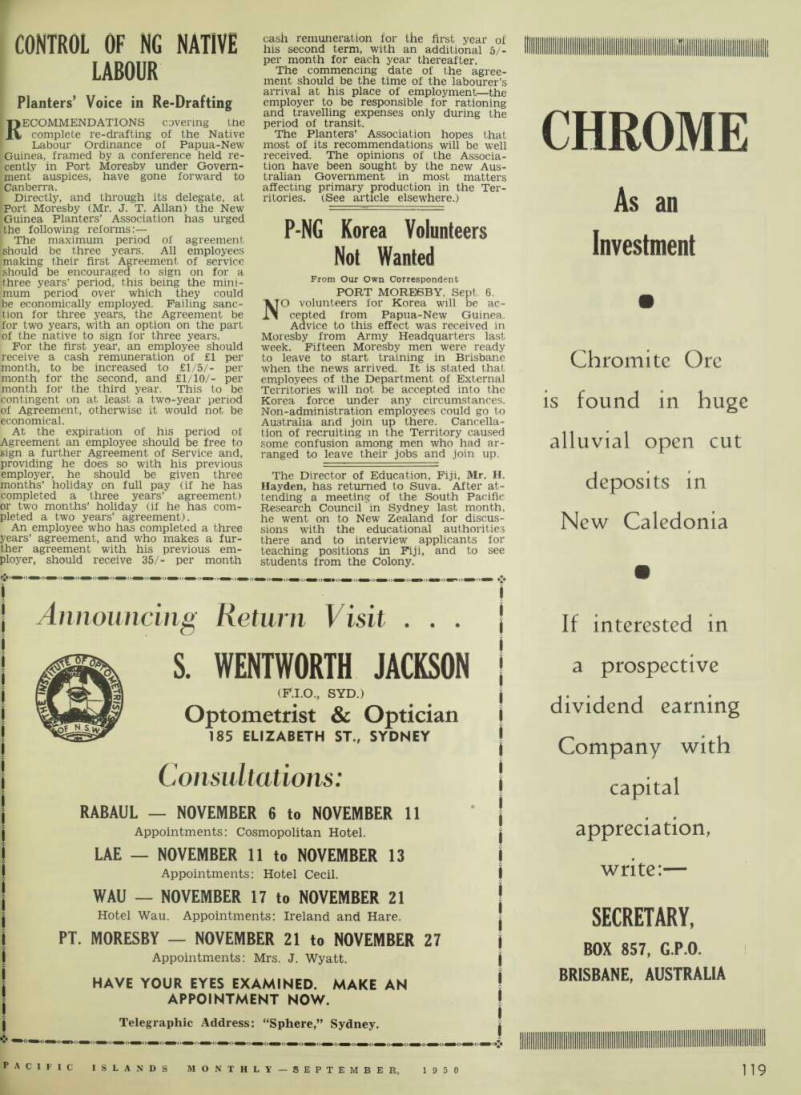
Recommendations covering the complete re-drafting of the Native Labour Ordinance of Papua-New Guinea, framed by a conference held re cently in Port Moresby under Govern ment auspices, have gone forward to Canberra. Directly, and through its delegate, at 'Port Moresby (Mr. J. T. Allan) the New Guinea Planters’ Association has urged the following reforms: — The maximum period of agreement [should be three years. All employees making their first Agreement of service should be encouraged to sign on for a three years’ period, this being the mini mum period over which they could be economically employed. Failing sanc tion for three years, the Agreement be for two years, with an option on the part of the native to sign for three years.
For the first year, an employee should receive a cash remuneration of £1 per month, to be increased to £l/5/- per month for the second, and £l/10/- per month for the third year. This to be contingent on at least a two-year period of Agreement, otherwise it would not be economical.
At the expiration of his period of Agreement an employee should be free to sign a further Agreement of Service and, providing he does so with his previous employer, he should be given three months’ holiday on full pay (if he has completed a three years’ agreement) or two months’ holiday (if he has com pleted a two years’ agreement).
An employee who has completed a three years’ agreement, and who makes a fur ther agreement with his previous em ployer, should receive 35/- per month
cash remuneration for the first year of his second term, with an additional 5/per month for each year thereafter.
The commencing date of the agree ment should be the time of the labourer’s arrival at his place of employment—the employer to be responsible for rationing and travelling expenses only during the period of transit.
The Planters’ Association hopes that most of its recommendations will be well received. The opinions of the Associa tion have been sought by the new Aus tralian Government in most matters affecting primary production in the Ter ritories. (See article elsewhere.)