Hospital Reborn
p. 113 · Read in the full issue
By a Special Correspondent
WHEN the American Lutheran Church took over the Madang area as its own New Guinea Mission, well before the last war, they decided to erect a hospital to facilitate medical missionary work.
The site had to be centrally situated for natives; suffi ciently close to a large native population needing help (and who thus would provide patients for training Native Medical Orderlies). From the European staff’s point of view, the site had to be within reasonably easy access to a large centre.
Except for its inland location, Amele filled the requirements and its one dis advantage could be overcome by buying a truck and build ing a road, although to build a road through rugged, jungle-covered New Guinea hill-country is no mean task, and it took time. Amele was 12 miles from the Gum River, to which the road had to be built, and the Gum is another four miles from Madang.
During the building opera tions, the mission’s medical superintendent, Dr. Theo. G.
Braun, had to pitch in, and his wife, a trained nurse, took over the bulk of the medical work. But by September, 1936, when Dr. and Mrs.
Braun went on furlough they had the satisfaction of seeing the nucleus of their hospital opened and medical work be ing done in spite of staff shortages.
Unfortunately th e work was soon to be de stroyed, for by the end of 1942 the area was under
enemy occupation with Dr. and Mrs. Braun and their staff prisoners of the Japanese. They remained so until released by the American and Australian forces in Hollandia in 1945. Although suffering from mal nutrition and overwork, it was not long before they were back in the field again.
At the beginning of 1950, Dr. Braun and his wife returned to the Madang area to take up residence at Yagaum to watch the growth of their new hospital, being erected to replace Amele. This new hospital was officially opened on July 23 and dedicated in the presence of 2,000 Europeans, Asiatics and natives.
It has once again been a task requiring much skill, fortitude and ingenuity.
Yagaum is eight miles nearer the Gum River and Madang but the pre-war road suffered hard usage under the hands of the invader and received no maintenance.
All the materials, timber, cement, iron roofing, fibro-cement, etc., and the equip ment for building, had to be transported by road to the Gum River from Madang, taken across by barge, raft, canoe or native carriers (only on rare occasions at low water can trucks be driven across and now that the delta has changed its shape, it’s almost impossible) to trucks waiting on the other side. The road from the river to the hospital is narrow and flanked by rugged jungle on either side with oc casionally sheer drops from the edge to the valley below.
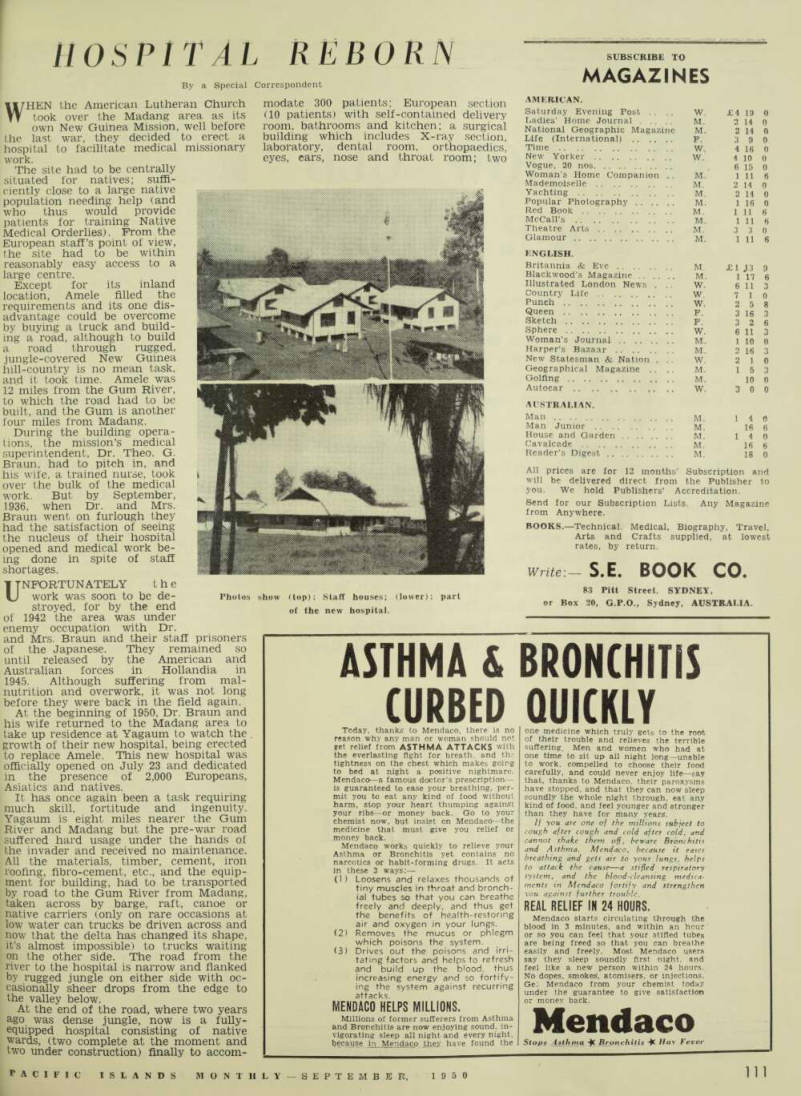
At the end of the road, where two years ago was dense jungle, now is a fully equipped hospital consisting of native wards, (two complete at the moment and two under construction) finally to accom
modate 300 patients; European section (10 patients) with self-contained delivery room, bathrooms and kitchen: a surgical building which includes X-ray section, laboratory, dental room, orthopaedics, eyes, ears, nose and throat room; two
Photos show (top): Staff houses; (lower): part of the new hospital.