Alarming Crime Wave Continues in
pp. 97-98 · Read in the full issue
Western Samoa
From Our Own Correspondent
APIA, August 23.
THE High Commissioner of Western Samoa, Mr. G. R. Powles, in a broad cast over Apia Radio on August 19, spoke of the current crime wave in the Territory.
Lawlessness, in recent months has cul minated in a number of crimes of violence like the assault on plantation manager, D C. M. Campbell, who was seriously in jured by knife wounds: the shooting of a Samoan employee of the New Zealand Reparation Estates Mulifanua Plantation bv trespassers; and, more recently, the killing of a Samoan chief in Savaii, also by knifing, following a land dispute. ‘The High Commissioner stressed also the increasing number of thefts from Government, school, Mission and private plantations: and pointed out that the stealing of coconuts, cocoa, bananas and other produce has reached incredible dimensions and that plantations, both European and Samoan, are suffering large losses in consequence. He appealed to Samoan leaders, teachers, missionaries and parents to use their influence to stop the wave of lawlessness and warned that the Government would not hesitate to take all necessary measures to put an end to such criminal offences and to enforce strictly the existing laws.
The necessity for strong action by the Government was highlighted, when a few hours after the High Commissioner’s radio address (which was broadcast in English and Samoan), another murder was committed right in Apia.
At 9.30 p.m., a middle-aged Samoan, Solofa, from the South Coast village of
Lefaga, was found unconscious near the Samoan Printing & Publishing Company’s premises. He had been struck with a blunt instrument and died without re gaining consciousness, shortly after being
admitted to the Apia Government Hos pital. The motive for the killing and the killers are unknown and so far the Police have been unable to make any headway in solving the case.
Government and European plantations have lately introduced a system of plan tation guards to patrol the boundaries of their properties. The high prices of copra and cocoa in recent years have been a growing temptation to young Samoans to make easy money by stealing coconuts and cocoa from plantations. Govern
ment and European plantations have been heavy sufferers, but Samoan plantation owners are also suffering heavily and are demanding more protection.
It is hoped that the recent re-introduc tion of the death penalty in New Zealand will be extended to Western Samoa. It is believed here that Samoan leaders are in favour of this measure, Mr. C. IS. Reay, Commissioner of Labour in Fiji, has been appointed an alternate Commissioner for the United Kingdom on the South Pacific Commission.
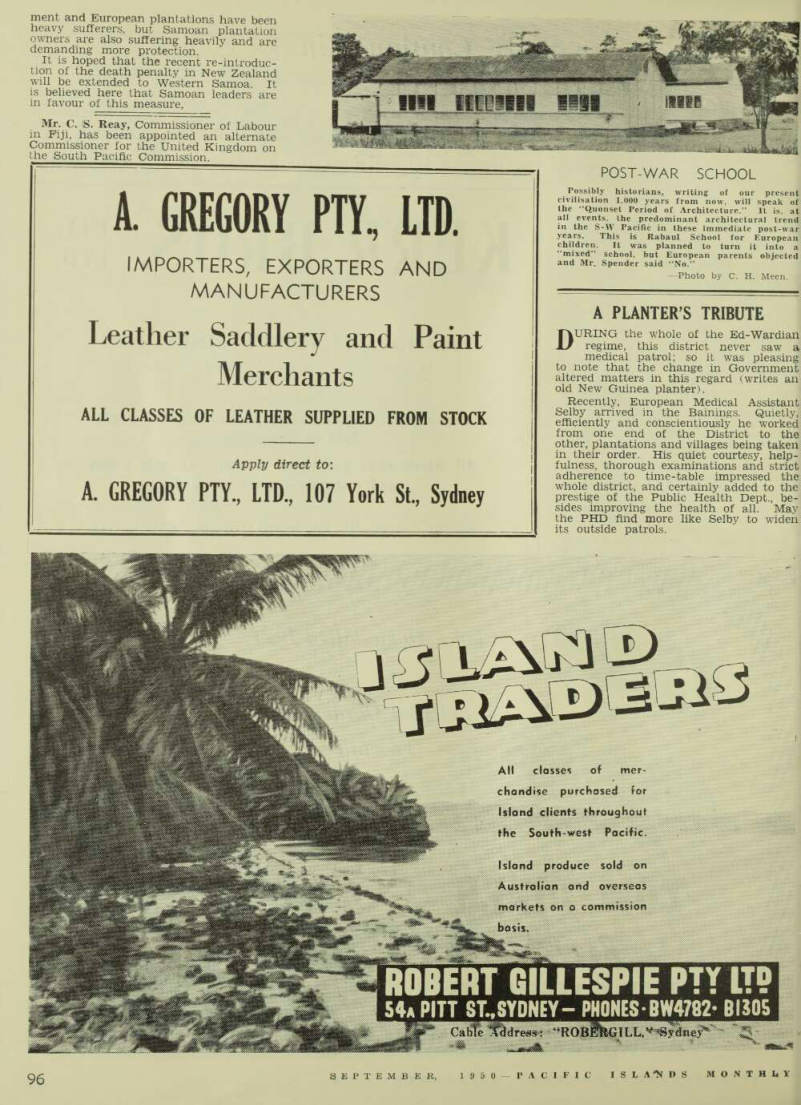
Post-War School
Possibly historians, writing of our present civilisation 1,000 years from now. will speak of the “Quonset Period of Architecture.” It is, at all events, the predominant architectural trend in the S-W Pacific in these immediate post-war years. This is Rabaul School for European children. It was planned to turn it into a “mixed” school, but European parents objected and Mr. Spender said “No.”
Photo by C. H. Meen.