Marching Rule Petering Out
p. 77 · Read in the full issue
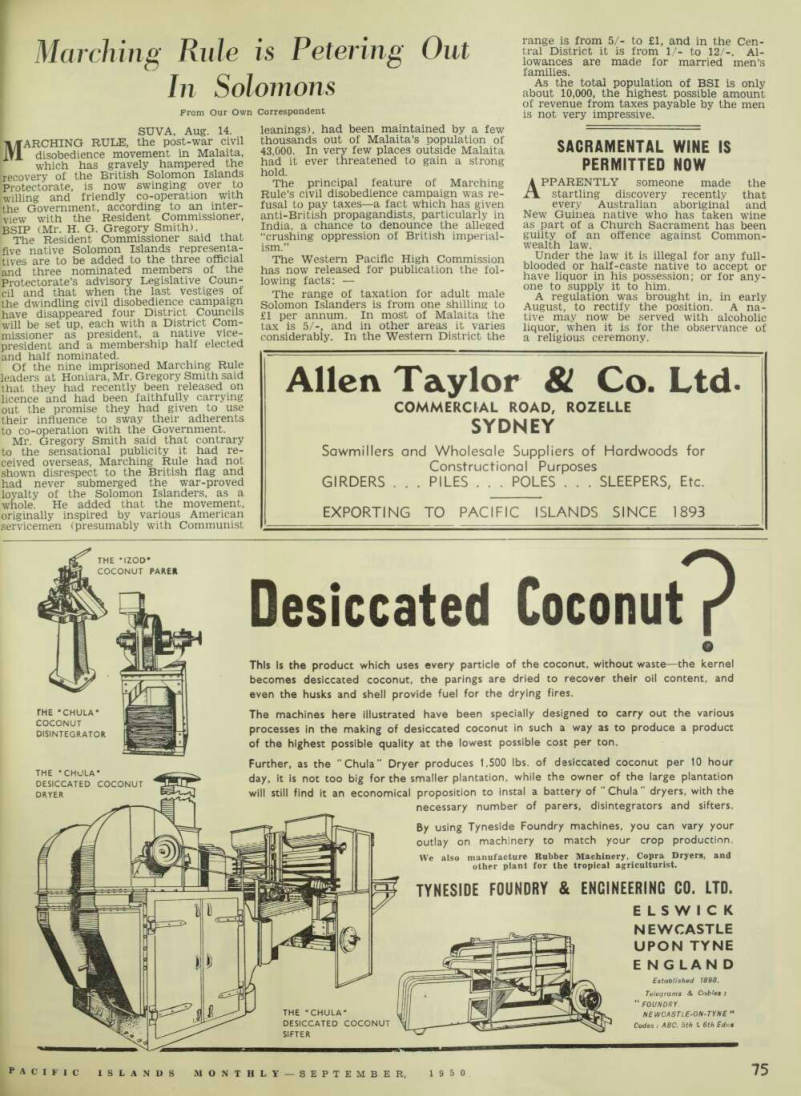
In Solomons
From Our Own Correspondent
Suva, Aug. 14.
Marching rule, the post-war civil disobedience movement in Malaita, which has gravely hampered the recovery of the British Solomon Islands 'protectorate, is now swinging over to [willing and friendly co-operation with the Government, according to an inter view with the Resident Commissioner, BSIP (Mr. H. G. Gregory Smith).
The Resident Commissioner said that five native Solomon Islands representa tives are to be added to the three official and three nominated members of the Protectorate’s advisory Legislative Coun cil and that when the last vestiges of the dwindling civil disobedience campaign have disappeared four District Councils will be set up, each with a District Com missioner as president, a native vice president and a membership half elected and half nominated.
Of the nine imprisoned Marching Rule leaders at Honiara, Mr. Gregory Smith said that they had recently been released on licence and had been faithfully carrying out the promise they had given to use their influence to sway their adherents to co-operation with the Government.
Mr. Gregory Smith said that contrary to the sensational publicity it had re ceived overseas, Marching Rule had not shown disrespect to the British flag and had never submerged the war-proved loyalty of the Solomon Islanders, as a whole. He added that the movement, originally inspired by various American servicemen (presumably with Communist
leanings), had been maintained by a few thousands out of Malaita’s population of 43,000. In very few places outside Malaita had it ever threatened to gain a strong hold.
The principal feature of Marching Rule’s civil disobedience campaign was re fusal to pay taxes —a fact which has given anti-British propagandists, particularly in India, a chance to denounce the alleged “crushing oppression of British imperial ism.”
The Western Pacific High Commission has now released for publication the fol lowing facts: The range of taxation for adult male Solomon Islanders is from one shilling to £1 per annum. In most of Malaita the tax is 5/-, and in other areas it varies considerably. In the Western District the
range is from 5/- to £l, and in the Cen tral District it is from 1/- to 12/-. Al lowances are made for married men’s families.
As the total population of BSI is only about 10,000, the highest possible amount of revenue from taxes payable by the men is not very impressive.