Tropicalities
pp. 64-65 · Read in the full issue
LITTLE realised by the public at large in Fiji, is the fact that the im pressive and brilliantly successful foundation stone ceremony at the site of the new Queen Victoria School at Matavatucou. Tailevu, and the linked commemoration at Lodoni on July 19 were saved from virtual disaster only by the self-sacrifice of the Governor, Sir Brian Freeston.
The previous day Sir Brian had opened the 1950 sitting of the Council of Chiefs and that night he developed symptoms of what was believed to be influenza but in reality was diphtheria.
It may be presumed that it was only the knowledge that, in Fijian eyes, the new Queen Victoria School was nothing less than visible British acknowledge ment of Fijian claims under British trusteeship, and that the occasion hac. been treated accordingly, with an immense amount of complicated organi sation, that carried the Governor through a day of travelling and ceremonial. From July 20 he was a hospital patient, and he resumed his post only on August 11.—S. * IT was almost like old times when on a recent Sunday natives started a free fight in Olry Square, Noumea. The police had to intervene, and arrested one quarrelsome native from Mare and one from Lifou. both of whom “had drink taken,” which seems fair enough.
One recalls a highly amusing incident during the war, when a couple of hun dred hardy scrappers from the Loyalties and a mainland tribe were hard at it with fists and stones, sooled on by their women folk, in the street out side the Noumea Post Office. When the Americans thought the fighting had gone on long enough, they sent an Army squad along to intervene; but both sides turned quickly and unani mously on the Yanks and chased them down the street. The Yanks took their defeat good-naturedly and the fighters returned to bashing each other,, but were eventually pacified by the efforts of a native Protestant pastor. They after
wards assembled in groups in Coconut Square, both sides claiming victory.
Before the war fighting between Mare and Lifou boys was a regular Sunday afternoon feature of Noumea life.
Though heads were sometimes broken, it was generally an innocent enough wav of letting off steam—HELP. ♦ ARTIST William Dobell, whose work in recent years has set the more conservative section of Australian art circles by the ears, has recently re turned to Australia from a painting expedition to New Guinea.
He says that he will not be entering any of his New Guinea work for this year’s Archibald and Wynne prizes. This is a pity, as there must be some affinity between Dobell and the New) Guinea primitive. It occurs to me that Dobell’s portrait of Joshua Smith, which won the Archibald prize a few years ago and started off the Dobell legend, had some thing in common with the carved wooden tambarans of the Sepik and other dis tricts. (In North America a tambaran would probably be called a totem-pole; in New Zealand, a tiki).
Dobell’s Joshua Smith was, to some, a great work of art. To others it was a vile caricature. A portrait in oils, we are told, should not be photographic but show the character of the subject as well as physical characteristics. Which leaves the non-arty wondering what there was in Joshua Smith’s character that had to be interpreted by long, pipe-stem arms, pixilated ears and the haunted look of a Belsen-survivor.
The elongated totem-pole effect of Joshua makes one feel that Dobell’s New Guinea work will be exceedingly interest ing.
While on his New Guinea journey Dobell called in at Angoram, on the Sepik, where he judged a competition among local craftsmen who had sub mitted “carved native masks and tradi tional statuettes” at the instigation of ADO Ralph Ormsby who is interested in reviving native arts and crafts.—JT.
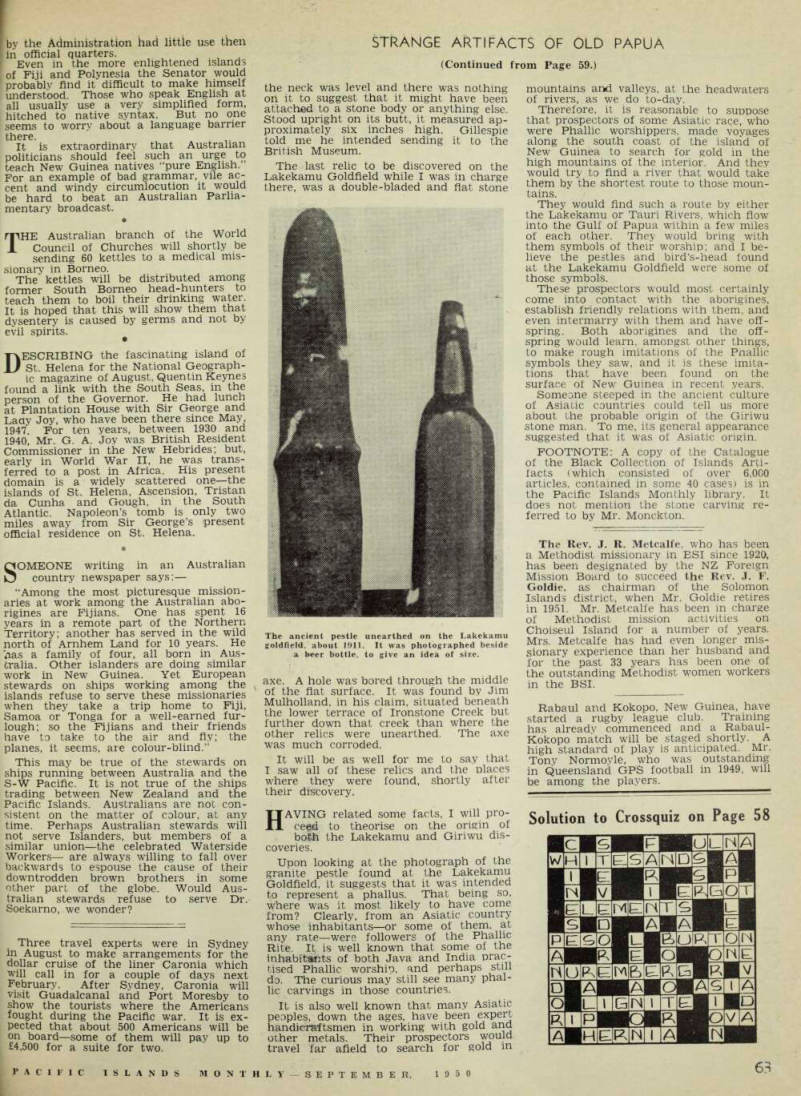
THIS is a Brett Hilder drawing of Mr.
Victor John Shearwin, who has served in the Solomons for 24 years, first in the Customs and more recently, in the Treasury, and so is one of the few old hands in the Protectorate. Sceptics refer to him as “Ripley” Shearwin, owing to an implied “Believe-it-or-not” in his stories of the past. His wife, Corinne, shares with Victor John a love of long cigarette holders and of fine living. * MR. Basil Kirke, who has been Controller of Broadcasts for Papua-New Guinea, with head quarters in Port Moresby, has returned to the Australian Broadcasting Commis sion’s executive staff in Sydney.
He has done four years of pioneering for the ABC in Moresby and, because he is no mean carpenter has left behind him as a memorial (in spite of Moresby being something of a barren waste) a garden station. So attractive is it, with its staff homes set among flowers and shrubs, that (it is said), ABC staff due to return South have asked to be allowed to remain.
Mr. Kirke is the third member of the family to go pioneering in New Guinea.
Clem and Hunter Kirke are well-remem bered.
One of the chief activities of Moresby radio is broadcasting to the Papuans in Motu and to the New Guinea natives in Pidgin.
SENATOR O’Byrne, of Tasmania, who was one of the Australian Parlia mentarians who visited New Guinea during the Federal Parliament’s winter recess, is worried about Pidgin English, as taught in New Guinea. He said, upon reaching home, that he found only one native in his travels with whom he could converse. He thinks a language barrier is being set up.„ and that straight English should be taught.
It is a matter of opinion, of course, whether a New Guinea native can be regarded as fortunate, or unfortunate, because an Australian politician cannot make himself understood to him.
During his reign as External Terri tories Minister, Mr. Eddie Ward had the same sort of misgivings about Pidgin.
But in spite of him, Territory officials went ahead and put the final nail in the coffin of pure English. That is, they invented or adopted a written form of Pidgin which is now widely used in com munications between Officialdom and natives. There was, of course, written Pidgin before the war—used mostly by Missions and Mission natives. But the fixed, phonetic written form now used
(Continued next page.)
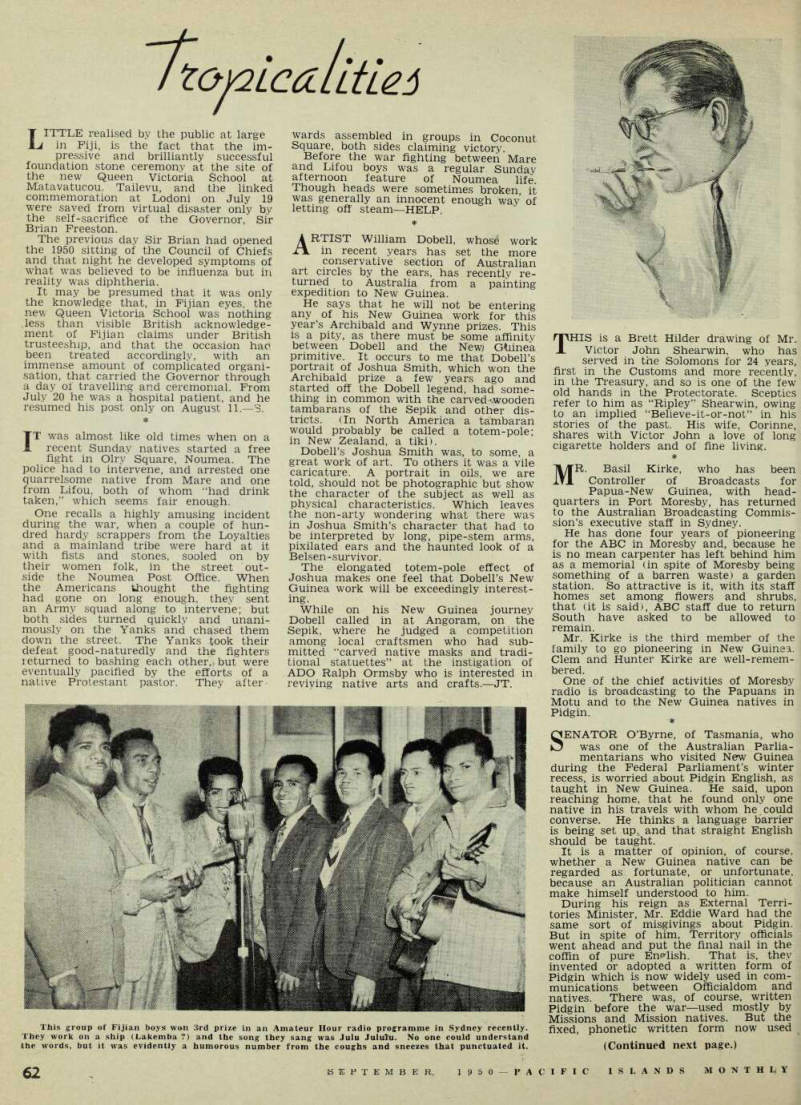
This group of Fijian boys won 3rd prize in an Amateur Hour radio programme in Sydney recently.
They work on a ship (Lakemba?) and the song they sang was Julu Jululu. No one could understand the words, but it was evidently a humorous number from the coughs and sneezes that punctuated it.
I by the Administration had little use then in official quarters.
Even in the more enlightened islands of Fiji and Polynesia the Senator would probably find it difficult to make himself understood. Those who speak English at all usually use a very simplified form, hitched to native syntax. But no one seems to worry about a language barrier there.
It is extraordinary that Australian politicians should feel such an urge to teach New Guinea natives “pure English.”
For an example of bad grammar, vile ac cent and windy circumlocution it would be hard to beat an Australian Parlia mentary broadcast. * THE Australian branch of the World Council of Churches will shortly be sending 60 kettles to a medical mis sionary in Borneo.
The kettles will be distributed among former South Borneo head-hunters to teach them to boil their drinking water It is hoped that this will show them that dysentery is caused by germs and not by evil spirits.
DESCRIBING the fascinating island of St. Helena for the National Geograph ic magazine of August, Quentin Keynes found a link with the South Seas, in the person of the Governor. He had lunch at Plantation House with Sir George and Lady Joy, who have been there since May, 1947 For ten years, between 1930 and 1940, Mr. G. A. Joy was British Resident Commissioner in the New Hebrides; but, early in World War 11, he was trans ferred to a post in Africa. His present domain is a widely scattered one—the islands of St. Helena, Ascension, Tristan da Cunha and Gough, in the South Atlantic. Napoleon’s tomb is only two miles away from Sir George’s present official residence on St. Helena. * SOMEONE writing in an Australian country newspaper says:— “Among the most picturesque mission aries at work among the Australian abo rigines are Fijians. One has spent 16 years in a remote part of the Northern Territory; another has served in the wild north of Arnhem Land for 10 years. He has a family of four, all born in Aus tralia. Other islanders are doing similar work in New Guinea. Yet European stewards on ships working among the islands refuse to serve these missionaries when they take a trip home to Fiji, Samoa or Tonga for a well-earned fur lough; so the Fijians and their friends have to take to the air and fly; the planes, it seems, are colour-blind.”
This may be true of the stewards on ships running between Australia and the S-W Pacific. It is not true of the ships trading between New Zealand and the Pacific Islands. Australians are not con sistent on the matter of colour, at any time. Perhaps Australian stewards will not serve Islanders, but members of a similar union—the celebrated Waterside Workers — are always willing to fall over backwards to espouse the cause of their downtrodden brown brothers in some other part of the globe. Would Aus tralian stewards refuse to serve Dr.
Soekarno, we wonder?
Three travel experts were in Sydney in August to make arrangements for the dollar cruise of the liner Caronia which will call in for a couple of days next February. After Sydney, Caronia will visit Guadalcanal and Port Moresby to show the tourists where the Americans fought during the Pacific war. It is ex pected that about 500 Americans will be on board—some of them will pay up to £4,500 for a suite for two.