To the tabled Island of Rapa
pp. 58-60 · Read in the full issue
With Clifford Kruse*
IHAD spent several hours hanging on the ratlines and clinging to the yardarm on the mainmast hoping that I’d be the first aboard the Terehau to sight the island. Then I could scream with the best of Jack London’s and Joseph Conrad’s characters, “Land ho!’’
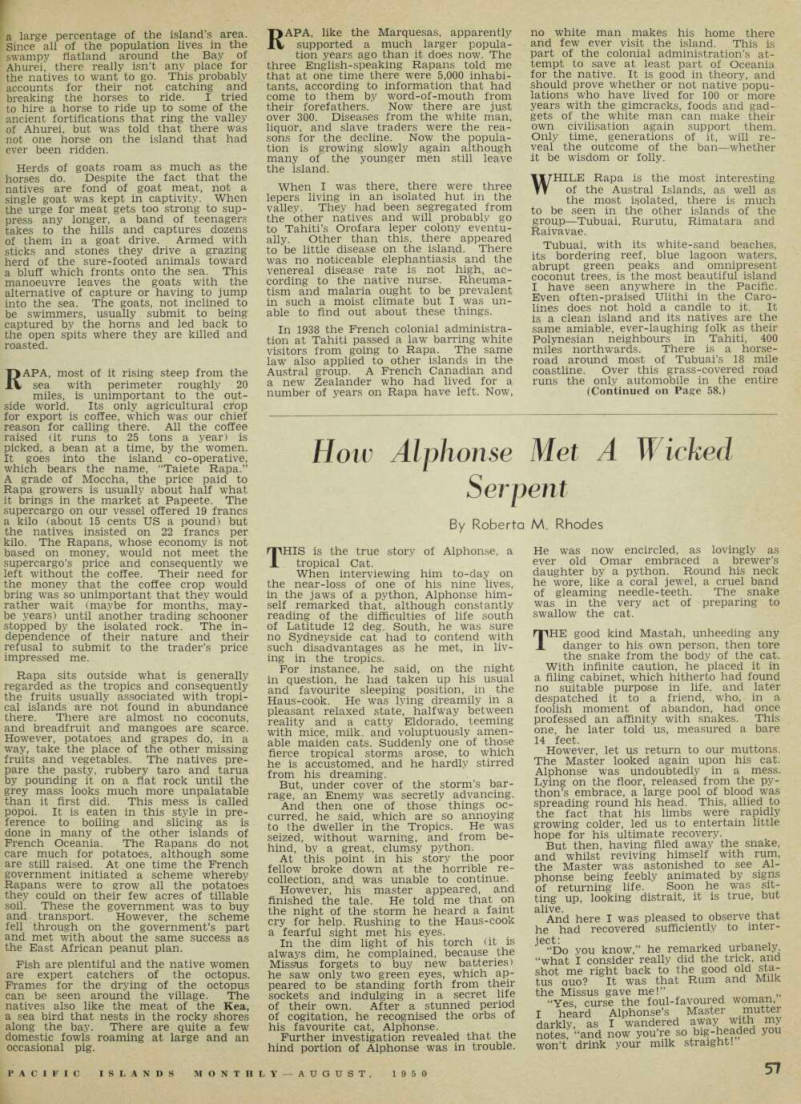
An hour before our 89-foot schooner was due at Rapa (1,000 miles south-east of Tahiti, little known and seldomvisited), a squall line began to form, cutting visibility almost to zero. We had had to slacken speed in case we ran right onto the hidden island. And then, all of a sudden, the clouds lifted, as some curvaceous performer at a burlesque show slowly, teasingly lifts her skirts above her knees. The island of Rapa lay just a mile beyond, its jade green dress sparkling with sunshine. No Hollywood producer could have manufactured a more dramatic opening scene, Nor could any Hollywood producer improve on the story or the scenery as it unfolded for me during my stay on this mystic bit of an island, so completely detached from the world. Here there were none of the hindrances of modern civilisation—no movie houses, no radios, no automobiles (nor even a horse to ride!), no roads no white men and, with the exception’ of an occasional schooner, no communication with the outside world,
The Terehau was the first commercial schooner to go to Rapa in over two years.
In America, where the complexities of civilisation and the strict codes of so ciety weigh heavily on a man, one of the most popular escape stories is “the Rapa story." This tale, basically true, varies from teller to teller in the amount of fiction it contains, but one thing about it is always constant: the point about the unbalanced ratio of men to women.
While in Rapa I was determined to find out what truth it might contain. I went to the Tahitian male nurse who attends to the islanders’ aches and pains, and who has the only complete census of the island. He checked his records and told me that there were, at that time, 305 inhabitants on the island and only 64 of them were men. About four women for every man.
Asked how this came about, the nurse said that most of the young Rapa men left the island to become sailors on schooners and only returned, if they ever did, when they were old men. He in troduced me to three men, all natives in their late forties, I would judge, who had been for many years in America. They had stowed away, when they were in their early twenties, on a vessel bound for Tahiti. In Papeete they stowed away
again on a steamer that took them to America. In San Francisco they jumped ship and, despite their lack of passports or credentials of any sort, were able to find work in the vineyards around Stock ton, California, where they lived com fortably and without detection for 11 years. Finally American immigration authorities caught up with them and they were deported to their native Rapa.
Because of this disproportion of men to women in the population, the men find themselves having to do very little of the work. Apart from building the whaleboats and fishing in the open sea, everything is done by the women. The men seem quite content to idle away their whole existence just sitting and meditating. Just what they find to medi tate upon that can occupy an entire life time, I didn’t find out.
THERE are a number of horses on Rapa, but none of these have been domesticated. The horses, which were imported from Rimatara in the Australs during the past century, roam wild on the headlands that form such
*This story was in type before we learned that Clifford Kruse had died on Kiriwina Is.. Eastern Papua, on August 6. See elsewhere in this issue.
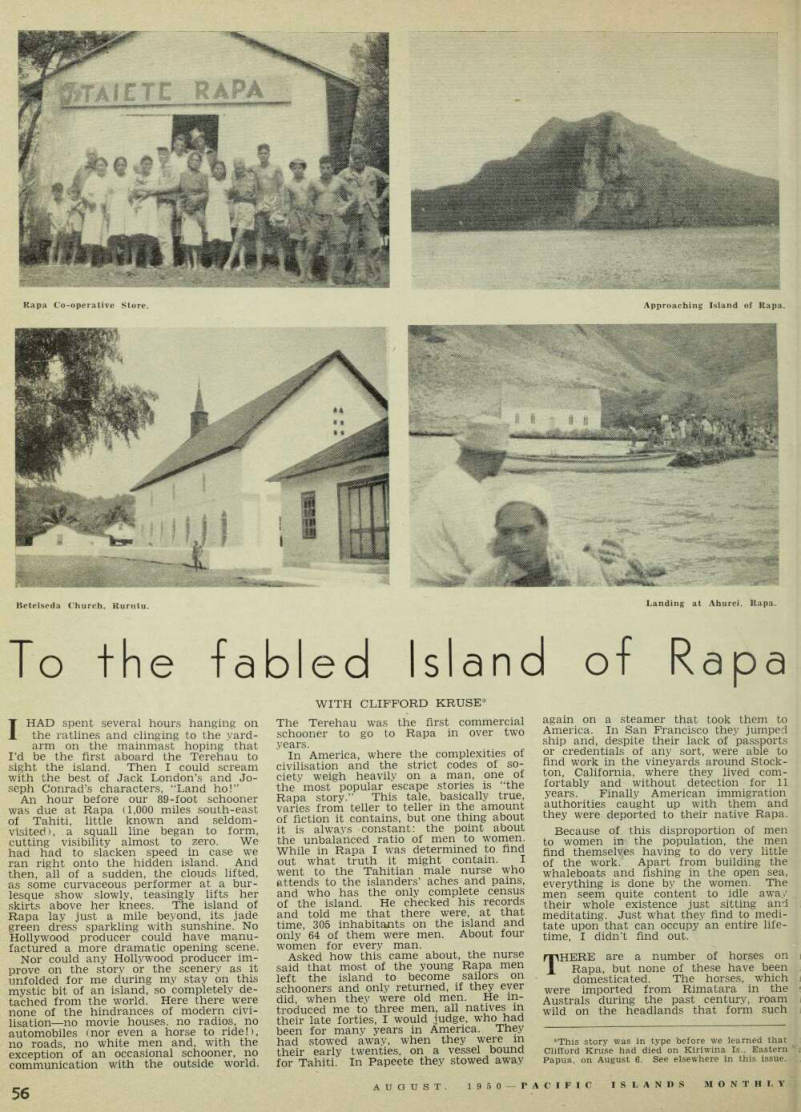
Rapa Co-operative Store.
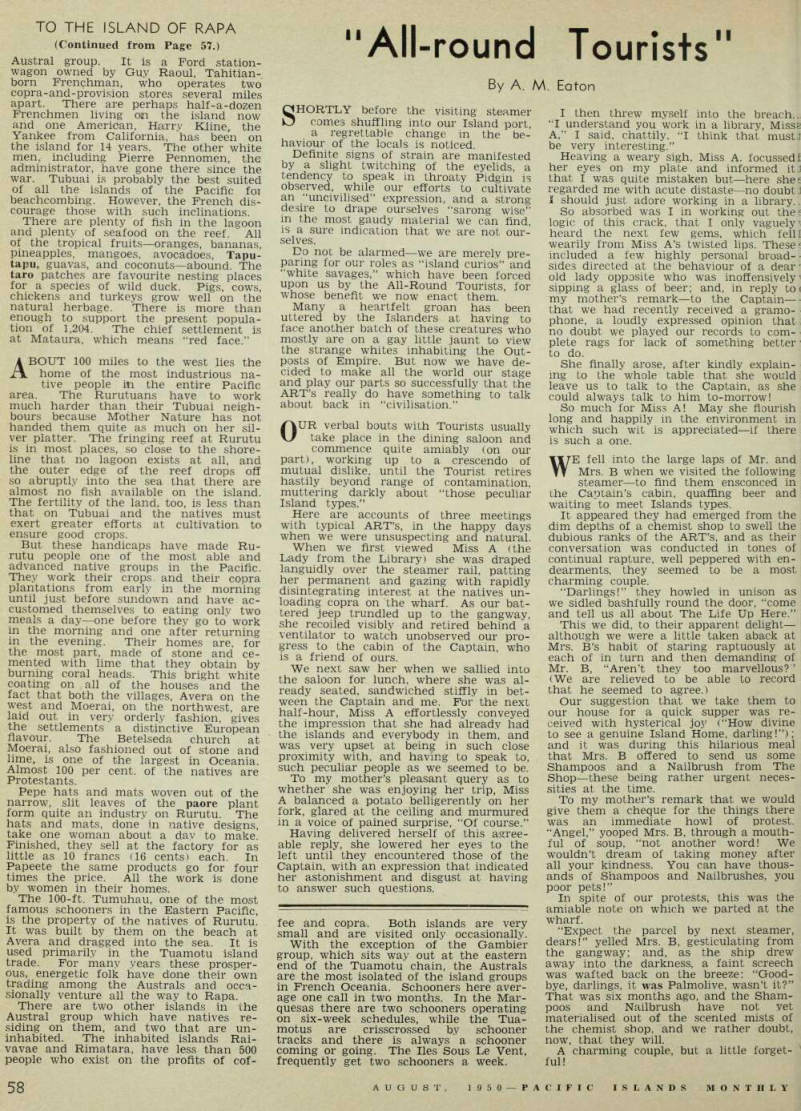
Betelseda Church, Rurutu.
Approaching Island of Rapa.
Landing at Ahurei, Rapa.
a large percentage of the island’s area.
Since all of the population lives in the swampy flatland around the Bay of Ahurei, there really isn’t any place for the natives to want to go. This probably accounts for their not catching and breaking the horses to ride. I tried to hire a horse to ride up to some of the ancient fortifications that ring the valley of Ahurei, but was told that there was not one horse on the island that had ever been ridden.
Herds of goats roam as much as the horses do. Despite the fact that the natives are fond of goat meat, not a single goat was kept in captivity. When the urge for meat gets too strong to sup press any longer, a band of teenagers takes to the hills and captures dozens of them in a goat drive. Armed with sticks and stones they drive a grazing herd of the sure-footed animals toward a bluff which fronts onto the sea. This manoeuvre leaves the goats with the alternative of capture or having to jump into the sea. The goats, not inclined to be swimmers, usually submit to being captured by the horns and led back to the open spits where they are killed and roasted.
RAPA, most of it rising steep from the sea with perimeter roughly 20 miles, is unimportant to the out side world. Its only agricultural crop for export is coffee, which was our chief reason for calling there. All the coffee raised (it runs to 25 tons a year) is picked, a bean at a time, by the women.
It goes into the island co-operative, which bears the name, “Taiete Rapa.”
A grade of Moccha, the price paid to Rapa growers is usually about half what it brings in the market at Papeete. The supercargo on our vessel offered 19 francs a kilo (about 15 cents US a pound) but the natives insisted on 22 francs per kilo. The Rapans, whose economy is not based on money, would not meet the supercargo’s price and consequently we left without the coffee. Their need for the money that the coffee crop would bring was so unimportant that they would rather wait (maybe for months, may be years) until another trading schooner stopped by the isolated rock. The in dependence of their nature and their refusal to submit to the trader’s price impressed me.
Rapa sits outside what is generally regarded as the tropics and consequently the fruits usually associated with tropi cal islands are not found in abundance there. There are almost no coconuts, and breadfruit and mangoes are scarce.
However, potatoes and grapes do, in a way, take the place of the other missing fruits and vegetables. The natives pre pare the pasty, rubbery taro and tarua by pounding it on a flat rock until the grey mass looks much more unpalatable than it first did. This mess is called popoi. It is eaten in this style in pre ference to boiling and slicing as is done in many of the other islands of French Oceania. The Rapans do not care much for potatoes, although some are still raised. At one time the French government initiated a scheme whereby Rapans were to grow all the potatoes they could on their few acres of tillable soil. These the government was to buy and transport. However, the scheme fell through on the government’s part and met with about the same success as the East African peanut plan.
Fish are plentiful and the native women are expert catchers of the octopus.
Frames for the drying of the octopus can be seen around the village. The natives also like the meat of the Kea, a sea bird that nests in the rocky shores along the bay. There are quite a few domestic fowls roaming at large and an occasional pig.
RAPA, like the Marquesas, apparently supported a much larger population years ago than it does now. The three English-speaking Rapans told me that at one time there were 5,000 inhabitants, according to information that had come to them by word-of-mouth from their forefathers.' Now there are just over 300. Diseases from the white man, liquor, and slave traders were the reasons for the decline. Now the populaturn is growing slowly again although many of the younger men still leave the island. , .
When I was there, there were three lepers hying in an isolated hut in the valley, They had been segregated from a P d Wlll Probably go to Tahiti s Orofara leper colony eventuto ls be li?t t le 6 disease o? i the t^sland aPP There was no noticeable elephantiasis and the vpnprpnl disease rate is not hiah acenrdirfp 1 to the native nurse Rheumanuip frv fi nr i nuf' about thpsp things able to find out about these things.
In 1938 the French colonial administration at Tahiti passed a law barring white visitors from going to Rapa. The same law also applied to other islands in the Austral group. A French Canadian and a new Zealander who had lived for a number of years on Rapa have left. Now,
no white man makes his home there and few ever visit the island. This is part of the colonial administration’s at tempt to save at least part of Oceania for the native. It is good in theory, and should prove whether or not native popu lations who have lived for 100 or more years with the gimcracks, foods and gad gets of the white man can make their own civilisation again support them, Only time, generations of it, will re veal the outcome of the ban—whether it be wisdom or folly, 117’HILE Rapa is the most interesting }/\ of the Austral Islands, as well as the mos t isolated, there is much t 0 seen j n other islands of the group—Tubuai, Rurutu, Rimatara and Raivavae.
Tubuai, with its white-sand beaches, its bordering reef, blue lagooni waters, abrupt green peaks and omnipresent coconut trees, is the most beautiful island lirios docs not hold 8- c&ndlo to it. It . g & clean island and - ts natives are the same amiable, ever-laughing folk as their Polynesian neighbours in Tahiti, 400 miles northwards. There is a horse road around most of Tubuai’s 18 mile coastline. Over this grass-covered road runs the only automobile in the entire
(Continued on Page 58.)
Austral group. It is a Ford station wagon owned by Guy Raoul, Tahitian born Frenchman, who operates two copra-and-provision stores several miles apart. There are perhaps half-a-dozen Frenchmen living on the island now and one American, Harry Kline, the Yankee from California, has been on the island for 14 years. The other white men, including Pierre Pennomen, the administrator, have gone there since the war. Tubuai is probably the best suited of all the islands of the Pacific foi beachcombing. However, the French dis courage those with such inclinations.
There are plenty of fish in the lagoon and plenty of seafood on the reef. All of the tropical fruits—oranges, bananas, pineapples, mangoes, avocadoes, Tapu tapu, guavas, and coconuts—abound. The taro patches are favourite nesting places for a species of wild duck. Pigs, cows, chickens and turkeys grow well on the natural herbage. There is more than enough to support the present popula tion of 1,204. The chief settlement is at Mataura, which means “red face.”
ABOUT 100 miles to the west lies the home of the most industrious na tive people in the entire Pacific area. The Rurutuans have to work much harder than their Tubuai neigh bours because Mother Nature has not handed them quite as much on her sil ver platter. The fringing reef at Rurutu is in most places, so close to the shore line that no lagoon exists at all, and the outer edge of the reef drops off so abruptly into the sea that there are almost no fish available on the island.
The fertility of the land, too, is less than that on Tubuai and the natives must exert greater efforts at cultivation to ensure good crops.
But these handicaps have made Ru rutu people one of the most able and advanced native groups in the Pacific.
They work their crops and their copra plantations from early in the morning until just before sundown and have ac customed themselves to eating only two meals a day—one before they go to work in the morning and one after returning in the evening. Their homes are, for the most part, made of stone and ce mented with lime that they obtain by burning coral heads. This bright white coating on all of the houses and the fact that both the villages, Avera on the west and Moerai, on the northwest, are laid out in very orderly fashion, gives the settlements a distinctive European flavour. The Betelseda church at Moerai, also fashioned out of stone and lime, is one of the largest in Oceania.
Almost 100 per cent, of the natives are Protestants.
Pepe hats and mats woven out of the narrow, slit leaves of the paore plant form quite an industry on Rurutu. The hats and mats, done in native designs, take one woman about a dav to make.
Finished, they sell at the factory for as little as 10 francs (16 cents) each. In Papeete the same products go for four times the price. All the work is done by women in their homes.
The 100-ft. Tumuhau, one of the most famous schooners in the Eastern Pacific, is the property of the natives of Rurutu.
It was built by them on the beach at Avera and dragged into the sea. It is used primarily in the Tuamotu island trade. For many years these prosper ous, energetic folk have done their own trading among the Australs and occa sionally venture all the way to Rapa.
There are two other islands in the Austral group which have natives re siding on them, and two that are un inhabited. The inhabited islands Rai vavae and Rimatara, have less than 500 people who exist on the profits of cof
fee and copra. Both islands are very small and are visited only occasionally.
With the exception of the Gambier group, which sits way out at the eastern end of the Tuamotu chain, the Australs are the most isolated of the island groups in French Oceania. Schooners here aver age one call in two months. In the Mar quesas there are two schooners operating on six-week schedules, while the Tua motus are crisscrossed by schooner tracks and there is always a schooner coming or going. The lies Sous Le Vent, frequently get two schooners a week.