Tropicalities
p. 57 · Read in the full issue
TWO stories about Missionaries from the Newcastle Herald: Embarrassment in glorious techni colour was recorded at the expense of the Secretary of the London Missionary Society in Australasia (Rev. N. Cocks), who gave an address at the Brown Street Congregrational Church. Mr. Cocks showed a film which took in one of his visits to Papua. As he left, he was car ried to the waiting launch by two native boys, sedan-chair fashion The scene was all dignity and tropical splendour till one of the boys stumbled, knocked against his mate, and the trio floundered in the sea. Mr. Cocks was shown being hauled, dripping, into the launch. ♦ ♦ * THE Rev. D. E. Ure, 20 years a mis sionary in Papua, was another speaker. He was telling a question er in the audience about natives in the highlands where the Australian sheep breeding experiments are going on. “The natives have little clothing, but in the cold weather they smear themselves with pig fat for warmth,” he said. “You can imagine what a Sunday congrega tion smells like.” Mr. Ure also told of natiye deacons who protested about the admission of a certain native woman to the church. They could find no fault— she attended church regularly, knew her catechism, lived a good life, and her husband belonged to the church. “Then what is your objection?” Mr. Ure asked.
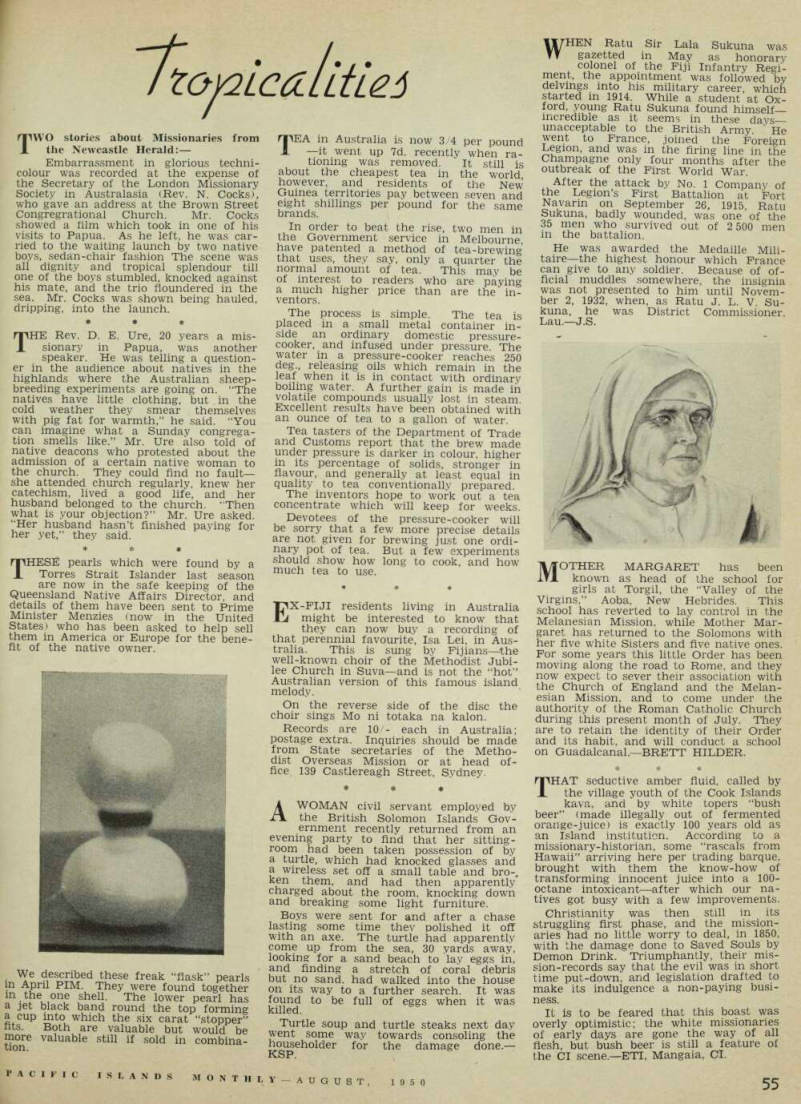
“Her husband hasn’t finished paying for her yet,” they said. * * * THESE pearls which were found by a Torres Strait Islander last season are now in the safe keeping of the Queensland Native Affairs Director, and details of them have been sent to Prime Minister Menzies (now in the United States) who has been asked to help sell them in America or Europe for the bene fit of the native owner.
. We described these freak “flask” pearls in April PIM. They were found together m the one shell. The lower pearl has a jet black band round the top forming a cup into which the six carat “stopper” fits. Both are valuable but would be more valuable still if sold in combina tion.
TEA in Australia is now 3/4 per pound —it went up 7d. recently when ra tioning was removed. It still is about the cheapest tea in the world, however, and residents of the New Guinea territories pay between seven and eight shillings per pound for the same brands.
In order to beat the rise, two men in the Government service in Melbourne have patented a method of tea-brewing that uses, they say, only a quarter the normal amount of tea. This may be of interest to readers who are paying a much higher price than are the in ventors.
The process is simple. The tea is placed in a small metal container in side an ordinary domestic pressure cooker, and infused under pressure. The water in a pressure-cooker reaches 250 deg., releasing oils which remain in the leaf when it is in contact with ordinary boiling water. A further gain is made in volatile compounds usually lost in steam.
Excellent results have been obtained with an ounce of tea to a gallon of water.
Tea tasters of the Department of Trade and Customs report that the brew made under pressure is darker in colour, higher in its percentage of solids, stronger in flavour, and generally at least equal in quality to tea conventionally prepared.
The inventors hope to work out a tea concentrate which will keep for weeks.
Devotees of the pressure-cooker will be sorry that a few more precise details are not given for brewing just one ordi nary pot of tea. But a few experiments should show how long to cook, and how much tea to use. * * * IjlX-FIJI residents living in Australia J might be interested to know that they can now buy a recording of that perennial favourite, Isa Lei, in Aus tralia. This is sung by Fijians—the well-known choir of the Methodist Jubi lee Church in Suva —and is not the “hot”
Australian version of this famous island melody.
On the reverse side of the disc the choir sings Mo ni totaka na kalon.
Records are 10/- each in Australia; postage extra. Inquiries should be made from State secretaries of the Metho dist Overseas Mission or at head of fice 139 Castlereagh Street, Sydney. ♦ * ♦ A WOMAN civil servant employed by the British Solomon Islands Gov ernment recently returned from an evening party to find that her sitting room had been taken possession of by a turtle, which had knocked glasses and a wireless set off a small table and bro-. ken them, and had then apparently charged about the room, knocking down and breaking some light furniture.
Boys were sent for and after a chase lasting some time they polished it off with an axe. The turtle had apparently come up from the sea, 30 yards away, looking for a sand beach to lay eggs in, and finding a stretch of coral debris but no sand, had walked into the house on its way to a further search. It was found to be full of eggs when it was killed.
Turtle soup and turtle steaks next day went some way towards consoling the householder for the damage done. —
Ksp.
WHEN Ratu Sir Lala Sukuna was gazetted in May as honorary colonel of the Fiji Infantry Regi ment, the appointment was followed by delvmgs into his military career, which started in 1914. While a student at Ox ford, young Ratu Sukuna found himself— incredible as it seems in these days— unacceptable to the British Army. He went to France, joined the Foreign Legion, and was in the firing line in the Champagne only four months after the outbreak of the First World War.
After the attack by No. 1 Company of the Legion’s First Battalion at Port Navarm on September 26, 1915, Ratu Sukuna, badly wounded, was one of the 35 men who survived out of 2 500 men in the battalion.
He was awarded the Medaille Mili taire—the highest honour which France can give to any soldier. Because of of ficial muddles somewhere, the insignia was not presented to him until Novem ber 2, 1932, when, as Ratu J. L. V. Su kuna, he was District Commissioner.
Lau.
J.S.
Mother Margaret has been known as head of the school for girls at Torgil, the “Valley of the Virgins,” Aoba, New Hebrides. This school has reverted to lay control in the Melanesian Mission, while Mother Mar garet has returned to the Solomons with her five white Sisters and five native ones.
For some years this little Order has been moving along the road to Rome, and they now expect to sever their association with the Church of England and the Melan esian Mission, and to come under the authority of the Roman Catholic Church during this present month of July. They are to retain the identity of their Order and its habit, and will conduct a school on Guadalcanal.—BRETT HILDER. * * * THAT seductive amber fluid, called by the village youth of the Cook Islands kava, and by white topers “bush beer” (made illegally out of fermented orange-juice) is exactly 100 years old as an Island institution. According to a missionary-historian, some “rascals from Hawaii” arriving here per trading barque, brought with them the know-how of transforming innocent juice into a 100octane intoxicant—after which our na tives got busy with a few improvements.
Christianity was then still in its struggling first phase, and the mission aries had no little worry to deal, in 1850, with the damage done to Saved Souls by Demon Drink. Triumphantly, their mis sion-records say that the evil was in short time put-down, and legislation drafted to make its indulgence a non-paying busi ness.
It is to be feared that this boast was overly optimistic; the white missionaries of early days are gone the way of all flesh, but bush beer is still a feature of
the Cl scene.
•ETI, Mangaia, Cl.