Magazine Section
p. 55 · Read in the full issue
Territories Talk-Talk
By "Tolala"
NOW that some encouragement is be ing given to private enterprise in NG, I see that two South Australians —one no other than the Editor of “Hoofs and Horns”—have plans for a tea plantation in the highlands. It’s about time we realised that NG can grow all our tropical requirements, and put that knowledge into practice. Sydney’s retail prices for pepper and coffee, for instance are respectively 3/3 an ounce, and 7/8 a pound. New Guinea growers should be able to do something with those lines and show a reasonable profit, at half the price.
Queen Emma, 40 years ago, carried out successful experiments in -growing this kind of product on Matanatar planta tion in the Kokopo district. But no one preservered then because the old coco nut was so easy to grow and required no trained labour to turn it into copra.
By-the-way, the modest kaukau (sweet potato) is selling in Sydney at 1/3 a pound!
INVARIABLY there are arguments about income taxation assessments.
One recently came before the Supreme Court in Sydney involving a man who was with the Yank Small Ships in NG for a while, and appealed against his earnings while there being taxed.
Apparently there are other similar cases pending and the judgment was reserved.
I hear many complaints from pre-war NG residents who received war damage compensation and have been taxed on the interest, which accumulated during the period between the loss and pay ment of the claim. Had there been a branch of the War Damage Commission established in NG after the war (whence most of the claims came) then surely the position could never have arisen, but there wasn’t and all claims had to go through Sydney. Somehow it doesn’t seem to add up rightly to me.
HAVE you ever tried to locate a pal who has come down to Sydney from NG, but you have no idea where he is staying? It might be imagined that it would be something akin to the pro verbial needle in the hay-stack. But not so. In the old days—before folk hop ped. down by ’plane—you could invariably track them down through the shipping department at BP’s; but in these days of modern transport it is not quite so easy. I was seeking a Bill Jones the other day. Enquiries at the PIM office drew a blank, even Bert Rawnsley in BP s didn’t know where he was, neither did Merle at the Plaza; but a call at Madge’s bar at Usher’s brought to light a veritable directory of Territorial! visi tors with their Sydney addresses. A flick of the leaves of the indexed address book by Madge gave me all the informa tion I required, and further queries told me that most Territorians register in Madge’s book as soon as they arrive.
THERE always have been favourite Sydney spotting spots for NG folk on leave—and probably always will be. In the early N ’2o’s it used to be Belfields, where Papuan, NG and Solo mon Islands residents foregathered’ then, in the ’3o’s, it changed to Usher’s where the famous Ethel could give you more information about NG personnel than the Government Secretary himself
then they gravitated to the Australia for a while, and afterwards returned to Usher’s where they congregate now, with a fair proportion patronising the Plaza.
It is not hard to track down the Ter ritorial if you really want to find them providing they do not shun the spotting spots.
BIRDS of paradise are either becoming more hardy, or their homes in cap tivity more to their liking. It used to be a common saying in the Islands that you could not keep a BOP in cap tivity—even in NG. Many attempts were made, but in vain. Now I read of a fe male blue bird in the Chicago Zoo being joined by a mate, which was flown over from Frisco, after a sea voyage from Sydney. The next thing we’ll hear will be some enterprising Yank starting a BOP farm for trimming milady’s Fifth Avenue hats.
FROM what one hears about the re classification of the P-NG Public Service it has certainly caused a lot of disappointment—and that’s putting it very mildly. Senior officers appear to have come off quite well, while the lower grades are left moaning. This is un fortunate and if there are not many vacancies in the ranks of the Public Service in a short while I shall be much surprised. Unless, of course, some of the classifications are amended. Papua and New Guinea are not as attractive as they used to be in pre-war days. Per haps a little less attention to UNO and more to government employees might be advantageous, all round.
THE reassurance of the Special Cor respondent (PIM, July, p 9) of “Let there be No Panic” in Rabaul over imminent volcanic eruptions is very timely, and he is quoting much of what Dr. Norman Fisher stated over ten years ago. The Australian government has al wavs had the wind-up over Rabaul since 1937, and Civil Servants in residents there in pre-war days encouraged this fear to a great extent, for they had no personal stake in the town (they were
not allowed to have one) and one loca tion was as good as another to them in which to perform their public service duties. The gov ernment was natu rally concerned over the safety of the residents, but an other contributing factor for concern was the possibility of claims for com pensation in the event of a major seismic upheaval.
In these years “Compo’ has become a big factor in na
tional life and that, in my opinion, Is one of the main reasons why the government is still toying with the idea of “moving Rabaul. ’ Dr. Fisher’s views may succeed in allaying government fears, and I hope they do. But the in stallation of an A 1 vulcanological ob servatory is essential, without delay.
WHY is it the present Vs always so niggardly in passing credit on to the past?
Minister Spender is reported in the middle of last month as saying that “with nromulgation of the Native Vil lage Councils Regulations the native peoples would for the first time have an opportunity for a measure of self-gov ernment.”
And yet in the TNG Administration Report to the League of Nations for 1936-37 one reads of the establishment of 14 groups of villages where Native Councils had been established and trans lations of some of the records were for warded to the Permanent Mandates Commission for examination . , . Fair go!
BITS AND PIECES: Rabaul will miss the Perrimans, who left recently for Europe, via the USA. Bert has seen a few changes in old Rabaul. It is 30 years since he used to tootle round in an old T Ford. Then the WRC staff in Rabaul consisted of a man named Tat ham as manager, and Bert as clerk and everything else. Their office was in a bungalow opposite Proclamation Square and later occupied by Johnny Walstab.
The WRC firm has gone a long way since then. . . . Present Territorial an nual copra production is said to be about 55,000 tons. In pre-war times native trade copra was estimated at 10,000 tons.
It would be interesting to know what it totals now, as an indication of native in dustry. ... A Sydney firm is offering boys a bonus of £lOO to sign apprenticeship articles for a period of five years. . . .
Indentured labour system?
Captain F. S. Melton, master of the Melanesian Mission ship Southern Cross, has been in Sydney on furlough.
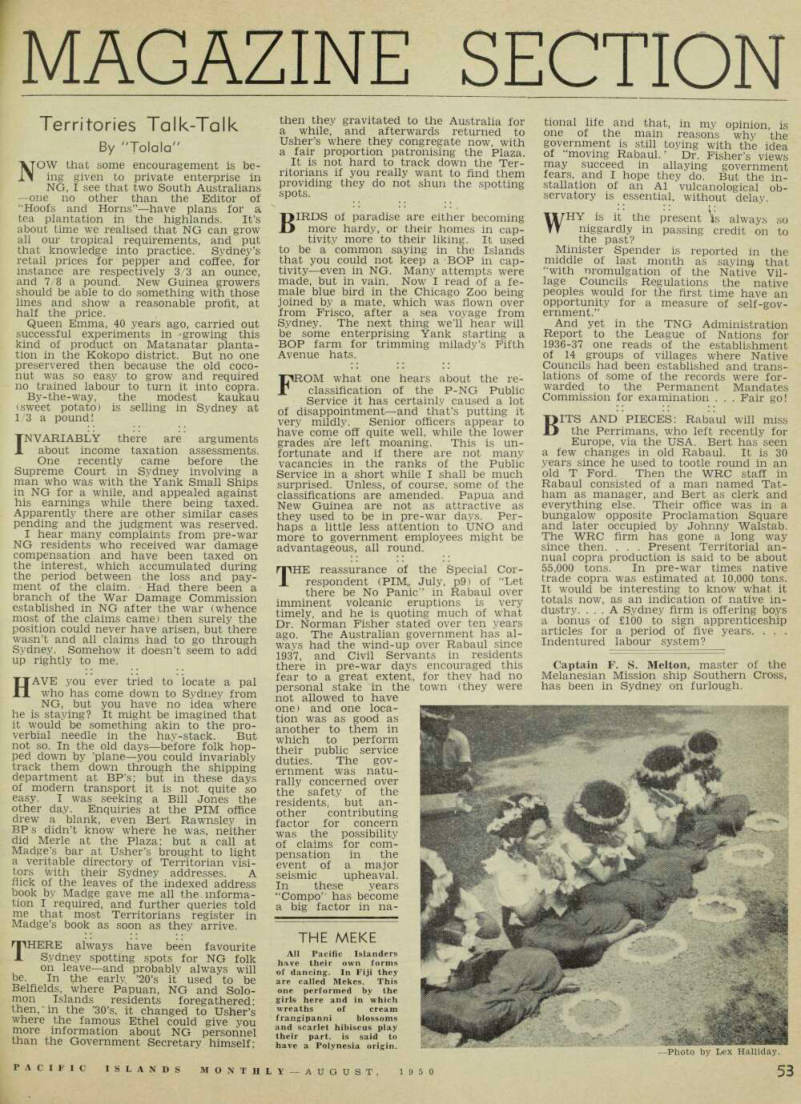
The Meke
All Pacific Islanders have their own forms of dancing. In Fiji they are called Mekes. This one performed by the girls here and in which wreaths of cream frangipanni blossoms and scarlet hibiscus play their part, is said to have a Polynesia origin.
—Photo by Lex Halliday.