Production
pp. 52-65 · Read in the full issue

Some Notes On Papain
By C. Lladdis
THE pawpaw tree (Carica papaya) is common to many parts of the tropics. It is a native of Central America and was introduced by the early navigators to the East Indies and the Philippines.
The profitable nroduction of the papaya will ordinarily depend upon the utilisa tion, by processing, of sizes and grades of its fruit not suited to fresh markets, and upon the use of the ripened fruit cul tivated for the production of papain.
Papain, the name given to the dried powder derived from the latex of the green fruit, is chiefly exported from Cey lon and the Philippines. In recent years, Tanganyika has become a large producer also. The enzymes contained in papain are required in the manufacture of various digestive preparations, for the making of chewing gum and special foods, and when the digestion of protein is required—e.g., in reducing shrinkage of wool, etc.
Although the tender, growing tips of the leaves of the papaya are sometimes consumed as greens, after boiling in water, the stem and leaves contain an alkaloid, carpain, which is used medicinally as a heart stimulant.
As it is easily the cheapest proteolytic enzyme to produce, the demand should steadily increase. But overproduction could easily exceed the demand, result ing in poor prices.
America’s imports of papain before the war were worth about £16,000 being sup plied mainly from the Philippines.
Britain’s requirements came mainly from Ceylon, with Tanganyika’s production going mainly to the Continent.
THE best soil is a light friable loam.
However, as with the climatic con ditions, a considerable latitude is allowed, and experience in regard to local varieties will be a guide.
Trees, when planted out, should be ap proximately 16 ft. by 16 ft. apart, with one male tree to every 20 female trees.
When making nursery plantings, care must be taken to allow for poor ger mination, and for failure of male trees, after planting out. The sex of the tree cannot be determined until flowering, nor can the sex be changed by severe lopping.
Experiments have shown that the ratio of female seeds in the fruit, to the male seeds, does not decrease from top to bot tom of the fruit—and 20 per cent, of all seedlings are male. Seeds from trees with small fruits, or those with an abundance of abnormal papayas, are generally avoided, as they may be poor producers.
At 6 in. to 9 in., the seedlings are planted out. For best results, the ground should be ploughed and harrowed in both directions, and holes prepared some two months prior to setting out —i.e., at the beginning of the wet season.
It is advisable to keep the Plantation free from weeds, care being taken not to injure the shallow roots of the tree.
It has been noted that, if it is proposed to plant on “kunai” ground, it is advisable to first grow Tephrosia Candida on it, at least for one year.
Once the sex of the tree has been de termined, the unwanted male trees can be removed. Two methods have been suggested. The whole tree can be dis carded and another seedling planted (thus allowing for the chance of another male tree) or the tree can be grafted over to a female tree. The conventional cleft graft is used, with a banana leaf wrapping over the graft and binding.
MAXIMUM life of the plantation is five years, in good areas. Trees are at their highest production when two years old, when 80-100 lb. of papain per acre may be expected. After this, the yield drops rapidly. Total papain production for the five years is between 200 and 250 lb. per acre. Prior to the war, the price of papain was anywhere from 5/- to 30/- per pound. The pre sent prices paid by the USA. and main tained since the war, have been around 15/- per lb. Approximately 5 to 7 lb. of fresh latex makes 1 lb. of dry papain.
Tapping is usually done in the early morning, with a knife of stainless steel, bone or similar composition—as any con tact with base metals results in an in ferior product. The knife or blade is set in cork or rubber, projecting .1/16 in. and tied to a stick for easier handling. Tao ping usually begins when the fruit has reached about 4 in. in diameter, when the tree is 9-12 months old, and may continue at intervals of seven days throughout the year. More frequem tap pings result in a lowered total yield.
Several methods of collection are used, the most popular being a cotton cloth fixed to a frame, so that the “saucer” or “umbrella” may be clamped to the tree just below the fruit. The latex is immediately collected and scraped into a wooden box fitted with a sliding lid.
With two such “saucers,” a worker is able to attend to two trees at a time; when the latex has ceased to flow from the first, the “saucer” is clamped to the third tree, and so on.
Hour or five longitudinal cuts are made in the fruit, spaced equally apart. The next tapping of this tree should be up to \ in. from the previous cuts. When the collecting box is full it is taken to the drier.
At no time should the latex come in contact with base metals or the human
skin as it has a strong corrosive action.
If the latex must be held for some time prior to drying, it has been found that a solution of 1 per cent, formalin prevents
the total putrefaction of the latex, al though it slightly lowers the quality of the finished papain.
(Continued on Page 61.)
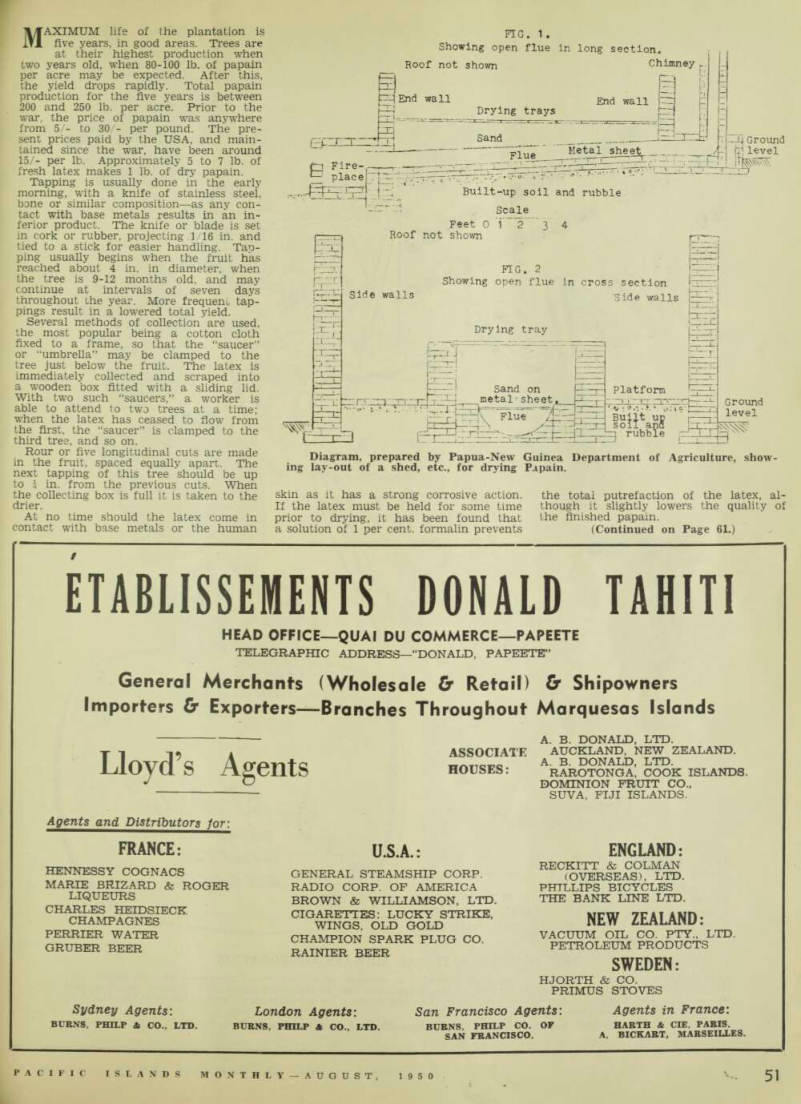
Diagram, prepared by Papua-New Guinea Department of Agriculture, show ing lay-out of a shed, etc., for drying Papain.
At the kiln, the latex is strained through muslin to remove any extraneous matter.
Sun-dried, being darker, is of lower value than the kiln-dried product. The best and highest grade papain is creamy white and crumbly.
The kiln may be a closed or open type.
The former gives the highest quality; but the cost of construction is higher, as adequate ventilation must be provided to keep down humidity. Kilns are operated at9odeg-100 deg. Fahr., and drying takes five-seven hours. With a tray 30 ft. x 6 ft., about 60 lb. of prepared papain is a day’s production. At first, the latex must be stirred with a wooden paddle.
Over-heating will result in darkening, and is a risk with the closed kiln.
Immediately, the dried latex —now papain—is sealed in new 4-gallon kero sene tins, the insides of which have been coated with paraflin wax, evacuated and sealed. Papain is graded by its colour, and the prepared paoain must not on any account be pulverised prior to packing. As papain deteriorates rapidly, it is essential that it be packed quickly.
THE Bureau of Agriculture and Industrial Chemistry, Agricultural Research Administration. US De partment of Agriculture, in 1944, made several experiments with the papaya. The products include canned and bottled papaya nectars and soft drinks, conserves, chutney, pickles, and butter. Other items were marmalade, sweet pickle, spiced sweet pickle, crystallised fruit and de hydrated papaya slices and pulp.
The dehydrated papaya slices were of interest as it is a good source of vitamins A and C and could readily be eaten as is. Further, having a low acid and high
sugar content, combined with the candy like taste and texture, it is suitable for incorporation in concentrated food rations, as well as confections.
The candied papaya, resembling candied citron peel in appearance and flavour, was tested in fruit-cake mix and in mince meat. Storage tests were carried out for over a year without apparent deteriora tion of the candied samples. Those stored over three years gradually developed a stale odour and flavour. The preserva tive used was sodium bisulfite, equiva lent of 50 parts per million of sulphur dioxide.
Further information can be obtained by those interested from the following sources: Department of Agriculture, Stock and Fisheries, Port Moresby, Papua; the Queensland Department of Agriculture: Florida Agriculture Experiment Station, USA; US Fruit and Vegetable Products Laboratory, Welasco, Texas; the Bureau of Agriculture and Industrial Chemistry, Agricultural Research Administration, US Department of Agriculture.