The Land of Opters
p. 63 · Read in the full issue
By John
Rolley
1 STOOD behind the counter wrapping a parcel of rice,, talcum powder, three inch nails and twist tobacco. The cus tomer put down 15 shillings and 80 francs.
For change I gave him a packet of chew ing gum and a box of matches. Then at the last minute, he traded in the chew ing gum, matches, and a withered five franc note for a bottle of lemonade.
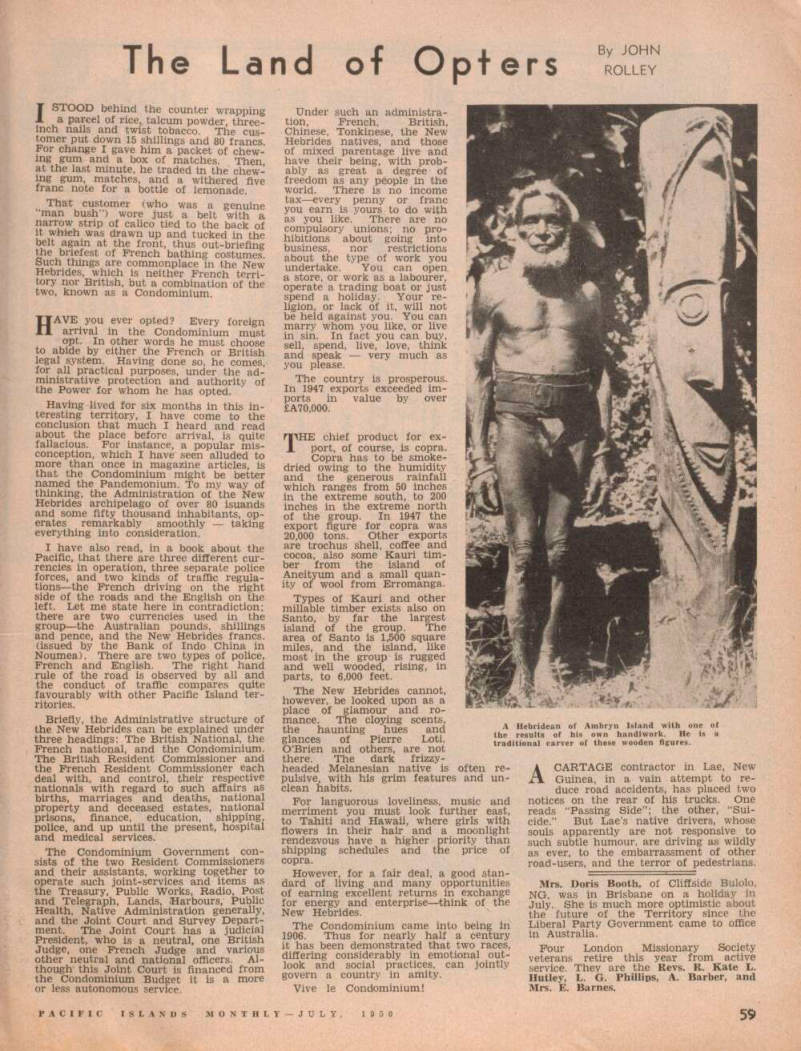
That customer (who was a genuine “man bush”) wore just a belt with a narrow strip of calico tied to the back of it which was drawn up and tucked in the belt again at the front, thus out-briefing the briefest of French bathing costumes.
Such things are commonplace in the New Hebrides, which is neither French terri tory nor British, but a combination of the two, known as a Condominium.
HAVE you ever opted? Every foreign arrival in the Condominium must opt. In other words he must choose to abide by either the French or British legal system. Having done so, he comes, for all practical purposes, under the ad ministrative protection and authority of the Power for whom he has opted.
Having lived for six months in this in teresting territory, I have come to the conclusion that much I heard and read about the place before arrival, is quite fallacious. For instance, a popular mis conception, which I have seen alluded to more than once in magazine articles, is that the Condominium might be better named the Pandemonium. To my way of thinking, the Administration of the New Hebrides archipelago of over 80 isuands and some fifty thousand inhabitants, op erates remarkably smoothly taking everything into consideration.
I have also read, in a book about the Pacific, that there are three different cur rencies in operation, three separate police forces, and two kinds of traffic regula tions—the French driving on the right side of the roads and the English on the left. Let me state here in contradiction; there are two currencies used in the group—the Australian pounds, shillings and pence, and the New Hebrides francs, (issued by the Bank of Indo China in Noumea). There are two types of police, French and English. The right hand rule of the road is observed by all and the conduct of traffic compares quite favourably with other Pacific Island ter ritories.
Briefly, the Administrative structure of the New Hebrides can be explained -under three headings: The British National, the French national, and the Condominium.
The British Resident Commissioner and the French Resident Commissioner each deal with, and control, their respective nationals with regard to such affairs as births, marriages and deaths, national property and deceased estates, national prisons, finance, education, shipping, police, and up until the present, hospital and medical services.
The Condominium Government con sists of the two Resident Commissioners and their assistants, working together to operate such joint-services and items as the Treasury, Public Works, Radio, Post and Telegraph, Lands, Harbours, Public Health, Native Administration generally, and the Joint Court and Survey Depart ment. The Joint Court has a judicial President, who is a neutral, one British Judge, one French Judge and various other neutral and national officers. Al though this Joint Court is financed from the Condominium Budget it is a more or less autonomous service.
Under such an administra tion, French, British, Chinese, Tonkinese, the New Hebrides natives, and those of mixed parentage live and have their being, with prob ably as great a degree of freedom as any people in the world. There is no income tax —every penny or franc you earn is yours to do with as you like. There are no compulsory unions; no pro hibitions about going into business, nor restrictions about the type of work you undertake. You can open a store, or work as a labourer, operate a trading boat or just spend a holiday. Your re ligion, or lack of it, will not be held against you. You can marry whom you like, or live in sin. In fact you can buy, sell, spend, live, love, think and speak very much as you please.
The country is prosperous.
In 1947 exports exceeded im ports in value by over £A70,000.
THE chief product for ex port, of course, is copra.
Copra has to be smoke dried owing to the humidity and the generous rainfall which ranges from 50 inches in the extreme south, to 200 inches in the extreme north of the group. In 1947 the export figure for copra was 20,000 tons. Other exports are trochus shell, coffee and cocoa, also some Kauri tim ber from the island of Aneityum and a small quan ity of wool from Erromanga.
Types of Kauri and other millable timber exists also on Santo, by far the largest island of the group. The area of Santo is 1,500 square miles, and the island, like most in the group is rugged and well wooded, rising, in parts, to 6,000 feet.
The New Hebrides cannot, however, be looked upon as a place of glamour and ro mance. The cloying scents, the haunting hues and glances of Pierre Loti, O’Brien and others, are not
there. The dark frizzy headed Melanesian native is often re pulsive, with his grim features and un clean habits.
For languorous loveliness, music and merriment you must look further east, to Tahiti and Hawaii, where girls with flowers in their hair and a moonlight rendezvous have a higher priority than shipping schedules and the price of copra.
However, for a fair deal, a good stan dard of living and many opportunities of earning excellent returns in exchange for energy and enterprise—think of the New Hebrides.
The Condominium came into being in 1906. Thus for nearly half a century it has been demonstrated that two races, differing considerably in emotional out look and social practices, can jointly govern a country in amity.
Vive le Condominium!
A CARTAGE contractor in Lae, New Guinea, in a vain attempt to re duce road accidents, has placed two notices on the rear of his trucks. One reads “Passing Side”; the other, “Sui cide.” But Lae’s native drivers, whose souls apparently are not responsive to such subtle humour, are driving as wildly as ever, to the embarrassment of other road-users, and the terror of pedestrians.
Mrs. Doris Booth, of Cliffside Bulolo, NG, was in Brisbane on a holiday in July. She is much more optimistic about the future of the Territory since the Liberal Party Government came to office in Australia.
Four London Missionary Society veterans retire this year from active service. They are the Revs. R. Kate L.
Hutley, L. G. Phillips, A. Barber, and Mrs. E, Barnes.
A Hebridean of Ambryn Island with one of the results of his own handiwork. He is a traditional carver of these wooden figures.