They are leaving Midway to
pp. 48-59 · Read in the full issue
the Gooney Birds
IT was announced in May that Midway Atoll, US Navy sentinel in the North Pacific these eleven years, is to be abandoned to its earliest settlers—the gooney-birds, more scientifically known as Laysan Albatross.
Midway was claimed by the United States in 1867 and is their oldest Pacific possession. It was then called Brooks Island, but this has since been changed to the more appropriate name of Mid way. Midway, from the US viewpoint, just about describes it; it is about 1,300 miles north-west of Honolulu and roughly half way between the American main land and the Orient.
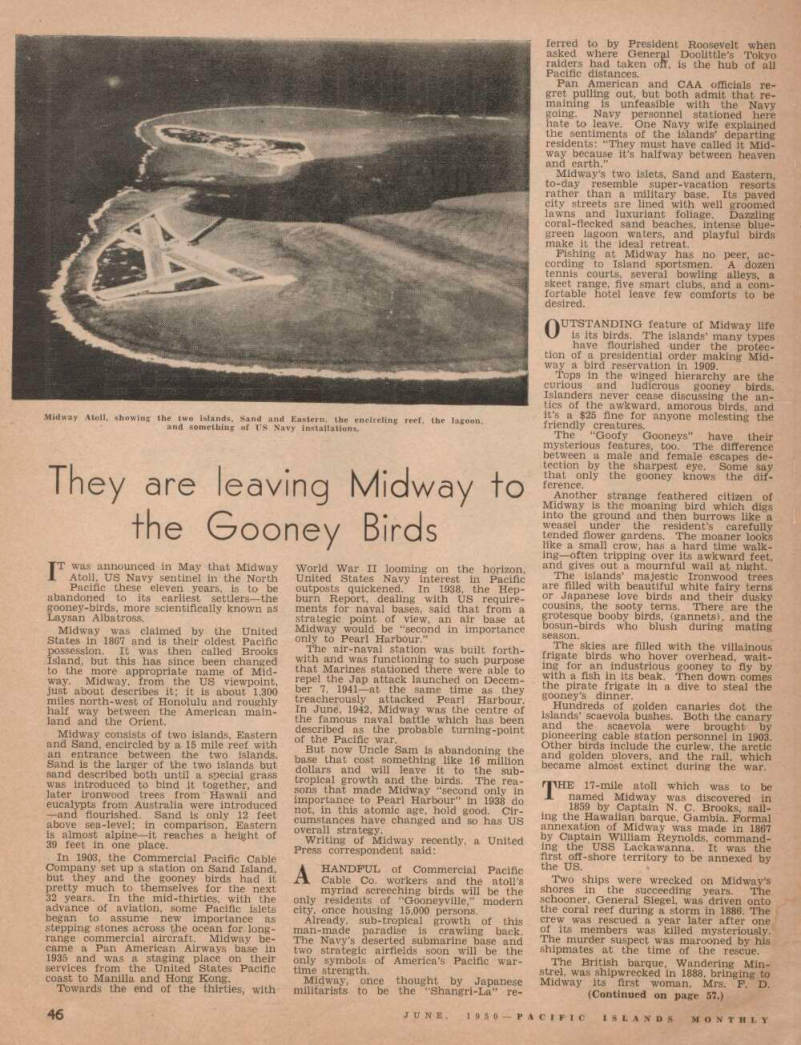
Midway consists of two islands, Eastern and Sand, encircled by a 15 mile reef with an entrance between the two islands.
Sand is the larger of the two islands but sand described both until a special grass was introduced to bind it together, and later ironwood trees from Hawaii and eucalypts from Australia were introduced —and flourished. Sand is only 12 feet above sea-level; in comparison, Eastern is almost alpine—it reaches a height of 39 feet in one place.
In 1903, the Commercial Pacific Cable Company set up a station on Sand Island, but they and the gooney birds had it pretty much to themselves for the next 32 years. In the mid-thirties, with the advance of aviation, some Pacific islets began to assume new importance as stepping stones across the ocean for long range commercial aircraft. Midway be came a Pan American Airways base in 1935 and was a staging place on their services from the United States Pacific coast to Manilla and Hong Kong.
Towards the end of the thirties, with
World War II looming on the horizon, United States Navy interest in Pacific outposts quickened. In 1938, the Hep burn Report, dealing with US require ments for naval bases, said that from a strategic point of view, an air base at Midway would be “second in importance only to Pearl Harbour.”
The air-naval station was built forth with and was functioning to such purpose that Marines stationed there were able to repel the Jap attack launched on Decem ber 7, 1941—at the same time as they treacherously attacked Pearl Harbour.
In June, 1942, Midway was the centre of the famous naval battle which has been described as the probable turning-point of the Pacific war.
But now Uncle Sam is abandoning the base that cost something like 16 million dollars and will leave it to the sub tropical growth and the birds. The rea sons that made Midway “second only in importance to Pearl Harbour” in 1938 do not, in this atomic age, hold good. Cir cumstances have changed and so has US overall strategy.
Writing of Midway recently, a United Press correspondent said: A HANDFUL of Commercial Pacific Cable Co. workers and the atoll’s myriad screeching birds will be the only residents of “Gooneyville,” modern city, once housing 15,000 persons.
Already, sub-tropical growth of this man-made paradise is crawling back.
The Navy’s deserted submarine base and two strategic airfields soon will be the only symbols of America’s Pacific war time strength.
Midway, once thought by Japanese militarists to be the “Shangri-La” re
ferred to by President Roosevelt when asked where General Doolittle’s Tokyo raiders had taken off, is the hub of all Pacific distances.
Pan American and CAA officials re gret pulling out, but both admit that re maining is unfeasible with the Navy going. Navy personnel stationed here hate to leave. One Navy wife explained the sentiments of the islands’ departing residents: “They must have called it Mid way because it’s halfway between heaven and earth.”
Midway’s two islets, Sand and Eastern, to-day resemble super-vacation resorts rather than a military base. Its paved city streets are lined with well groomed lawns and luxuriant foliage. Dazzling coral-flecked sand beaches, intense blue green lagoon waters, and playful birds make it the ideal retreat.
Pishing at Midway has no peer, ac cording to Island sportsmen. A dozen tennis courts, several bowling alleys, a skeet range, five smart clubs, and a com fortable hotel leave few comforts to be desired.
OUTSTANDING feature of Midway life is its birds. The islands’ many types have flourished under the protec tion of a presidential order making Mid way a bird reservation in 1909.
Tops in the winged hierarchy are the curious and ludicrous gooney birds.
Islanders never cease discussing the an tics of the awkward, amorous birds, and it’s a $25 fine for anyone molesting the friendly creatures.
The “Goofy Gooneys” have their mysterious features, too. The difference between a male and female escapes de tection by the sharpest eye. Some say that only the gooney knows the dif ference.
Another strange feathered citizen of Midway is the moaning bird which digs into the ground and then burrows like a weasel under the resident’s carefully tended flower gardens. The moaner looks like a small crow, has a hard time walk ing—often tripping over its awkward feet, and gives out a mournful wail at night.
The islands’ majestic Ironwood trees are filled with beautiful white fairy terns or Japanese love birds and their dusky cousins, the sooty terns. There are the grotesque booby birds, (gannets), and the bosun-birds who blush during mating season.
The skies are filled with the villainous frigate birds who hover overhead, wait ing for an industrious gooney to fly by with a fish in its beak. Then down comes the pirate frigate in a dive to steal the gooney’s dinner.
Hundreds of golden canaries dot the islands’ scaevola bushes. Both the canary and the scaevola were brought by pioneering cable station personnel in 1903.
Other birds include the curlew, the arctic and golden plovers, and the rail, which became almost extinct during the war.
THE 17-mile atoll which was to be named Midway was discovered in 1859 by Captain N. C. Brooks, sail ing the Hawaiian barque, Gambia. Formal annexation of Midway was made in 1867 by Captain William Reynolds, command ing the USS Lackawanna. It was the first off-shore territory to be annexed by the US. , Two ships were wrecked on Midway’s shores in the succeeding years. The schooner, General Siegel, was driven onto the coral reef during a storm in 1886. The crew was rescued a year later after one of its members was killed mysteriously.
The murder suspect was marooned by his shipmates at the time of the rescue.
The British barque, Wandering Min strel, was shipwrecked in 1888, bringing to Midway its first woman, Mrs. P. D.
(Continued on page 57.)
Midway Atoll, showing the two islands, Sand and Eastern, the encircling reef, the lagoon, and something of US Navy installations.
Walker, wife of the ship’s captain. The near-starved crew was rescued 13 months later by the schooner Norma, out of Honolulu.
First settlers came to Midway in 1903, when the Commercial Pacific Cable Co. set up its lonely station to service the trans-Pacific cable. A description of the first night on the then barren sand strip was written years later in a letter by the company’s first manager, B.
W. Colley.
“Our first night’s experience was some what startling,” he said. “We walked around the island —not much to see— reef, sand and ocean, plus birds.
“Then, as night fell, there arose the most astonishing medley of sounds like caterwauling—shrill screams of cats, squeaking and moans, as of people in distress. We did not know what to make of it. It was weird, especially accompanied by the boom of the surf on the reef.
“We finally turned in. All those sounds were made by the sea birds, and we soon got as used to them as you are to the sound of the city streets.”
When Pan American arrived in 1935 to end the cable station’s solitude, they brought in the first power-plant, pre fabricated houses, and set up the island’s first water supply system. Soon the Sikorsky China Clippers were plying the skylanes over the sea routes used by the fore-runners of the air age.
When in 1939-40 the Navy moved in, the naval air station was built using many of the Pan American facilities already there.
A Marine garrison was set up, growing to a strength of 850 men by February, 1941. December 7, 1941, at 9.35 p.m., Mid
way was bombarded by a Japanese raid ing force estimated to consist of two cruisers and two destroyers. The Japanese retired under fire from shore batteries. Four Americans were killed that day on Midway.
After hostilities ended, Navy personnel were allowed to bring their families with them to Midway. The islands’ small city was renovated from a wartime camp to a city of modern luxuries.
The Rev. and Mrs. A. W. E. Silvester, of the NZ Methodist Mission, returned to the Solomons after leave in the Dominion in March. While they were in New Zealand, Mr. Silvester received the American decoration, Medal for Merit.
He won this high award for guiding an advance party of Americans on Jap-held Vella Lavella in 1943. The actual in vestiture, however, was not held until Mr.
Silvester returned to NZ recently.