Malevolent
pp. 44-45 · Read in the full issue
Malabar
By Geoffrey Shepherd
NOT the least of tiny Lord Howe Island’s attractions for its many tourists is the lure of its green mountain peaks and great basalt heights that make the island visible 60 miles out to sea.
At the southern end. and overshadow ing other island heights, are the mas sive bulks of Mts. Gower and Lidgbird rising sheer for nearly 3,000 feet. They are the source of the island’s heavy rain fall- of its cloud-mists and rainbows; the habitat of rare bird life; the retreat of wild goats and pigs; and, on the lofty plateau of Mt. Gower, spending half their life in a fantastic world of scudd ing cloud-vapours are some of the world’s rarest tree-ferns and palms.
Overshadowed by these two southern heights is a series of saw-tooth peaks on the island’s northern shores, six miles away. And the highest of these is Mala bar.
For 714 feet it rises. From the shadows of Lord Howe’s luxuriant palm forests, it climbs up through a thick under growth in an easy gradient, but from its summit its mood abruptly changes.
On its northern side it falls sheer to the waters of the Pacific which violently smash on its rocky base, throwing up curtains of spray. Many visitors have climbeff Malabaa- with ease from the south, but there is no record of anyone who has successfully challenged its abrupt northern cliffs.
The long upward southern track is well worn and the few rocky outcrops en countered would not worry even the most inexperienced climber. Following a rough passage through undergrowth which has been blazed many times and is well defined, every now and again you duck to avoid large spider-webs that hang over the track like sticky, silken nets. Now you tackle the climbing in earnest, but compared with the huge southern peaks this one is child’s play.
Half way up on a rocky outcrop is a good excuse to pause for a rest, then the go ing becomes just a little more strenu ous. There are no precipitous drops— yet. The old sagging field-telephone line, that served war-time coast-watchers posted up on Malabar’s summit with their HQ below, acts as a support. That is, when it does not lose itself in the undergrowth.
At the summit you stand on the brink of the highest of the island’s northern ridges. Ahead is the Pacific —and in finity. Below, at the bottom of the cliff’s
dizzy depths, a sheer drop—and eternity.
Looking westwards the other ridges have the same characteristic features; their wooded slopes rising gradually from the south, but their northern scarps all fall ing sheer to the ocean.
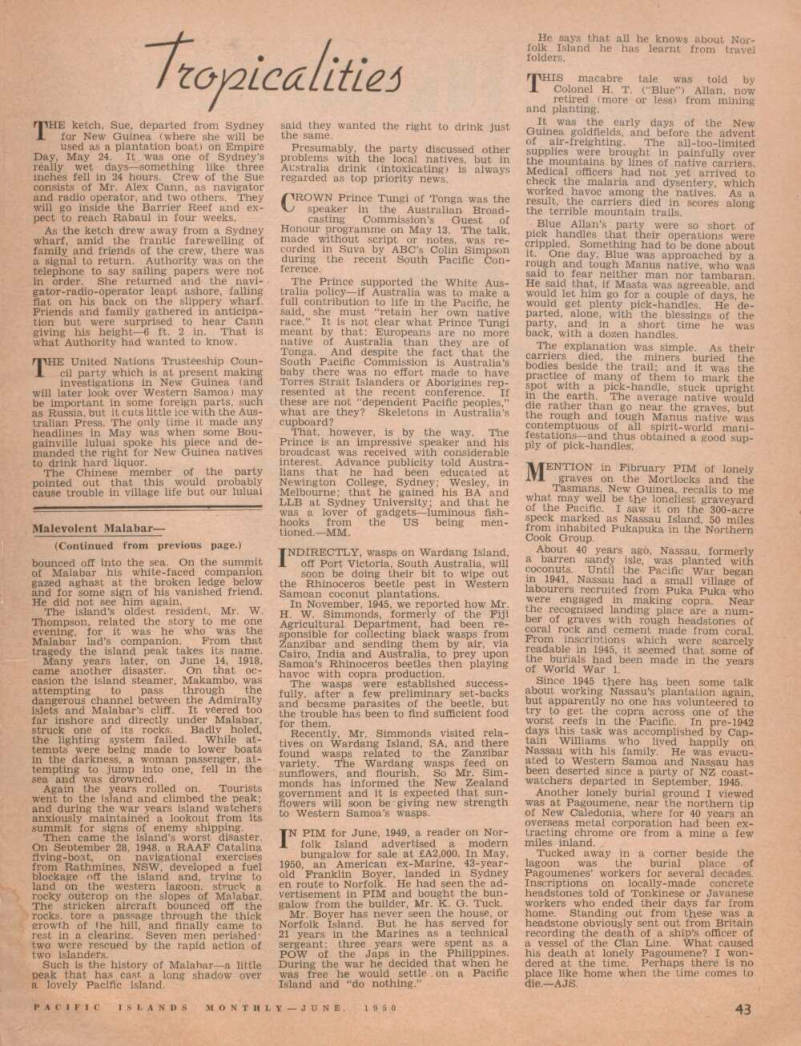
Half a mile out to the north-east, lie the Ad miralty Islets, breaking the sea like a school of whales. The great caver nous arch that penetrates the largest of the Islets is plainly visible.
The silence of the sum mit is uncanny. Looking down south at the narrow, twisting island, forgetting for a moment the few clearings and the two 150ft. radio towers thrusting out of the dark sea of green below, the scene is little different from that witnessed by the first per son who climbed this peak a little over 100 years ago.
Looking eastward you are confronted with the stupendous reality of the lonely Pacific—for thous
ands of miles you could sail directly east over this desolate waste of water before you finally came to South America and you would find no land, no other small palm-fringed island like this one, not even lone citadel rocks to
break its fastness.
BUT Malabar has rather a grim history. One ■* day in 1881 two lads climbed the peak in search of goats—the descendants of which to-day still roam around Malabar. One was an island lad but the other was much darker skinned —a native boy who origin ally came from the Mala bar coast of India, but who more recently had come down from New Caledonia with other labour to work the phos phate deposits on the Admiralty islets.
Reaching the summit the island boy sighted a wild goat and set off in pursuit. His companion was more intent in peer ing down the cliff’s face in
search of nesting birds. Then he spied one of the most beautiful —the Bosun bird. It was nesting a little way down the cliff face near a ledge.
Carefullv he lowered himself until he reached it. Then, the bird almost with-
in his grasn, he relaxed. But the ledge was rotten and under his weight plunged into the abyss below. The lad plunged after it and seconds later hit the rocks and (Continued next page)
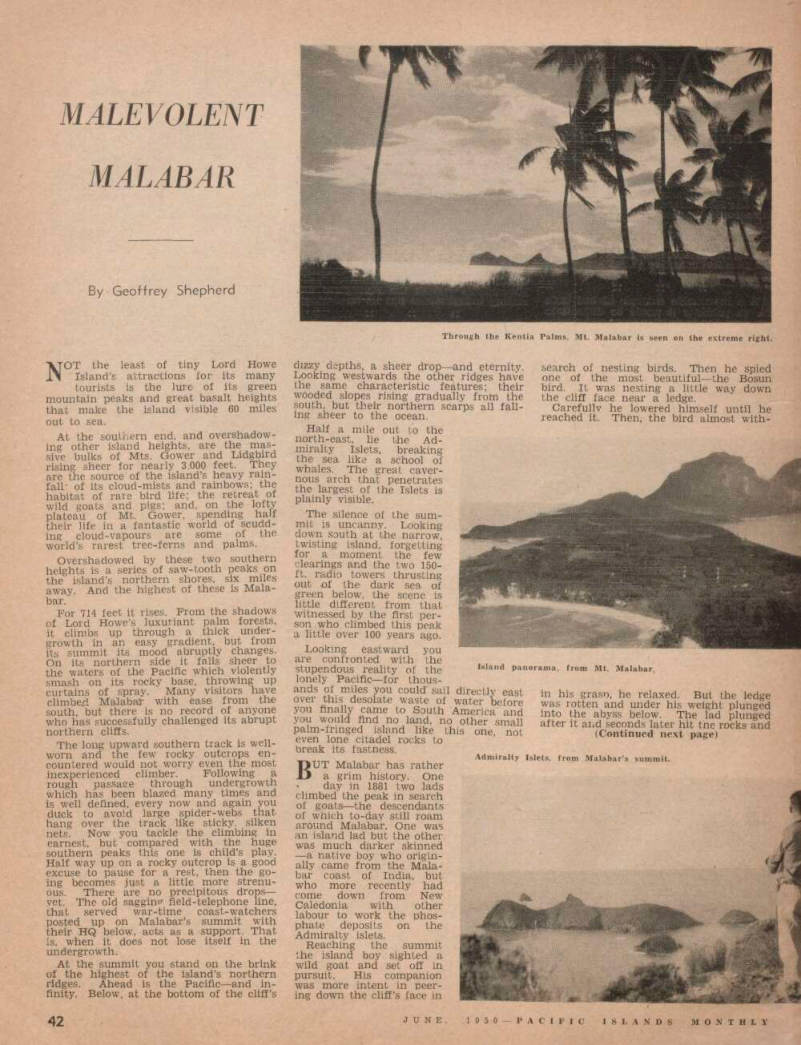
Through the Kentia Palms, Mt. Malabar is seen on the extreme right.
Island panorama, from Mt. Malabar.
Admiralty Islets, from Malabar’s summit.
bounced off into the sea. On the summit of Malabar his white-faced companion gazed aghast at the broken ledge below and for some sign of his vanished friend.
He did not see him again.
The island’s oldest resident, Mr. W.
Thompson, related the story to me one evening, for it was he who was the Malabar lad’s companion. From that tragedy the island peak takes its name.
Many years later, on June 14, 1918, came another disaster. On that oc casion the island steamer, Makambo, was attempting to pass through the dangerous channel between the Admiralty islets and Malabar’s cliff. It veered too far inshore and directly under Malabar, struck one of its rocks. Badly holed, the lighting system failed. While at tempts were being made to lower boats in the darkness, a woman passenger, at tempting to jump into one. fell in the sea and was drowned.
Again the years rolled on. Tourists went to the island and climbed the peak; and during the war years island watchers anxiously maintained a lookout from its summit for signs of enemy shipping.
Then came the island’s worst disaster.
On Sentember 28, 1948. a RAAF Catalina flving-boat, on navigational exercises from Rathmines, NSW, developed a fuel blockage nff the island and, trying to land on the western lagoon, struck a rocky outcrop on the slopes of Malabar.
The stricken aircraft bounced off the rocks, tore a passage through the thick growth of the hill, and finally came to rest in a clearing. Seven men perished two were rescued by the rapid action of two islanders.
Such is the history of Malabar —a little peak that has cast a long shadow over a lovely Pacific island.