News From New Ireland
pp. 101-102 · Read in the full issue
From Our Own Correspondent KAVIENG, April 30.
Tomalabatt Plantation, Tabar
Islands, formerly the property of the late Mr. J. S. Talmage, has been bought by Mr. Woo You, one of Kavieng’s most popular Chinese residents.
Seeto Young, 51, who had been in New Guinea for 37 years, died at Put Put near Kavieng, on March 20. He was a brother of Seeto Gui, well-known New Britain planter and trader.
The Minister for External Territories Mr. Spender, and Mrs. Spender seemed delighted with their short stay at Kavieng in April. Arrangements for their reception and well-being went off without a hitch.
They received addresses of welcome in English by prominent natives; Mr. Sen der listened attentively to the woes of the planters; and a Chinese deputation, also a half-caste deputation waited upon him. He seemed to have had the situa tion well sized up before he came to Kavieng, judging by his general know ledge and grip of New Guinea’s problems.
He did not fail to emphasise that the Territory was costing the Australian tax payer £4,000,000 a year, and said that if residents wanted further facilities and amenities they would have to pay for them.
Largest European gathering for years was at the residence of Mr. Peter V.
Saunders, where the planters provided an excellent buffet supper in honour of the distinguished guests, among whom was an old New Guinea friend, Captain “Orm”
Denny, popular pre-war goldfields pilot of Guinea Airways, Ltd.
HAPPY, unsophisticated Chimbu natives are working conscientiously around Kavieng. They seem to be taking kindly to their new surroundings and are being watched with much interest.
There have been many visitors to Kavieng recently. We have had anthropologists, dieticians, nutritionists, baby-welfare nurses, doctors and a col lector of native curios for a Swiss museum. If one among them can stick some vitamins into the local lads so that they will at least have energy enough to bring their sick offspring to the free hos pitals so generously supplied by a paternal Administration, and by various mission bodies, then their visits will not be in vain.
Unless our New Irelanders get off their backsides and work—for work is the anti dote for most ills —then they must die off much faster than they did before the war Mr. Love, cousin of the world-famed Maori anthropologist, Sir Peter Buck, is doing some X-ray work among the natives here. He never fails to extol the virtues of “God’s Own Country’’ (New Zealand) but so far he has passed little comment on NG!
Anzac Dav was celebrated with due solemnity, but subsequent revelry. A ceremony took place at the flagstaff and an address was given by the Rev. Ben Chenoweth, Methodist Overseas Mission.
The smart detachment of the New Guinea Police Force was under the command of A/Sub-Inspector P. E. Towner. The “Last Post’’ and “Reveille” were sounded, and the large gathering lifted up its voice and sang “O God, Our Help in Ages Past.” A Digger of the two world wars ulaced a lone wreath at the foot of th° flagstaff, after which native women and children placed small bunches of flowers around it. At the end of the two minutes’
silence, a fine, well-sounding voice rent tne quiet air— “ They shall not grow old . . .”
It was Kavieng’s most impressive and best-attended post-war Anzac Day ceremony. Chinese tiade stores supplied native ex-servicemen with free lemonade, biscuits and sweets.
Later py cprvipp m pn f “KmrfJ’ adjourned to sung and the old ti?H S °mvf Z*™ flowed and h th o e l^| t r o ns ie w?n\ d^n T i e n b ln bee e r rag w e hich Ch show? h bottles ° H f peer, which shows that those who served
a. u ssrsf ssar’fflhss be emulatins
PALM trees swaying in the gentle breeze and fringing a silvery, white-sand beach with rollers breaking over the nearby “pslutog for ApH 1° w hen Amp C WPirf! ed ? mg ° n p il 8 when Miss Anne Weldon Lowrey,
formerly of London, England, and now a stenographer with the Administration at Rabaul married Mr. Kenneth James Kablul* 1 patrol -° mcer ’ also Rationed at
™ Udui -
The y were married at “Lebrechtshof,” near Kavieng, the plantation home of Mr. and Mrs. H. L. Schultze. Officiating minister was the Rev. Ben Chenowach, Methodist Overseas Mission. Best man was Mr - Jack Percival, of the Department
&SStoS SSmS"
made a host Mr H L Schultze gave the hririe
awaywith **'<***■
Twenty-four guests, some of whom had flown from Rabaul for the occasion, were the rece Ption. After spending their honeymoon at Soubu Plantation, the New by plane on A ? ril 20 ’ where they will re sume their former duties.
Heard in April over the ABC in a Bach and Beethoven recital was pianist Margaret Stevenson who in private life is Mrs. C. L. Barrow, wife of a British Administrative official in the New Heb rides. Born in the North of Ireland she lived in the south and studied in Eng land. She says that keeping a grand piano in the Hebrides is a “bit of a responsibility”—she keeps a hurricane lamp going inside hers to keep out the damp. With her two small children she will be leaving Australia for Ireland in June.
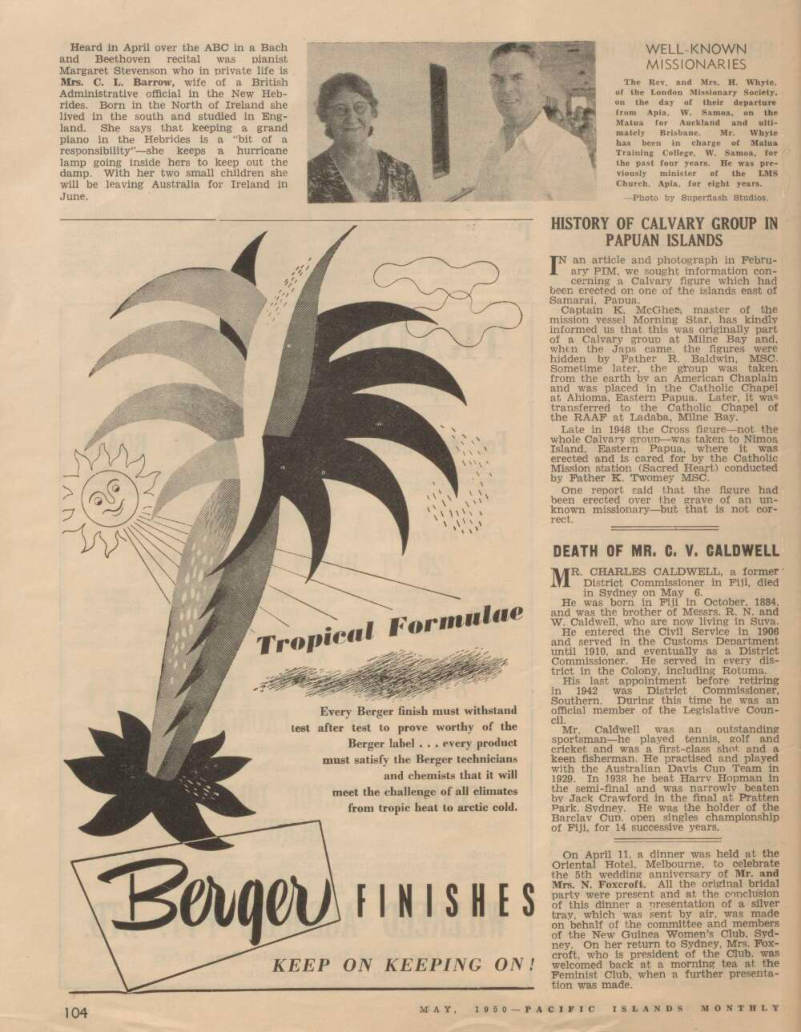
Well-Known
Missionaries
The Rev. and Mrs. H. Whyte, of the London Missionary Society, on the day of their departure from Apia, W. Samoa, on the Matua for Auckland and ulti mately Brisbane. Mr. Whyte has been in charge of Malua Training College, W. Samoa, for the past four years. He was pre viously minister of the LMS Church, Apia, for eight years. —Photo by Superflash Studios.