Magazine Section
pp. 55-56 · Read in the full issue
Territories Talk-Talk
By "Tolala"
HMAS TARANGAU certainly sounds
better than the original name chosen for the Manus base (Seeadler). ' B” in Tropicalities (PIM April) gives Tarangau a Papuan origin. This may be so, but to me it seems to perpetuate the good old name of ANGAU, with a “Jack Tar" prefix. It is a happy thought, any way.
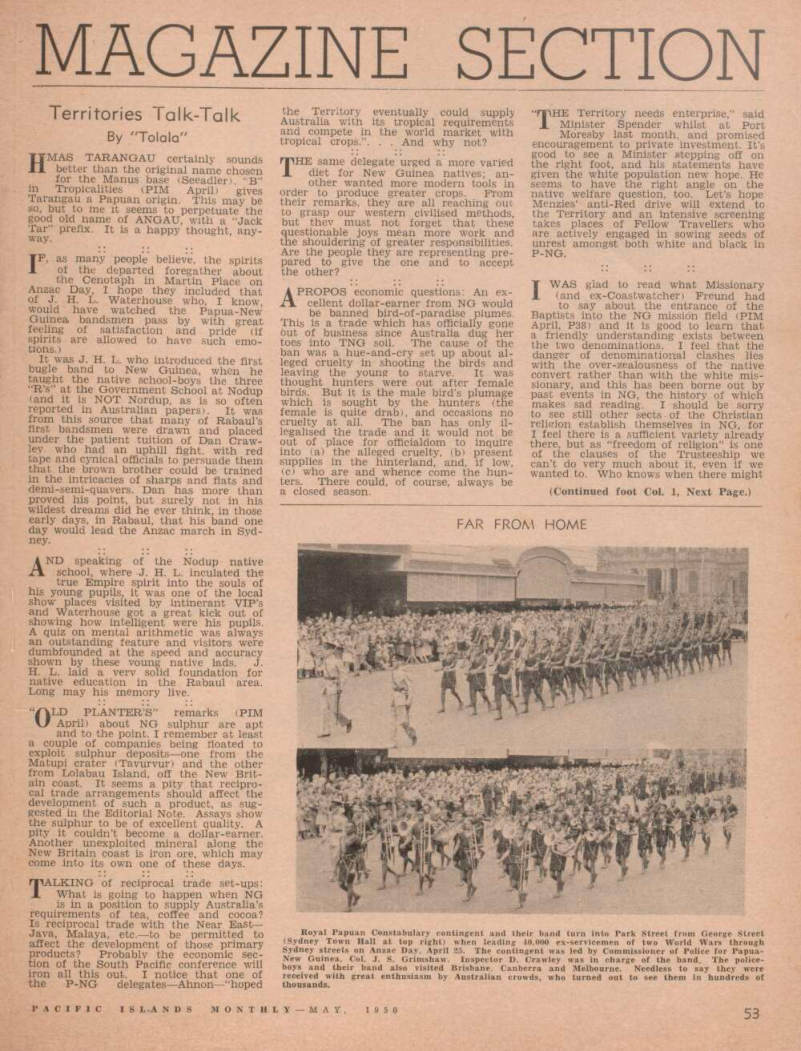
IF, as many people believe, the spirits of the departed foregather about the Cenotaph in Martin Place on Anzac Day, I hope they included that of J. H. L. Waterhouse who, I know would have watched the Papua-New Guinea bandsmen pass by with great feeling of satisfaction and pride (if spirits are allowed to have such emo tions.) It was J. H. L. who introduced the first bugle band to New Guinea, when he taught the native school-boys the three “R’s” at the Government School at Nodup (and it is NOT Nordup, as is so often reported in Australian papers). It was from this source that many of Rabaul’s first bandsmen were drawn and placed under the patient tuition of Dan Craw ley. who had an uphill fight, with red tape and cynical officials to persuade them that the brown brother could be trained in the intricacies of sharps and fiats and demi-semi-quavers. Dan has more than proved his point, but surely not in his wildest dreams did he ever think, in those early days, in Rabaul, that his band one day would lead the Anzac march in Syd ney.
AND speaking of the Nodup native school, where J. H. L. inculated the true Empire spirit into the souls of his young pupils, it was one of the local show places visited by intinerant VlP’s and Waterhouse got a great kick out of showing how intelligent were his pupils.
A quiz on mental arithmetic was always an outstanding feature and visitors were dumbfounded at the speed and accuracy shown by these voung native lads. J.
H. L. laid a verv solid foundation for native education in the Rabaul area.
Long may his memory live.
“/"|LD PLANTER’S” remarks (PIM w April) about NG sulphur are apt and to the point. I remember at least a couple of companies being floated to exploit sulphur deposits—one from the Matupi crater (Tavurvur) and the other from Lolabau Island, off the New Brit ain coast. It seems a pity that recipro cal trade arrangements should affect the development of such a product, as sug gested in the Editorial Note. Assays show the sulphur to be of excellent quality. A pity it couldn’t become a dollar-earner.
Another unexploited mineral along the New Britain coast is iron ore, which may come into its own one of these days.
TALKING of reciprocal trade set-ups: What is going to happen when NG is in a position to supply Australia’s requirements of tea, coffee and cocoa?
Is reciprocal trade with the Near EasL- Java, Malaya, etc. —to be permitted to affect the development of those primary products? Probably the economic sec tion of the South Pacific conference will iron all this out. I notice that one of the P-NG delegates—Ahnon—“hoped
the Territory eventually could supply Australia with its tropical requirements and compete in the world market with tropical crops. . . . And why not? ■ HE same delegate urged a more varied diet for New Guinea natives; another wanted more modern tools in order to produce greater crops. From their remarks, they are all reaching ouc to grasp our western civilised methods, but thev must noti forget that these questionable joys mean more work and the shouldering of greater responsibilities.
Are the people they are representing prepared to give the one and to accept the other? :: v .
PROPOS economic questions: An excellent dollar-earner from NG would be banned bird-of-paradise plumes, This is a trade which has officially gone but of business since Australia dug her toes into TNG soil. The cause of the ban was a hue-and-cry set up about alleged cruelty in shooting the birds and leaving the young to starve. It was thought hunters were out after female birds. But it is the male bird’s plumage which is sought by the hunters (the female is quite drab), and occasions no cruelty at all. The ban has only illegalised the trade and it would not be out of place for officialdom to inquire into (a) the alleged cruelty, (b) present supplies in the hinterland, and, if low, (c) who are and whence come the hunters. There could, of course, always be a closed season.
“mHE Territory needs enterprise,’’ said X Minister Spender whilst at Port Moresby last month, and promised encouragement to private investment. It’s good to see a Minister stepping off on the right foot, and his statements have given the white population new hope. He seems to have the right angle on the native welfare question, too. Let’s hope Menzies’ anti-Red drive will extend to the Territory and an intensive screening takes places of Fellow Travellers who are actively engaged in sowing seeds of unrest amongst both white and black in
P-Ng.
T WAS glad to read what Missionary X (and ex-Coastwatcher) Freund had to say about the entrance of the Baptists into the NG mission field (PIM April, P3B) and it is good to learn that a friendly understanding exists between the two denominations. I feel that the danger of denominational clashes lies with the over-zealousness of the native convert rather than with the white mis sionary, and this has been borne out by past events in NG, the history of which makes sad reading. I should be sorry to see still other sects of the Christian religion establish themselves in NG, for i feel there is a sufficient variety already there, but as “freedom of religion” is one of the clauses of the Trusteeship we can’t do very much about it, even if we wanted to. Who knows when there might
(Continued foot Col. 1, Next Page.)
not be an influx of Moslem, Buddhist or Shinto missionaries bent on propagating each his own particular creed?
With that old-time sentimental poetess, Ella Wheeler Wilcox, I agree So many gods, and so many creeds, And so many paths that wind q,nd wind, While just the art of being kind Is all this sad world needs.
SEEMS a pity NG’s delegates to the SPC at Suva could not have been dinkum New Guineaites. with the true native outlook. Ahnon is a half caste Chinese and Kassi’s mother was a Caroline Islander. The latter’s as sociations have for years been non native. As a records clerk in Administra tion he is “tops,” but that does not necessarily qualifv him to sneak for the native peoples. Perhaps the selection shows how backward these people are in not having appointed a full-blooded native to this all-important gathering.