Sidelights on the South Pacific Conference
pp. 12-104 · Read in the full issue
From R. W. Robson.
Suva, May 2.
SAT below the dais of that most ex- H. cellent chairman, Sir Brian Preeston, Governor of Fiji, and looked out over the hundred or more delegates to the -gouth Pacific Conference and, like most other observers, I wondered whether this was anything more than a glorious waste of time and paper.
What I saw was like the United Nations in miniature. Rows of desks arranged in a half-circle, facing the chairman; the names of countries painted on signs above each desk; microphones placed carefully before each speaker; interpreters hovering attentively beside the delegations from the French and Dutch Territories; and the delegations, meticulously laundered and starched and barbered, sitting stiffly in their allotted places, and upon their faces —which ranged in colour from off uhite to deepest black —an expression of earnestness and anxiety.
In a building right alongside this big central hall ol the Nasinu Teachers Training College the real work of the Conference was being done. As a back ground to the sober, high-pitched voices of the selected speakers, one could hear the rattle of typewriters and the click of duplicator*".
The super-organisers of the South . Bfpifitf Commission had assembled a team ' oi expert young women from the various public services and they, assisted by an other team—Fijian, Samoan and Tongan Training College students who had been co-opted as clerks and messengers— churned out copies of everything that was spoken before the Conference. It was organisation, plus. Never before did re porters have an easier job.
It was like a well-produced play. All dressing had been taken care of. There was not a word, or a button, out of place.
There were no interjections. There was no spontaneity.
IN his opening speech, Sir Brian Free ston called it the Parliament of the South Pacific. A Parliament is an assemblage of the freely-chosen repre sentatives of the people. Few, if any, of these representatives had been elected; practically every one was the nominee of his particular government carefully hand-picked, groomed, and prepared for this Conference. In a large proportion of cases, the speeches read by delegates (from type-written paper of foolscap size) were the obvious products of depart mental offices.
Behind each delegation sat the “ad visers” quiet, self-effacing, efficient European officials, for the most part, who saw that each delegate conformed to the general plan. Politics were most sternly; forbidden. All the courtesies and formali- 1 ties of a Western Parliament were rigidly observed.
But it was not a Parliament. It was a beautiful and impressive play, shaped like a Parliament. It cost a lot of money.
Australia paid 30 or 35 ner cent, of it, the other five nations about 15 per cent, each. Fiji, as the host Government, shouldered much expense.
Out of each discussion (see formal re port elsewhere in this issue) on each paper there came a series of resolutions, for submission to the South Pacific Com mission. All the paoers, and all the dis cussions, and all the resolutions, could easily have been prepared for the Com mission by the officials of the 16 Terri tories, in postal communication, without all the work and worry and expense en tailed in this Conference.
Observing all these things, most of the VlP’s and pressmen present were at first inclined to write off the first South Pacific Conference as a solemn farce, of little practical value.
BUT, as the days passed, other con siderations came into the picture; observers took a longer view; and the general conclusion was that the Con ference, while in some respects a little ridiculous, was eminently worth-while, and an essential part of the plan behind the South Pacific Commission. Here are the answers to the destructive criticism which I have noted above:
• At the present stages of administra tive development in tne various Terri tories, it was not possible to choose representatives by popular vote. So, as far as possible, the Administrations selected what seemed to be representa tive natives. As it was essential that such men be educated to a standard to allow them to take part in a general con ference, the choice was limited, especially in the Melanesian Territories.
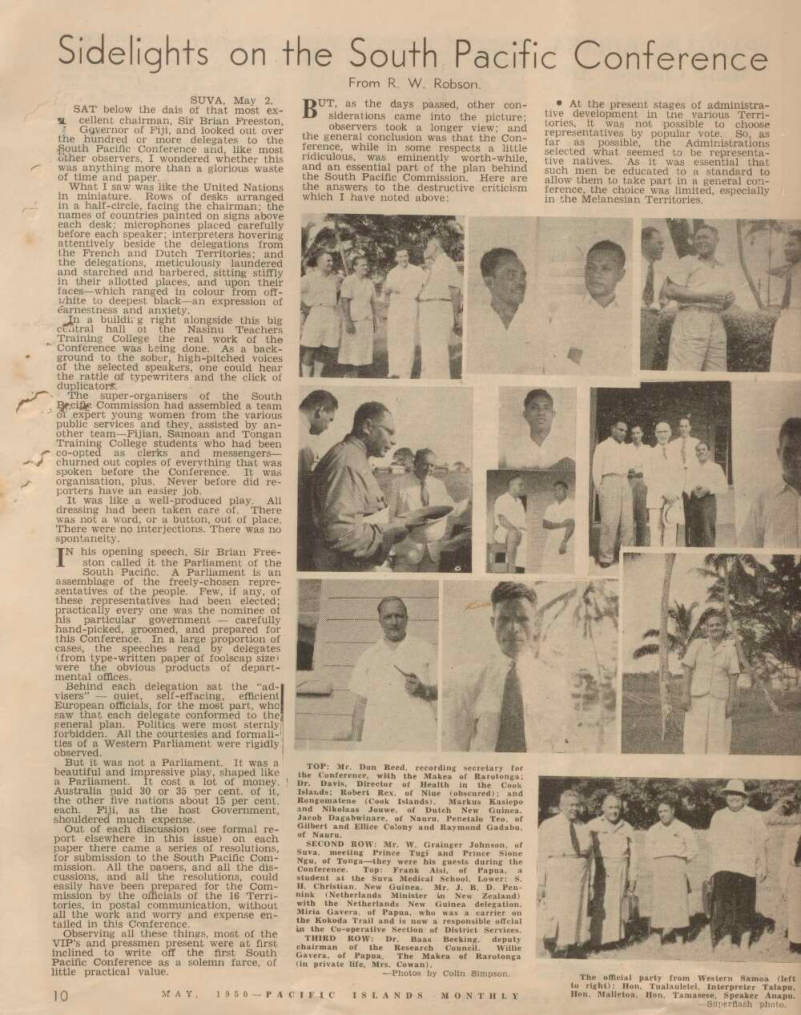
TOP: Mr. Don Reed, recording secretary for the Conference, with the Makea of Rarotonga; Dr. Davis, Director of Health in the Cook Islands; Robert Rex. of Niue (obscured); and Rongomatene (Cook Islands). Markus Kasiepo and Nikolaas Jouwe, of Dutch New Guinea.
Jacob Dagabwinare, of Nauru, Penetalo Teo. of Gilbert and Ellice Colony and Raymond Gadabu. of Nauru.
SECOND ROW: Mr. W. Grainger Johnson, of Suva, meeting Prince Tugi and Prince Sione Ngu, of Tonga—they were his guests during the Conference. Top: Frank Aisi, of Papua, a student at the Suva Medical School. Lower: S.
H. Christian, New Guinea. Mr. J. B. D. Pen nink (Netherlands Minister in New Zealand) with the Netherlands New Guinea delegation.
Miria Gavera, of Papua, who was a carrier on the Kokoda Trail and is now a responsible offcial in the Co-operative Section of District Services.
THIRD ROW: Dr. Baas Becking, deputy chairman of the Research Council. Willie Gavera, of Papua. The Makea of Rarotonga (in private life, Mrs. Cowan). —Photos by Colin Simpson.
The official party from Western Samoa (left to right): Hon. Tualaulelei, Interpreter Talapu, Hon, Malietoa, Hon. Tamasese, Speaker Anapu. —Superflash photo.
• As it was not expected that anything much of practical value would come out of this first Conference, while it was hoped that these Conferences, in time, would become more representative and more useful, it was regarded as of first importance that the Conference should be given the right shape and structure, as a future guide. Great care was taken in this respect. • The real value of this first Confer ence lies in what has happened outside the Conference room, where the men from 16 different Territories are living together in the comfortable quarters provided at the Training College.
It is that latter consideration, above all, which makes this Conference worth while. For the first time in history, Polynesians, Melanesians and Micro nesians are living happily together in one group, getting to know each other on a friendly basis, and seeking a common out look on the serious problems which con front the Pacific Islands as a whole.
On other occasions in the past, when these people have made contact, it usually meant a fight. This time, under the tute lage of the Europeans, and in the growing enlightenment of Western education, they meet as friends, eager to confer on matters of common interest, to engage in social experiments and—this most de sirable of all—to laugh together*, with and at each other.
KNOWING the high plans of the South Pacific Commission, and sitting and looking out over this carefully-staged Conference, one is appalled at the diffi culties which confront the planners.
They may bring these scattered races into closer contact, may imbue a few in structed men with a desire for better food, better health and greater cleanli ness in the village (these are the simple things, in order of importance, which en gross the native mind) —but how are they going to carry on the plan unless they have native races sufficiently educated to understand what they are talking about, and a common language in which to in struct them?
In Polynesia and Micronesia, there are about as many languages as there are Territories. In Melanesia, where is found the overwhelming bulk of the South Pacific population—and almost complete illiteracy—there are hundreds of languages.
Thinking along these lines, one wonders whether this all-South Pacific Conference isn't a little premature. The Commission could do a great deal, fairly soon, with a Polynesian or a Polynesian-Micro nesian Conference; but can the natives of Melanesia contribute anything of prac tical value while these enormous prob lems of education and language remain unsolved?
However, the Commission has put its plough into the earth, and started off with its hands on the controls. We can only wish it luck with the great experi ment.
POLITICS have been strictly tabu. But we cannot forget international affairs.
Communism is sweeping across Asia.
Under the direction of the blundering United Nations, the East Indies have been taken from the Dutch and given to the ill-conceived and immature “Republic of Indonesia.” It seems certain that Indo nesia soon will come under Communist influence. Then, the East Indies becomes a natural bridge between one thousand million people in overcrowded Asia, and the fertile, pleasant lands of the South Pacific, where there are only a few scattered millions. The Dutch were our natural protectors; the Indonesians are not.
In the circumstances, it is just as well that, per medium of the SP Conference,
or any other medium available, the Western nations should guide and direct the Pacific Islanders. Perhaps, in view of events in Asia and Indonesia, we may regard the SP Conference as an insur ance.
THE more one sees of this Conference, the more one senses the difference between Islands peoples. Most of the Polynesians are big men; all are sophisticated, dignified, carrying them selves with the easy assurance that comes with pride of race. In this respect, the Fijians, although formally classed as Melanesians, must go in with the Poly nesian-Micronesian group.
The Melanesians, on the other hand, are ail small men, and even those who are well-educated and accustomed to European contacts, seem shy and bashful.
Some observers point out that the dele gates who are most at their ease in this gathering are those from races who for the longest time, have had a share in Government; whereas the apparently un comfortable ones are from Territories where European administration still is complete and absolute.
THE outstanding figure of the Confer 'ence is Tugi, Crown Prince and Premier of Tonga—a very big man of attractive personality, and charming man ners. He speaks perfect, cultured Eng lish—he was educated at Sydney Univer sity—and his contributions to the debates have been notable, obviously based on wide reading and the analysis of a keen, well-balanced mind. As the future ruler of the world’s only independent Poly nesian kingdom, he is entitled to official and social leadership; but he takes and confirms his leadership on his own per sonal quality—he is easily the most able man among the delegates. His brother, Prince John—now Governor of Vavau— is also a big, striking man, but, as he leaves the leadership to Tugi, he is not so prominent.
Other notable figures are Polynesian delegates—High Chiefs Tamasese and Malietoa, from Western Samoa, the at tractive and well-dressed Makea of Raro tonga, Mrs. Cowan, and the well-known Fijian, Ratu Edward Thakombau. At the Conference, and at Suva’s many social functions, these Islanders of noble line age impress everyone by their dignified bearing, their good looks and the culture and charm of their English conversation.
BUT that does not mean that the other delegates are completely over shadowed. In the first day or two, the general shyness and reluctance to speak were almost painful—only the skill and sympathy with which Sir Brian Freeston controlled the Conference pre vented some embarrassing situations—but after that they faced the microphone with confidence. The men from the French Colonies, a handsome, obviously Hurst-trained lad from Nauru, the Gilbert and Ellice Islanders—all spoke their al lotted pieces with dignity and impressive ness.
The two apparently well-educated Papuans from Dutch New Guinea made a good impression. As their country is under imminent threat by Indonesia, and as the more easterly delegates were keenly interested in these brothers from the west, there was a strong temptation upon the Conference to “talk politics”; but the Dutch New Guinea men were under a double obstacle —the stern official ban on politics, and their inability to speak English.
The Papua and New Guinea men brought to the Conference by Health Director Dr. J. Gunther and Education Director W. C. Groves acquitted them selves well. They were interesting, as a demonstration of how these natives can be trained; but, of course, they could
(Continued on page 105)
hardly be regarded as the representatives of the million or million and a quarter natives in the Australian Territories.
ONCE the opening ceremony was over, the Conference followed a simple system. Each morning a paper, carefully prepared beforehand, was read by one of the delegation. After that, there was a discussion upon it.
It was not a spontaneous discussion.
Delegates brought a prepared commen tary, of strictly limited wordage, and read this through a microphone.
When all such commentaries had been read, a small committee was set up to draft, for submission to the Commission, a set of resolutions arising out of the paper and the discussion. The resolutions were submitted in the afternoon, and usually provoked some little discussion, of a most orderly character. This would be over by 3.30 or so, and then the dele gates were free to be amused, or amuse themselves, until next morning.
Various entertaining or instructive functions were arranged—a visit to Bau and another to Makogai, for example; and the delegates seemed to enjoy themselves very thoroughly for the fortnight, at the ultimate expense of the ratepayers of six nations.
THE more prominent people of the Polynesian delegations did not take quarters at Nasinu. High Chief Tamasese, of Samoa, the Makea Ariki, of Rarotonga, and several of the French delegations, stayed at the Grand Pacific Hotel; the two Tongan princes are the guests of Mr. W. Grainger Johnson, managing director of W. R. Carpenter (Fiji) Ltd.; and High Chief Malietoa, of Samoa, is residing with a friend.
The Tongans and Samoans wear their national dress, but all the other delegates are in European clothes.
THE delegates have been provided with really excellent accommodation at the Teachers’ Training College at Nasinu, about five miles out of Suva.
Several scores of selected young men of the Fiji and adjoining Territories are be ing trained here as school teachers—the Suva Central Medical School system ap plied to education.
A large proportion of the students have gone home; but about 60 byight lads have remained, voluntarily, to act as cooks, messengers, batmen and bottle-washers to the delegates. Everyone seems comfor tab’e, and a spirit of goodwill is be coming more manifest every day.
Officials of the South Pacific Commission are keeping a close eye on all activities in and out of the Conference room.
Everyone praises the achievements of the Secretary-General, Mr. W. D. Forsyth, and his staff. His organising work, which he directs from a hurriedly prepared office behind the Conference hall, is superb.
Members of the Research Council, and various official observers, have their places here, and there is an atmosphere of pleasant co-operation.
Hardest-working team is the American group of officials and observers, led by Dr. Felix Keesing, Australian-born American anthropologist. It is generally recognised that, although the Americans have the smallest land area in the South Pacific in their care, their contribution to this South Pacific Commission, in energy, enthusiasm and personnel, is probably the biggest and most important.
One meets Americans everywhere in these South Pacific groups to-day—an interesting commentary on post-war developments. Generally, there are close co-operation and good feeling between Americans and British.
THROUGH extraordinary bad luck, the Trans Oceanic flying-boat, which was to carry the Solomon Islands and New Hebrides delegates to Noumea,
o? k° Suva for the opening on April had an engine break-down in Honiara, an rS,T • delegates could not get away.
The. inclination, at first, was to cancel the trip; but the Commission finally de-
cided to incur some trouble and expense and bring them over, and they arrived to fill the empty places in the Conference Room on April 30.
It was a wise decision. Rightly or
Wrongly, the failure of the Western Pacific High Commission to send Solomon Islands natives to the Victory March, in London, in 1946, is still regarded with resentment by the gentlemen behind the Marching- Rule movement, and is deplored by many Europeans. A failure to send BSI men to the Suva Conference would have rubbed salt into the open wound.
Although the BSI natives are noted for their intelligence—they are given a higher rating in this respect than the average Fijian—it is not likelv that they will con tribute any more to the Conference than the rest of the Melanesians.
TSLANDERS are laughter-loving people' 1 but the awfulness of thp r’onfprpnrp X set-up cJSatedamon- them infhe beginning, a solemnity that could be felt.
The influence that eventually broke it down was a Hish Chief Tufele from American P SaSoa g ’ Uf6 ’
They were discussing mosquito control.
Everyone agreed that the communities should be forced to set aside certain days, each month, for the attack upon mos quitoes. The only question was, how many days. Various delegations suggested various times. Fiji thought one day each month would be ample.
American Samoa could not agree. Some islands were worse than others. In the case of Fiji, he thought there should be more frequent attacks on mosquitoes.
Fiji delegates bristled. One could see their minds working; “All through the centuries, we had to fight these damned Samoans—looks as if we'll have to fight ’em again.”
The chairman looked grave. Inter
national complications!
“Yes,” continued High Chief Tufele, in his broad American accent. “Judging by the amount of sleep each night since I’ve been here, I am in favour of making the Fijians work three days a week, destroy ing their mosquitoes.”
The hatchet was buried in the first chorus of laughter the Conference had heard.
SOME time later, the chairman put an end to seme little argument that had developed by quoting the rules of the Conference.
The leg-puller from Eastern Samoa arose portentously. He did not think the chairman was properly interpreting the .rules. He doubted whether there was any rule really covering the situation.
The chairman’s brow was furrowed with care. The delegates stirred eagerly.
Thank God for a fight!
American Samoa lifted his voice. “Show me the Conference rule which allows us to smoke,” he demanded. “Yet we’re all smoking.”
Conference relaxed. The chairman grinned. “Nothing in the rules allows us to smoke,’’ he said. “Nothing in the rules allows us to breathe.”
Conference signified approval of the kind of logic that appeals to the Poly nesian mind.
THE funniest incident occurred outside the Conference. That most serious man, Dr. Baas Becking, deputy chairman of the Research Council, had spoken to delegates about the need for better health in the average Island village. ‘‘What we need,” he said, “is a lower village mortality and a higher birth-rate.”
But the gremlins which attend all news paper composition saw to it that when the Fiji Times reported this statement, the “t” was left out of mortality.
That evening, in the GPH, a band of solemn scientists led Dr. Baas Becking aside, and presented the newspaper, and tut-tutted softly as he read the amazing statement. At first, he stared unbeliev ingly; then he choked—and then he joined in the laughter.
“I’ll stand by it,” he said. “Damn it, yes, I’ll stand by it!”
Which proves that, contrary to popular belief, scientists engaged in Pacific re search can be quite human, at times