Those Old Sonoma Days
pp. 60-61 · Read in the full issue
It All Has Changed Since Those Old Sonoma Days
So OSCAR NORDMAN, of Tahiti, tells R. W. ROBSON
THE afternoon shadows were lengthen ing in Victoria Parade, Suva, one day last month (March), when a square built man strolled along from the port district, and sat himself down in the shade of the flamboyant tree —a favourite spot near the fire-brigade station, on the edge of the lagoon.
He sat here for some time, enjoying the cool air from the reef, and looking across the road at the busy life of Suva’s main business street. His mind went back over the memories of 30 years ago, and he laughed; and this is what he wrote that evening to his wife in Tahiti:— “Away back before World War I, when the Sonoma was in Suva, I used to go and sit in that same place, beside the lagoon. I was young and handsome then, and I had a nice uniform, and my beam measurement was not anything like what
it is now. In those days, I had only to sit there by myself for a few minutes, and some of those pretty Suva girls would come along and talk to me. There was always something to do. Do you remem ber?
“To-day, I sat there for an hour, and not a soul spoke to me. How I wished I were back in Papeete, with you!”
On Tuesday, March 21, Oscar Nordman arrived in Sydney, making his 34th entry into the famous port. It was 25 years since he made his 33rd entry, and he was eager to compare the Sydney of his Oceanic Steamship Company days, when
he was a gay and care free young purser, with the overcrowded, bustling metropolis of to-day.
He did not like what he found. He thought, for example, that he could book straight into a hotel.
He slept in four different beds on four different nights, before he could find a place to accommodate him for a week He departed, wi f h outspoken relief, at the end of ten days. His most vivid memories centre around the rushing, dis courteous people who walked upon his feet.
It was when he tried to describe the Sydney he knew that the little incident of the Suva flamboyant-tree came out The stories he told me of the Sydney-San Francisco sea-lanes of 40 years ago—and his comparisons between the leisurely happy travellers of those days, and the grim-faced little parties who now rush across the Pacific Ocean at 200 and 300 m.p.h.—did suggest that in achieving the Air Age we have sacrificed something of a rather delightful character in Trans pacific voyaging.
In so many words, Oscar was not kindly disposed towards air-travel. In his view, it had contributed to the ruin of a once lovely world. But his Nemesis overtook him.
To catch his ship and get back to his beloved Tahiti in reasonable time, Oscar had to travel from Sydney to Vila by air.
I saw him off at the air-port. I still laugh as I recall Oscar’s expression when he was introduced to this—to him—new form of transportation. But I know Oscar, and I know what will happen.
Sooner or later, our alert Papeete ship chandler will be a leading agent in the sale of air-travel.
I agree with Oscar, however, that the Trans-Pacific steamship lines of the era before World War I had a colour, gaiety and romance that can never be recaptured by these super-efficient air-lines.
I urged Mr. Nordman to write, for the PIM, something about his feelings as he returned to Sydney after so many years.
He sent us the following article:— MY long-cherished dream was realised (wrote Oscar Nordman). I was back again in Sydney, after an absence of half a lifetime. And I arrived almost exactly 37 years, to the day, after we sailed out through Sydney heads into a very famous storm.
We sailed on the old Sonoma at 4 pjm. on March 13, 1913, and, before we got to the Heads, we were meeting heavy rollers and shipping green seas. I saw an Orient and a P and O liner returning, and I thought we might anchor. But Captain Trask said, “The mails must go through”; and we went out into the teeth of it.
I never knew worse seas —again and again I thought we were gone. Our aerial was carried away, and Sydney radio lost contact with us. Then a man stationed at Sydney Heads reported that he had seen the Sonoma turn turtle, as she met the full force of the storm.
The Sydney papers, next morning, pub-
lished alarming reports about the Sonoma, and there was much anxiety.
But, by 2 a.m., we had run into quieter water; when daylight came, we repaired our aerial; and the Sydney afternoon papers reported that the Sonoma was safe and referred to “Trask, the nervy Yankee skipper.”
The Sonoma landed her mails, at the due hour and date, in San Francisco.
WHEN I went ashore in that place, in Sydney, exactly 37 years afterwards, the first person I saw was Editor Robson, of the Pacific Islands Monthly.
Next, I renewed acquaintance with the Brazilian Consul, Dr. Carlos Zalapa, who, over an excellent lunch, asked after his many Tahiti friends.
I wanted to see Joseph Birchall, one of the Pursers who was with me on the old Sonoma, and I finally located him at 18 Apsley Avenue, Kingsford. I wouldn’t have missed it. His house was adorned with the name of a ship on which he and I served, the old Alameda. We had not seen each other for 34 years. It was a happy meeting and we exchanged some lively memories. I learned that one of the old Pursers who still is on the lists of the living is Dannie T. Mehigan, re tired and living at 711 Walla Vista Avenue, Oakland, California. Joseph Birchall, Dannie T, Mehigan, Captain E.
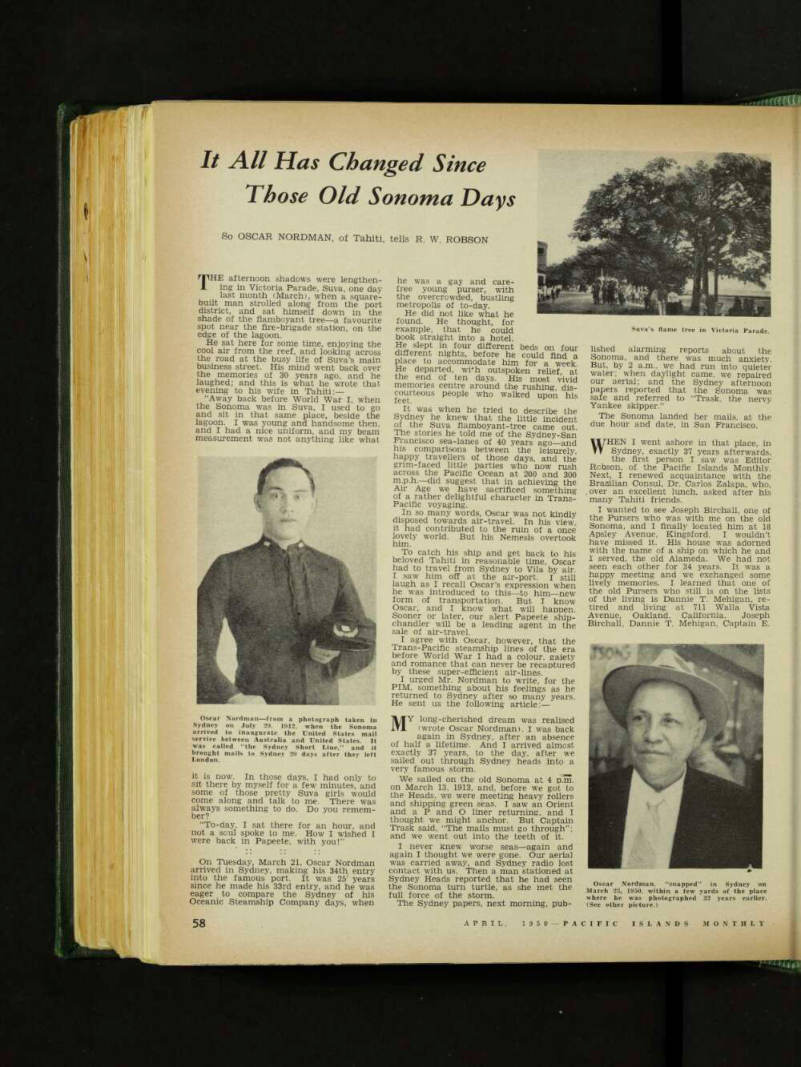
Oscar Nordman —from a photograph taken in Sydney on July 29. 1912. when the Sonoma arrived to inaugurate the United States mail service between Australia and United States. It was called “the Sydney Short Line,” and it brought mails to Sydney 29 days after they left London.
Suva’s flame tree in Victoria Parade.
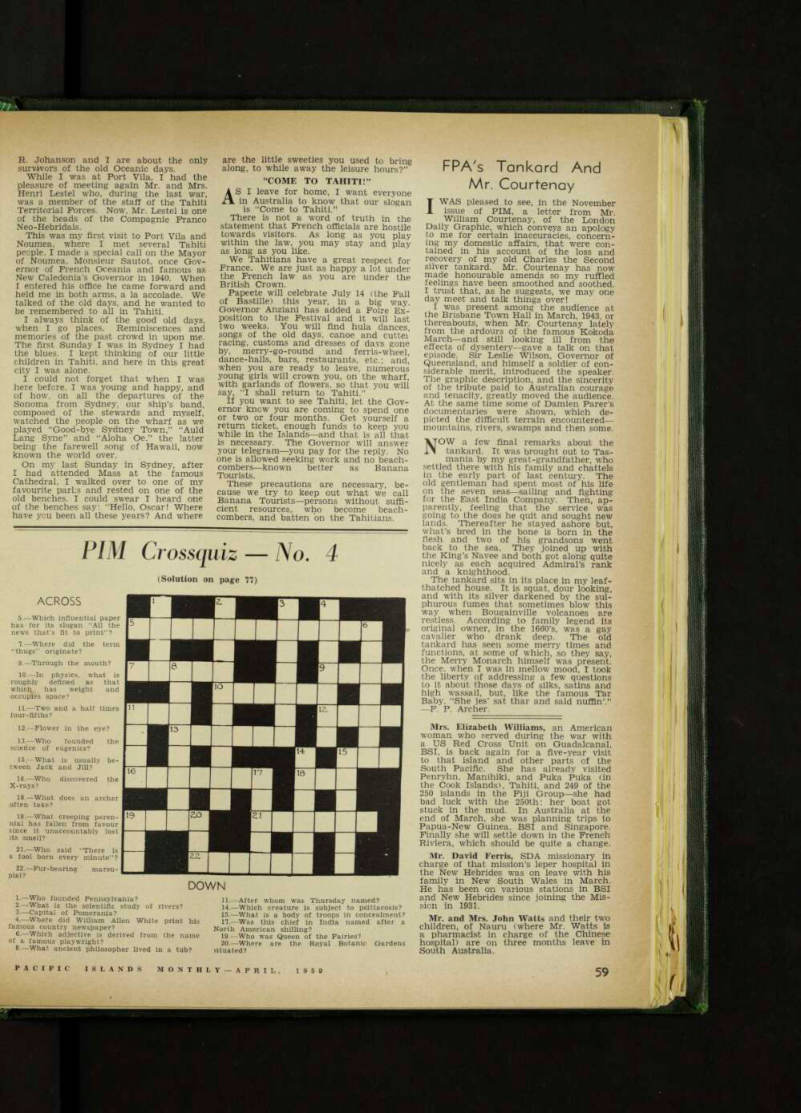
Oscar Nordman, “snapped” in Sydney on March 23, 1950, within a few yards of the place where he was photographed 32 years earlier. (See other picture.)
R. Johanson and I are about the only survivors of the old Oceanic days.
While I was at Port Vila, I had the pleasure of meeting again Mr. and Mrs.
Henri Lestel who, during the last war, was a member of the staff of the Tahiti Territorial Forces. Now, Mr. Lestel is one of the heads of the Compagnie Franco Neo-Hebridais.
This was my first visit to Port Vila and Noumea, where I met several Tahiti people. I made a special call on the Mayor of Noumea, Monsieur Sautot, once Gov ernor of French Oceania and famous as New Caledonia’s Governor in 1940. When I entered his office he came forward and held me in both arms, a la accolade. We talked of the old days, and he wanted to be remembered to all in Tahiti.
I always think of the good old days, when I go places. Reminiscences and memories of the past crowd in upon me.
The first Sunday I was in Sydney I had the blues. I kept thinking of our little children in Tahiti, and here in this great city I was alone.
I could not forget that when I was here before, I was young and happy, and of how, on all the departures of the Sonoma from Sydney, our ship’s band, composed of the stewards and myself, watched the people on the wharf as we played “Good-bye Sydney Town,” “Auld Lang Syne” and “Aloha Oe,” the latter being the farewell song of Hawaii, now known the world over.
On my last Sunday in Sydney, after I had attended Mass at the famous Cathedral, I walked over to one of my favourite parks and rested on one of the old benches. I could swear I heard one of the benches say: “Hello, Oscar! Where have you been all these years? And where
are the little sweeties you used to bring along, to while away the leisure hours?”
“Come To Tahiti!”
AS I leave for home, I want everyone in Australia to know that our slogan is “Come to Tahiti.”
There is not a word of truth in the statement that French officials are hostile towards visitors. As long as you play within the law, you may stay and play as long as you like.
We Tahitians have a great respect for France. We are just as happy a lot under the French law as you are under the British Crown.
Papeete will celebrate July 14 (the Pall of Bastille) this year, in a big way.
Governor Anziani has added a Foire Ex position to the Festival and it will last two weeks. You will find hula dances, songs of the old days, canoe and cuttei racing, customs and dresses of days gone by, merry-go-round and ferris-wheel, dance-halls, bars, restaurants, etc.; and, when you are ready to leave, numerous young girls will crown you, on the wharf, with garlands of flowers, so that you will say, “I shall return to Tahiti.”
If you want to see Tahiti, let the Gov ernor know you are coming to spend one or two or four months. Get yourself a return ticket, enough funds to keep you while in the Islands—and that is all that is necessary. The Governor will answer your telegram—you pay for the reply. No one is allowed seeking work and no beach combers—known better as Banana Tourists.
These precautions are necessary, be cause we try to keep out what we call Banana Tourists —persons without suffi cient resources, who become beach combers, and batten bn the Tahitians.