Tropicalities
p. 59 · Read in the full issue
THESE “Fijians” with the strange sounding names!
Right now in Sydney is a young gent —down here to study optometry at the Sydney Technical College—-with the fas cinating name of Asad Asgar, passing himself off as a Fijian. I say “passing himself off as a Fijian” with some con viction, although I have not seen Asad — if any self-respecting Fijian gave that Indian name to his son, then I’m willing to believe I’m an Eskimo. Our friend from Fiji arrived at a week-end when things are dull in the news world. He cnerefore got a very good press as the first “Fijian” to study optometry. More over, in the following week, the ABC which is usually more knowledgable, in troduced him into its News Review session —still as a Fijian. Facing up to the microphone, Asad Asgar went off like a gusher, talking at a speed unlike any English-speaking Fijian I have met. He said all the usual things—that he was the son of peasant farmers; that his people were so very poor, couldn’t afford glasses, and that when qualified he was going back to Fiji to improve their hard lot, etc., etc. He carefully did not say that he was a Fijian; but neither did he say that he was an Indian. With that flow of speech it should have been easy to convince even an Australian news paper reporter.
Since the war, Fijians have been in censed on numerous occasions by per ambulating Indians who have allowed themselves, for reasons of their own, to be known abroad as Fijians. These are the people, let it be said, who in Fiji would renounce the Empire for Mother India. It doesn’t make sense.
Australasians, it seems, have progressed somewhat from the days of Captain Ccok when everyone with a brown skin was called an Indian, and gone so far into reverse as to call everyone so-coloured a Fijian. Nothing can be done about it then, in Australia or NZ. But plenty can be done about it in Fiji. Asad Asgar, or whatever his name is, has a permit to stay in Australia for a year—so boys, with any luck in just one year from now Asad should be sailing right back to Fiji!—J. ♦ ♦ * MAYBE the Australian Minister for the Navy does not read Tolala’s Talk Talk, but I was interested to see that he had fallen in with a suggestion made in that column (Feb. PIM) and changed the Teutonic name for the RAN base cn Manus to one of Papuan origin.
HMAS Seeadler now becomes HMAS Tarangau—and according to the minis ter both names mean the same thing— a sea eagle.
The original HMAS Tarangau was the RAN station at Finschhafen which has now been closed down. —B. * . * ♦ THE Malayan rubber shoe industry has started a big drive to export more sports shoes to the UK market.
Malaya, since the war ended, has de veloped this industry until they are pro ducing an average of a million pairs of various types per month. In the last sum mer thousands of pairs of Malayan rubber sandals were bought in Australia at prices ranging from 5 - to 10 - Australian cur rency. They are the cheapest sports shoe on the Australian market and, as such, were a tremendous success.
They should be popular in the Pacific Islands where the cheap sandals of pre
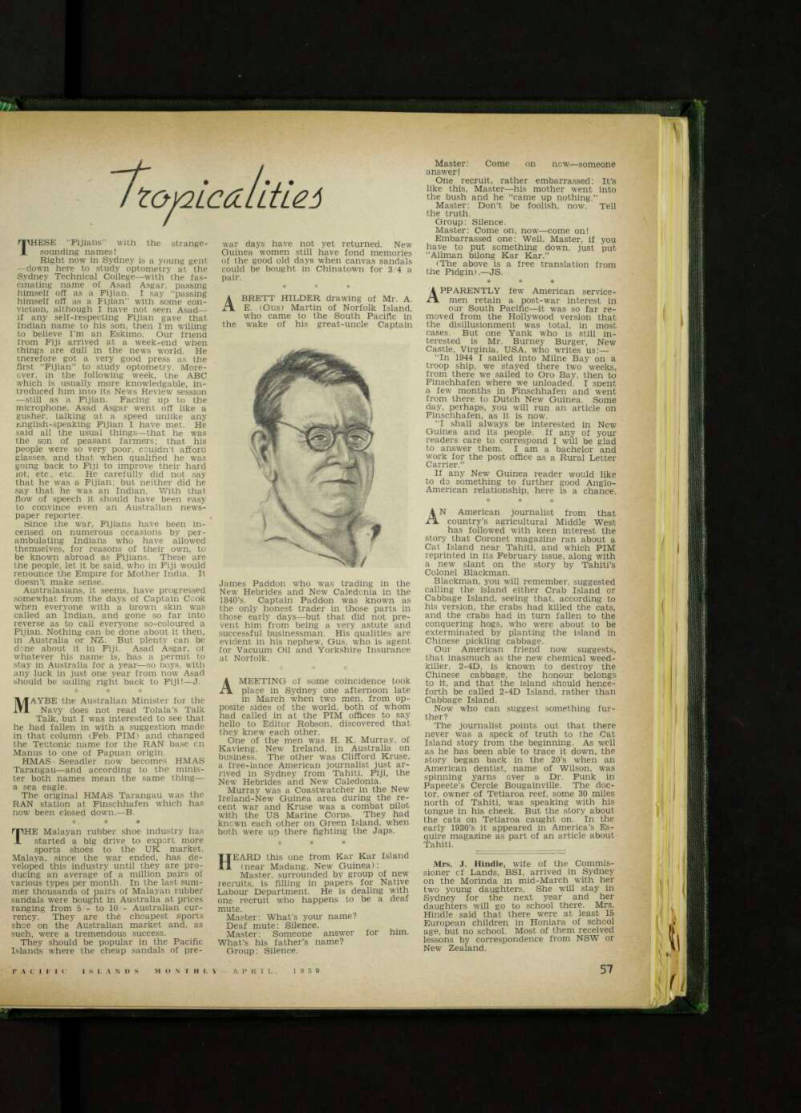
war days have not yet returned. New Guinea women still have fond memories of the good old days when canvas sandals could be bought in Chinatown for 3 4 a pair. * * * A BRETT HILDER drawing of Mr. A.
E. (Gus) Martin of Norfolk Island, who came to the South Pacific in the wake of his great-uncle Captain
James Paddon who was trading in the New Hebrides and New Caledonia in the 1840’s. Captain Paddon was known as the only honest trader in those parts in those early days—but that did not pre vent him from being a very astute and successful businessman. His qualities are evident in his nephew, Gus, who is agent for Vacuum Oil and Yorkshire Insurance at Norfolk. * * A MEETING of some coincidence took place in Sydney one afternoon late in March when two men, from op posite sides of the world, both of whom had called in at the PIM offices to say hello to Editor Robson, discovered that they knew each other.
One of the men was H. K. Murray, of Kavieng, New Ireland, in Australia on business. The other was Clifford Kruse, a free-lance American journalist just ar rived in Sydney from Tahiti, Fiji, the New Hebrides and New Caledonia.
Murray was a Coastwatcher in the New Ireland-New Guinea area during the re cent war and Kruse was a combat pilot with the US Marine Corps. They had known each other on Green Island, when both were up there fighting the Japs. * * * HEARD this one from Kar Kar Island (near Madang, New Guinea): Master, surrounded by group of new recruits, is filling in papers for Native Labour Department. He is dealing with one recruit who happens to be a deaf mute.
Master: What’s your name?
Deaf mute: Silence.
Master; Someone answer for him.
What’s his father’s name?
Group: Silence.
Master: Come on now— someone answer!
One recruit, rather embarrassed: It’s like this, Master—his mother went into the bush and he “came up nothing.”
Master: Don’t be foolish, now. Tell the truth.
Group: Silence.
Master: Come on, now —come on!
Embarrassed one: Well, Master, if you have to put something down, just put “Allman bilong Kar Kar.” (The above is a free translation from the Pidgin).—JS. * * * APPARENTLY few American service men retain a post-war interest in our South Pacific—it was so far re moved from the Hollywood version that the disillusionment was total, in most cases. But one Yank who is still in terested is Mr. Burney Burger, New Castle, Virginia, USA, who writes us;— “In 1944 I sailed into Milne Bay on a troop ship, we stayed there two weeks, from there we sailed to Oro Bay, then to Finschhafen where we unloaded. I spent a few months in Finschhafen and went from there to Dutch New Guinea. Some day, perhaps, you will run an article on Finschhafen, as it is now.
“I shall always be interested in New Guinea and its people. If any of your readers care to correspond I will be glad to answer them. I am a bachelor and work for the post office as a Rural Letter Carrier.”
If any New Guinea reader would like to do something to further good Anglo- American relationship, here is a chance. * * * AN American journalist from that country’s agricultural Middle West has followed with keen interest the story that Coronet magazine ran about a Cat Island near Tahiti, and which PIM reprinted in its February issue, along with a new slant on the story by Tahiti’s Colonel Blackman.
Blackman, you will remember, suggested calling the island either Crab Island or Cabbage Island, seeing that, according to his version, the crabs had killed the cats, and the crabs had in turn fallen to the conquering hogs, who were about to be exterminated by planting the island in Chinese pickling cabbage.
Our American friend now suggests, that inasmuch as the new chemical weed killer, 2-4 D, is known to destroy the Chinese cabbage, the honour belongs to it, and that the island should hence forth be called 2-4 D Island, rather than Cabbage Island.
Now who can suggest something fur ther?
The journalist points out that there never was a speck of truth to the Cat Island story from the beginning. As well as he has been able to trace it down, the story began back in the 20’s when an American dentist, name of Wilson, was spinning yarns over a Dr. Funk in Papeete’s Cercle Bougainville. The doc tor, owner of Tetiaroa reef, some 30 miles north of Tahiti, was speaking with his tongue in his cheek. But the story about the cats on Tetiaroa caught on. In the early 1930’s it appeared in America’s Es quire magazine as part of an article about Tahiti.
Mrs. J. Hindle, wife of the Commis sioner cf Lands, BSI, arrived in Sydney on the Morinda in mid-March with her two young daughters. She will stay in Sydney for the next year and her daughters will go to school there. Mrs.
Hindle said that there were at least 15 European children in Honiara of school age, but no school. Most of them received lessons by correspondence from NSW or New Zealand.