Norfolk
pp. 58-59 · Read in the full issue
Island
Landings
by Brett Hilder
THE present revival of the tourist trade to Norfolk Island relies almost en tirely on the air-services from Syd ney and Auckland. But this has only been possible since the war, during which the airfield was built by the New Zealand forces. In the previous 170 years all visi tors have had to land through the surf and onto the rocky coast, including the only pre-war aviator to call —Francis Chichester in his little float-plane.
Air navigators should have no trouble in locating the isle although it measures only five miles by four, and is 900 miles from Sydney and 400 from the nearest other land. There is a Radio-Range, along whose “Beams” the aircraft can fly; a Radar station, useful for locating planes, and the aircraff’s own Direction- Finder for use in thick weather The main difficulty for aircraft would bje the height of the airstrip above sea level, which makes it more prone to be hidden in low clouds.
The aids to sea-navigation are not so lavishly supplied, but at least the ship can better afford to hang around waiting for the weather to clear. The island can be very hard to find at times of overcast skies and low clouds, for if the ship can see neither stars, sun nor island, its exact position must remain in doubt.
There is nothing to stop a ship getting on the “Beam” provided for aircraft, if it were in action at the time, but I have never heard of it being done. The sea farer’s problem is not so much finding the
tsland, as getting the cargo work done at the very exposed anchorages and land ing places.
For a day or two before we get to the island, therefore, we are taking note of the wind, sea, and particularly the ocean swell, and trying to estimate what the surf will be like around the different sides of this rock-bound Garden of Eden.
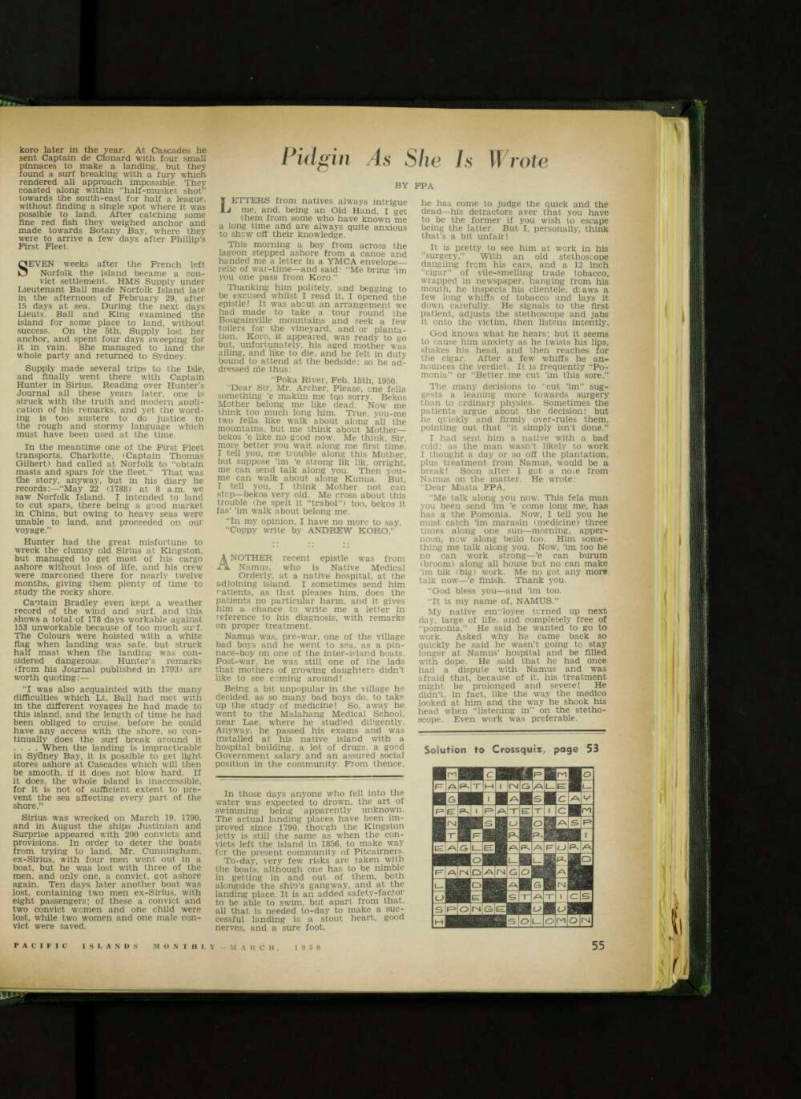
Many of the ocean’s gentle undulations are not visible until they reach soundings off the coast, when they well up from their several directions and produce a heavy surf around the different sides of the island. The cliffs rise sheer from the surf up to several hundred feet, except at Kingston, which has been the centre of government right through the years.
However, the convict-built jetty for the anchorage in Sydney Bay is wide open to any swell from between South and West.
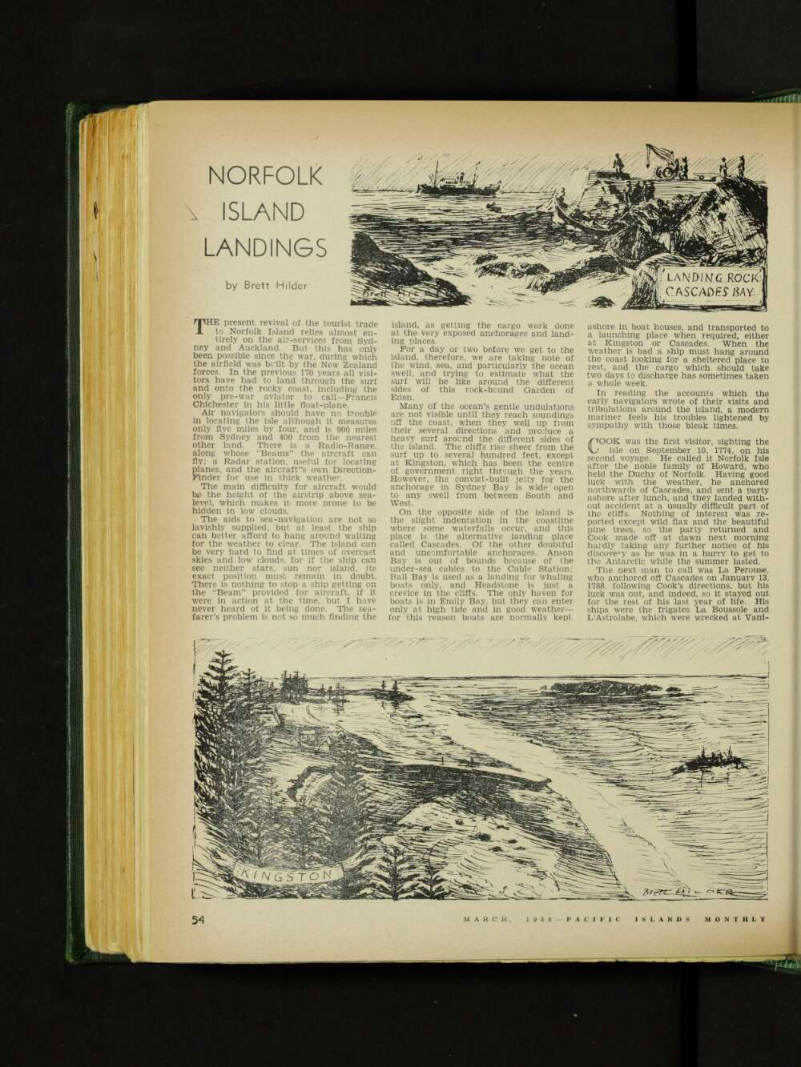
On the opposite side of the island is the slight indentation in the coastline where some waterfalls occur, and this place is the alternative landing place called Cascades. Of the other doubtful and uncomfortable anchorages, Anson Bay is out of bounds because of the under-sea cables to the Cable Station; Ball Bay is used as a landing for whaling boats only, and Headstone is just a crevice in the cliffs. The only haven for boats is in Emily Bay, but they can enter only at high tide and in good weather — for this reason boats are normally kept
ashore in boat houses, and transported to a launching place when required, either at Kingston or Cascades. When the weather is bad a ship must hang around the coast looking for a sheltered place to rest, and the cargo which should take two days to discharge has sometimes taken a whole week.
In reading the accounts which the early navigators wrote of their visits and tribulations around the island, a modern mariner feels his troubles lightened by sympathy with those bleak times.
COOK was the first visitor, sighting the isle on September 10, 1774, on his second voyage. He called it Norfolk Isle after the noble family of Howard, who held the Duchy of Norfolk. Having good luck with the weather, he anchored northwards of Cascades, and sent a party ashore after lunch, and they landed with out accident at a usually difficult part of the cliffs. Nothing of interest was re ported except wild flax and the beautiful pine trees, so the party returned and Cook made off at dawn next morning hardly taking any further notice of his discovery as he was in a hurry to get to the Antarctic while the summer lasted.
The next man to call was La Perouse, who anchored off Cascades on January 13, 1788, following Cook’s directions, but his luck was out, and indeed, so it stayed out for the rest of his last year of life. His ships were the frigates La Boussole and L’Astrolabe, which were wrecked at Vani-
koro later in the year. At Cascades he sent Captain de Clonard with four small pinnaces to make a landing, but they found a surf breaking with a fury which rendered all approach impossible. They coasted along within “half-musket shot” towards the south-east for half a league, without finding a single spot where it was possible to land. After catching some fine red fish they weighed anchor and made towards Botany Bay, where they were to arrive a few days after Phillip’s First Fleet.
SEVEN weeks after the French left Norfolk the island became a con vict settlement. HMS Supply under Lieutenant Ball made Norfolk Island late in the afternoon of February 29, after 15 days at sea. During the next days Lieuts. Ball and King examined the island for some place to land, without success. On the sth, Supply lost her anchor, and spent four days sweeping for it in vain. She managed to land the whole party and returned to Sydney.
Supply made several trips to the Isle, and finally went there with Captain Hunter in Sirius. Reading over Hunter's Journal all these years later, one is struck with the truth and modern appli cation of his remarks, and yet the word ing is too austere to do justice to the rough and stormy language which must have been used at the time.
In the meantime one of the First Fleet transports, Charlotte, (Captain Thomas Gilbert) had called at Norfolk to “obtain masts and spars for the fleet.” That was the story, anyway, but in his diary he records:—“May 22 (1788) at 8 a.m. we saw Norfolk Island. I intended to land to cut spars, there being a good market in China, but owing to heavy seas were unable to land, and proceeded on our voyage.”
Hunter had the great misfortune to wreck the clumsy old Sirius at Kingston, but managed to get most of his cargo ashore without loss of life, and his crew were marooned there for nearly twelve months, giving them plenty of time to study the rocky shore.
Captain Bradley even kept a weather record of the wind and surf, and this shows a total of 178 days workable against 153 unworkable because of too much surf.
The Colours were hoisted with a white flag when landing was safe, but struck half mast when the landing was con sidered dangerous. Hunter’s remarks (from his Journal published in 1793) are worth quoting:— “I was also acquainted with the many difficulties which Lt. Ball had met with in the different voyages he had made to this island, and the length of time he had been obliged to cruise, before he could have any access with the shore, so con tinually does the surf break around it ... When the landing is impracticable in Sydney Bay, it is possible to get light stores ashore at Cascades which will then be smooth, if it does not blow hard. If it does, the whole island is inaccessible, for it is not of sufficient extent to pre vent the sea affecting every part of the shore.”
Sirius was wrecked on March 19. 1790, and in August the ships Justinian and Surprise appeared with 200 convicts and provisions. In order to deter the boats from trying to land, Mr. Cunningham, ex-Sirius, with four men went out in a boat, but he was lost with three of the men, and only one, a convict, got ashore again. Ten days later another boat was lost, containing two men ex-Sirius, with eight passengers; of these a convict and two convict women and one child were lost, while two women and one male con vict were saved.
In those days anyone who fell into the water was expected to drown, the art of swimming being apparently unknown.
The actual landing places have been im proved since 1790, though the Kingston jetty is still the same as when the con victs left the island in 1856, to make way for the present community of Pitcairners.
To-day, very few risks are taken with the boats, although one has to be nimble in getting in and out of them, both alongside the shin’s gangway, and at the landing place. It is an added safety-factor to be able to swim, but apart from that, all that is needed to-day to make a suc cessful landing is a stout heart, good nerves, and a sure foot.