Magazine Section
pp. 53-54 · Read in the full issue
Territories Talk-Talk
By "Tolala"
warning by the Administration to the P-NG copra producers, in re spect of the low-grade copra being produced, is nothing if not Gilbertian.
Failure of the government shipping scheme can be held responsible for most of the faulty copra; a fact which Senator Roy Kendall stressed in his maiden speech in the Senate at the beginning of this month; and when he spoke about shipping in New Guinea, he knew what he was talking about from previous ex perience in Islands waters.
Planters fared better in the old German days of 40 years ago so far as overseas and inter-island shipping was concerned. The Sydney-Hong Kong NDL steamers called at Maron, in the Western Islands after leaving Rabaul, and the NDL Sumatra and Meklong catered for the inter-island service, while the Neu Guinea Com pagnie’s Siar and Madang (both steamers) covered the NGC properties.
At Kavieng SS Nusa was stationed as the government vessel, while SS Buka was used by the Kieta Kiap. Buka was scuttled by the German Kiap in Roro wana Bay at the beginning of the 1914 war.
Great little steamers—both the Buka and Nusa (which were sister ships) used wood fuel, with the result that at every anchorage there were piles of firewood stacked by the village natives following on orders from the Kiaps. That was economy and would have pleased Aus tralian Auditor-General Joyce, who has recently made some trite remarks about NG shipping under government control.
ONCE again our old friend T. Leslie McAlpine has taken up his pen in his anti-indentured labour cam paign, and he wants the Minister to “examine every phase of the iniquitous indentured labour system . .
Mac, who has had experience as a plantation manager in BSI, Bougainville and Madang, and as an inspector throughout the TNG, is one of the very few experienced men who adversely criticise the indenture system. That there have been some abuses in the re cruiting of labour no one will deny. There are breaches cf the Traffic Regulations in Sydney every day, but people still drive motor vehicles.
Indentured native labour came under Australia’s notice with a bad name when we took over NG from the Germans in 1914. Much of it was patriotic publicity to work up a little more hatred of the Hun. There have been some bad Ger man employers of natives, and there have also been some bad Australian employers of natives. But the opinion that all Ger man recruiters used pressure methods, or “pulled boys” is far from the truth. I remember one German schooner that went recruiting for many weeks and re turned with cne “monkey” (small boy).
For many a day he was known as the “£4OO recruit,” for it had cost the com pany that much for the trip.
“Free labour,” or non-indentured, leaves greater scope for exploitation than if the native works on a contract. In the latter case the native is under strict government control. The very name “in dentured labourer” now, however, con jures up Queensland sugar fields and
iron chains. “Registered labourer’’ would sound better and help to finish this ballyhoo about “slavery.” The white employee in the Islands is far more enslaved by reason of economic and social responsibilities, and his agreement, than any contract labourer. ‘ ASMH staff correspondent has had his stories of Rabaul and Manus Island featured on Granny’s editorial page this month, and many of his observations are interesting.
In his Rabaul story he mentions the rapid increase of Chinese interests, not only in the township, but in the acquisition of many flourishing plantations in New Britain. “Australia,” says the writer, “may have a race minority problem building up in this corner of her Trusteeship Territory.”
There is always a likelihood of such problems arising where an attempt is made to mix the East and West, “for never the twain will meet,” no matter how much the West may kid itself into a feeling of righteous tolerance. The German administration realised this when, finding Chinese were reaching out for economic development, it restricted their agricultural activities to the southwest coast of New Ireland, but gradually our own administration relaxed this policy, and this may be a contributing factor to the building-up of a minority race problem, mentioned by the staff correspondent with PU thls S particular
what shThaf,g“
has lost, undoubtedly, in the greater economic expansion enjoyed by TNG, ?{?lnpsp ca f? ! ,ri 1 ? dire y attnbuted t 0 the ThP snli it inn to the race nroblem seems to be an U ac^owledae^ent Pl and ei a ora™tical observance of well-worn
phrase a“| each JSopfe to ”eT
contained—and that applies to educa-
tional methods for the children as much as economic development for the adults, , '* , ** . ** , , doubt these Pidgin English news papers,” turned out by an energetic Department of Education at various points in the Territories, have their uses in moulding public native opinion. But Pidgin has its dangers unless very caie fully handled at both the sending and receiving ends, The Rabaul News is credited (in the Southern Press) with implanting in the minds of the Lae natives the idea of a Second Coming of Christ as a result of a a somewhat ambiguous Christmas mes sage when the tenses of the verb “to come” became slightly mixed.
Pidgin was never intended to convey abstract meanings and ethical reason ings. Missionaries have long realised this and usually convey their Message in the local vernacular. Pidgin is a “talk be long work,”—purely materialistic with literal interpretations that cannot be ex pected to convey the intricate meanings of religious dogmas and theological prin ciples. :: ;; ;: COMPARATIVE trade figures are ( wakaiive trade figures are always interesting, but often decep . Take for instance ex as compared with 1938~39 coo! comparedwith 1938-39 (£4,301,588). At first glance you might think production had been stepped up.
‘export
year exported was val e ten aeo—and vet tonnaee fJst vear was onlv a little over half of that exported before the war Gold °n the 1938-39 period was valued at £2,100,000; last year it was less than £1 million. In later years the bottom seems d ™PP ed ° ut ° f the shell and rub '
(Continued foot of page 50)
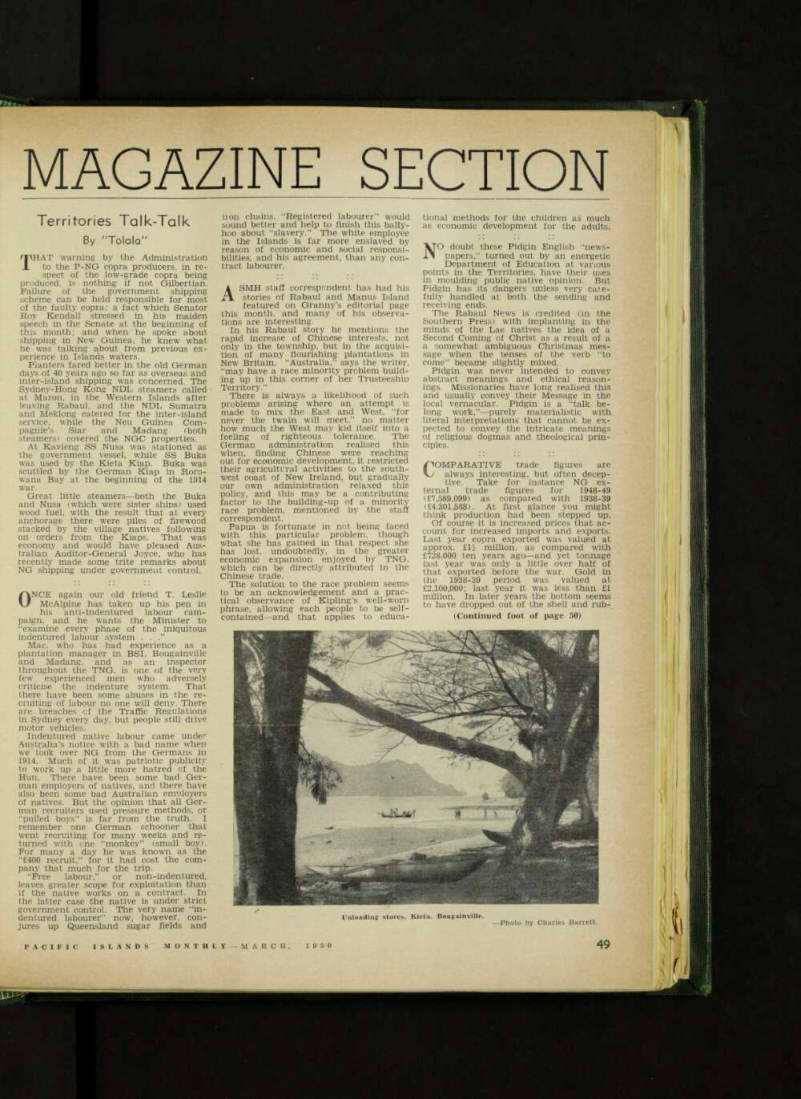
Unloading stores, Kieia, Bougainville. —Photo by Charles Barrett.
ber trade, for returns show a mere £7 for the former, while a fiver covers the exports of rubber from NG.
Pre-war shell exports exceeded £lO,OOO and rubber over £4,000. Don’t be misled by a false idea that production is by any means back to normal.
BITS and' PIECES: Flying-man Bill Duncan, son of the evergreen Jimmy, of Harbour Master and Ra popo fame, was in Sydney last month from China, where he did a post-war job with UNRRA. Bill was interested in a plantation down Buka Passage way some years ago. . . . Federal government has allocated £192,000 for a hydro-elec tric scheme at Port Moresby. . . . BP Trust Co. is seeking the daughter (Bon nie) of the late George Naess, well-known South Coast, New Britain, planter be fore the war. He died during the Jap occupation. . . . Dr. W. E. H. Stanner has been appointed Reader in Comparative Social Institutions at the Australian National University. He is at present in London. . . . The E. J. Wauchopes are back again in Sydney from their planta tion at Awar. Both full of beans. . . .
Ken Douglas, of San Remo (Talasea) with wife and son, John, returned this month to NG after holidaying in Tas mania and other spots en route. . . .
Captain A. W. R. McNicoll has been ap pointed in command of HMAS Warra munga, 10th Destroyer Flotilla. . . . Hol lywood is producing a war thriller, “New Guinea,” all about army engineers build ing an airstrip behind the Jap lines.
Gregory Peck is one of the stars. ... At the Methodist annual conference it was stated that a leper hospital was being built in Papua to accommodate 100 patients. Government to pay the cost of erection, staff and maintenance if the Church finds a Christian staff.