How ‘Dynamite Mac’ Missed Tahiti
pp. 18-100 · Read in the full issue
Amusing Angles of a Boat Theft In Samoa
From a Special Correspondent
IT was the evening of January 2, 1950; and the flash youths along the beach in Apia, Western Samoa, were bored.
They had enjoyed a week’s wassail, more or less, and they did not like the dismal prospect of work, once more.
“Dynamite Mac Mago” put it to his gang that they seize a ship, shake the stinking dust of Apia off their calloused heels, and head for Tahiti, land of soft colours and kindly maidens.
The gang hesitated. They liked the idea, but they feared the recklessness of “Dynamite Mac”—that was his boxing ring soubriquet. His general record did not make for confidence and comfort.
So the gang faded away—all except two—Moki (Vince) Periera, and Lolesea Lei’ataua.
Moki and Lolesea were not repelled by the plan for a bit of piracy. They were two of the bright lads who, 18 months ago, ran away with A. G. Smyth’s Wyben.
They were hot navigators. Once clear of Apia with the Wyben, they blindly followed the sunset until they met up with the Solomons. The Wyben ulti mately was sold in the Solomons, at a heavy loss to Smyths; but the gallant crew, brought back to Samoa by the police, somehow escaped the punishment they richly deserved.
Moki and Lolesea decided to go with Luapo Fa’amau —otherwise “Captain Mago,” otherwise “Dynamite Mac Mago.” Very late that night, they sneaked onto the wharf and reconnoitred O. F. Nelson & Co’s. 54 ft. motor-vessel Gaumatau, a scow type of ship with an 18 ft. beam, and worth about £6,000.
From the cabin of the Gaumatau came the gentle, rythmic snores of Peau Tusi tala, the youthful Samoan caretaker.
They crept upon Peau, and sat upon his chest, and pressed a long, sharp knife against his throat—in the best style of the Wild West pictures which Samoan youths find so exhilarating—and the terrified Peau did precisely as he was told.
They started the engine about 2 ajn., and headed out through the reef, and away into the north-east. Captain Mago assumed command. First stop, Tahiti.
They kept the engine going for about 36 hours; and naturally, they ran out of fuel. Then they carried on with a stay sail and mainsail.
They drifted around for a whole month —they do not know themselves where they were. Captain Mago said he was taking them to Tahiti.
Aboard, they found biscuits and canned meat, and these provisions, supplemented by fish which they caught, kept them going. They got water by the simple de vice of spreading, when it rained, a sail with a hole cut in its centre, and running the water through the hole into a can.
They knew that High Authority would be searching for the Gaumatau. There was paint aboard. They wiped Gaumatau off their ship’s blunt bows, and substi tuted therefor the name Vincent. (See photograph.) ON February 2 they sighted land, a long way off.
“Tahiti,” said the confident Captain Mago. His three companions shouted their joy.
Their ship drifted no nearer the distant land. So the ingenious Captain Mago mixed lubricating oil with kerosene, and somehow persuaded the engine to run on it. A few hours later, they landed on what seemed a hospitable beach.
Polynesian folk approached. “I orana ‘ce!” (the Tahitian greeting) shouted the knowledgeable Captain Mago.
The people stared. “Talofa!” (the Samoan greeting) they replied.
Captain Mago staggered slightly, and then spoke to them in Samoan, They replied in Samoan, with a slightly differ ent accent.
The voyagers discovered that they had landed in Falaesau Bay, in Ta’u, in the Manua Group of Eastern (American) Samoa, less than 200 miles from Apia.
The two disillusioned former members of the crew of the late lamented Wyben seemed inclined to take their leader apart; but there was no time. The people of Ta’u were naturally asking questions, and it was urgent that the pirate gang tell the same story. So, after consulta tion, they announced that they and their ship Vincent had been making a trip be tween Upolu and Savaii, and been blown off their course. If they could be sup plied with petrol and food, they would be on their way.
The Government officials in Ta’u — Lefiti, District Governor, and the Chief Pharmacist’s mate (Medical Orderly, in British parlance)—did not like the look of the new arrivals. They had heard of the theft of the Gaumatau. An exam ination of the name Vincent, on the vessel, showed amateurish painting; and,
beneath the new paint, they discerned the word Gaumatau.
The gang submitted very quietly to arrest, and the radio buzzed.
Ta’u told Pago Pago about it, and Pago Pago told Apia. Nelsons, very happy indeed to learn that their Gaumatau had been recovered apparently undamaged, placed their motor-vessel Calmar at the disposal of the Govern ment; and, loaded with police, stores and petrol, she set off for Pago Pago. Thence, having concluded necessary formalities with the helpful American officials, the Calmar went on to Ta’u and collected the Gaumatau and her gang of subdued pirates, and set sail for Apia.
THE report that Calmar and Gaumatau were on their way back, with Dynamite Mac and the two ex-Wyben pirates, and young Peau in handcuffs, stirred the Apia waterfront to frenzy. It looked as if the arrival were going to resemble a Royal landing. The police acted swiftly and secretly.
The harbour-master, Captain Jones, slipped unobtrusively out of the harbour, and met the two vessels far to the east of Apia, and the police followed instruc tions to land their prisoners in Salua fata (16 miles east of Apia), where a police car would be waiting.
(Continued on Page 95)
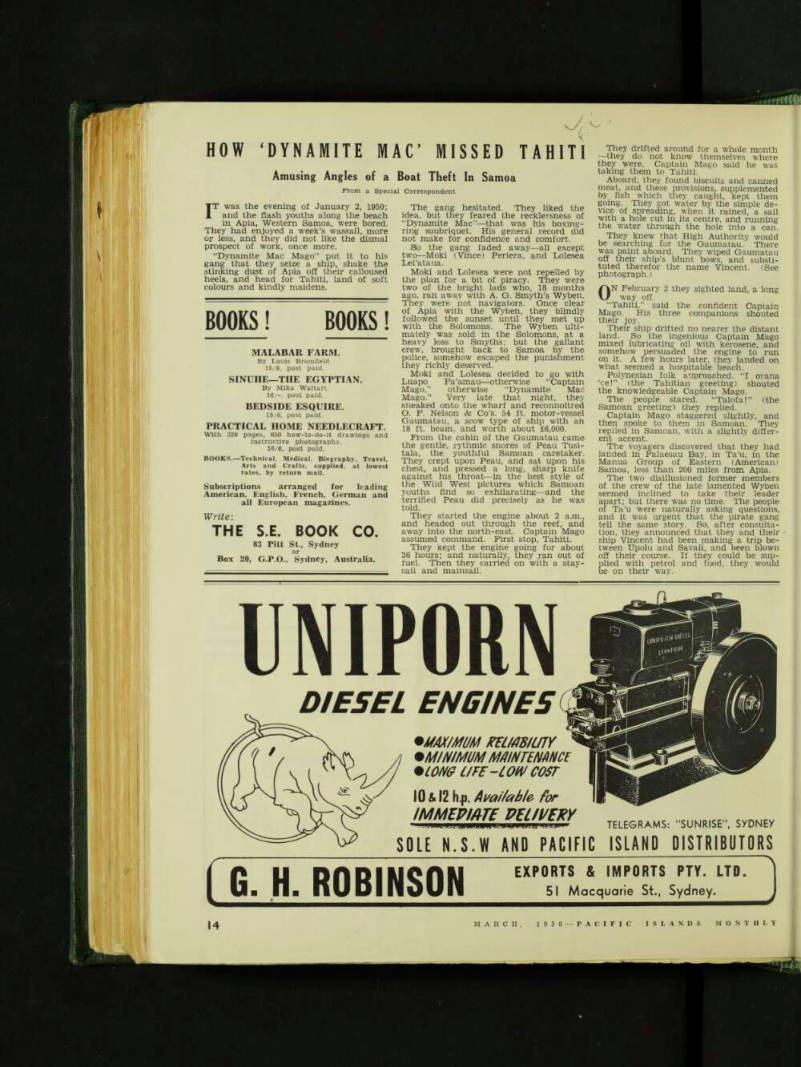
TOP: The MV Gaumatau, lying beside the dock in Apia just after her return. The name “Vincent” is still painted on her bow.
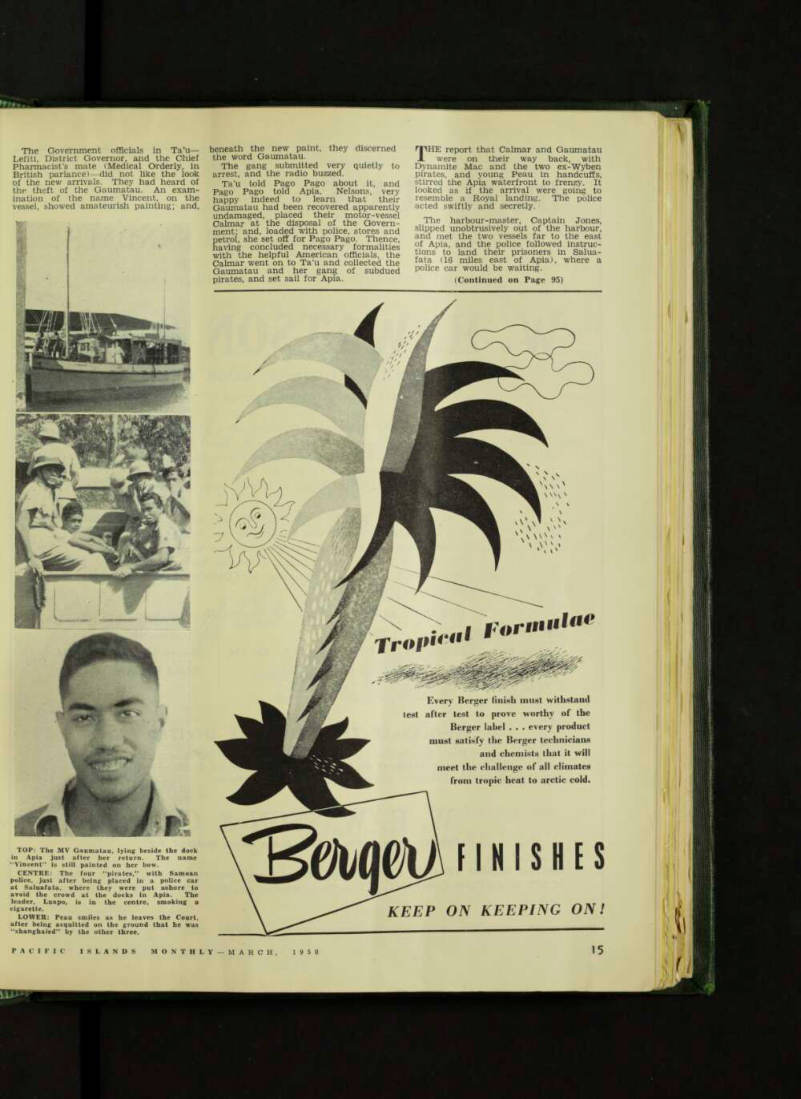
CENTRE: The four “pirates,” with Samoan police, just after being placed in a police car at Saluafata, where they were put ashore to avoid the crowd at the docks in Apia. The leader. Luapo, is in the centre, smoking a cigarette.
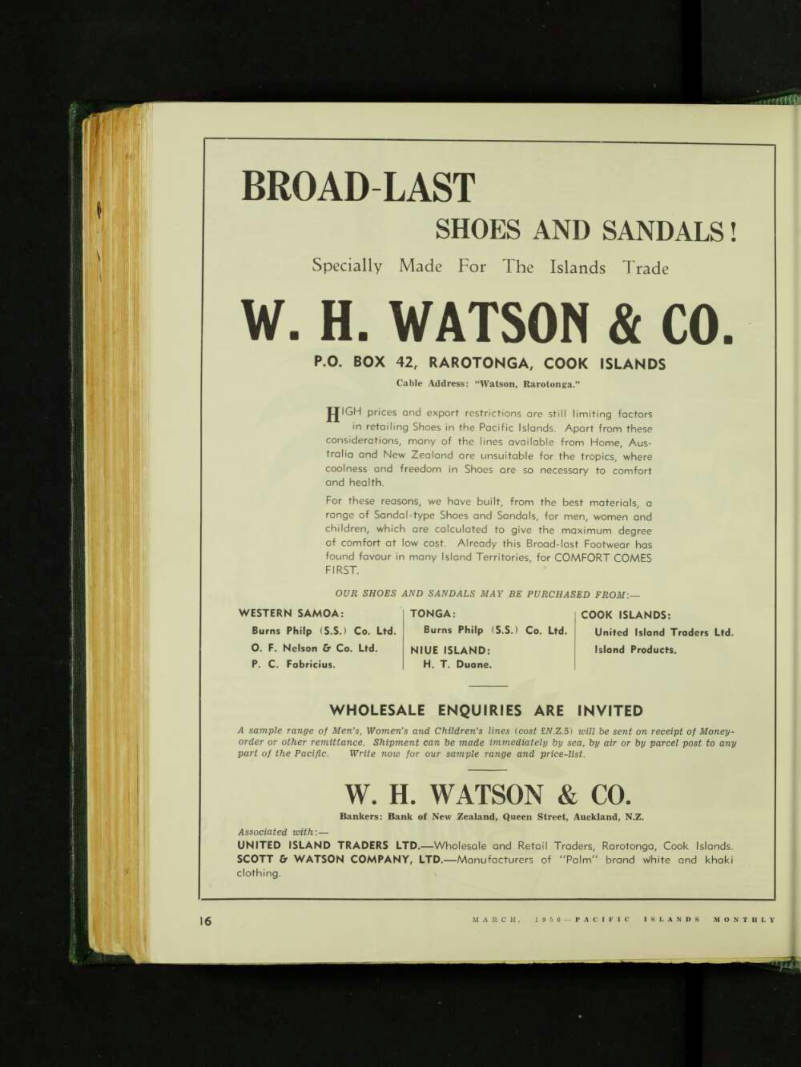
LOWER: Peau smiles as he leaves the Court, after being acquitted on the ground that he was “shanghaied” by the other three.
MY friend, Alf Vercoe, insists that it was pure coincidence that he was sitting on the sea-shore at Salua fata, nursing his excellent camera and a Telephoto lens, when the police came in and landed their prisoners on the beach, to be met by more police under Senior Sargeant Phillip. He says he had gone to the vicinity of Piula Methodist College to see his wife’s brother Well, if it wasn’t coincidence, Alf is psychic; because no one else in Apia seemed to even suspect anything of the police ruse to keep the glamour off Dynamite Mac. This coast is 40 miles long, and the prisoners could have been landed anywhere on a dozen beaches.
Actually, they were landed within a few hundred yards of where our news-hawk was sitting with his camera!
Anyway, it was for me a very happy coincidence. Herewith you will find the
By extraordinary luck, a professional photographer was at Saluafata when the police and “pirates” were brought ashore from the Gaumatau. He got these pictures from a distance of nearly half a mile, through a 13 cm. Telephoto lens. Top shows the party arriving on the beach. The gentleman in the centre, with his pants rolled up, is “Dynamite Mac Mago.” The lower picture shows the party marching off the beach to the waiting police cars.
excellent photographs which Mr. Vercoe secured of a quite remarkable event.
THE four adventurers were brought be fore Judge C. C. Marsack’s High Court on February 9.
Luapo—now a very much deflated Dynamite Mac—did not give any trouble.
He knew the others were going to say that they were “shanghaied” into the enterprise by him; so he pleaded guilty to the charge of theft of the boat, and was given five years’ hard labour.
The other three, pleading not guilty, were remanded to February 23. The Judge, having heard the evidence and the defence, did not waste any time over the two ex-Wyben men; each got the same sentence as Luapo. They had five weeks together on the sea in hooliganism and piracy; they now will have five years to gether, in gaol, to cherish their memories.
The Judge accepted the plea of Peau, that he was overpowered and forced to go with the other three. He does not appear to have made any frantic effort to escape from the gang of thieves; but he is only a youngster, and his character has been good, and so he was discharged, not guilty.
Nelsons are out of pocket to the extent of some meat and biscuits, a perforated sail and a badly-carboned engine; the West Samoan Government has had con siderable expense in seeking and punish ing the malefactors; and the flash youths of Apia waterfront have been shown that crime doesn’t pay.
When preaching on gambling in Bris bane recently, the Rev. J. F. McKay of the Toowong Presbyterian Church, said that a report had even come from Port Moresby where it was alleged that the natives had a “lottery craze.” A local agency in Moresby, according to Mr.
McKay, sold nearly as many tickets in Australian lotteries to natives as to Euro peans. He said that natives were indig nant when they did not win. They argued that they had paid for a prize and should get one.
The engagement has been announced of Miss Willamina Andresen, daughter of Mr. A. M. Andresen, of Mandoliana Is., Florida Group, BSI, to Mr. William (“Billy”) Barley, son of Mr. J. C. Barley, former old-time resident of the Solomons, now retired and living in Australia.