Eight Huge Bomb Blasts
p. 10 · Read in the full issue
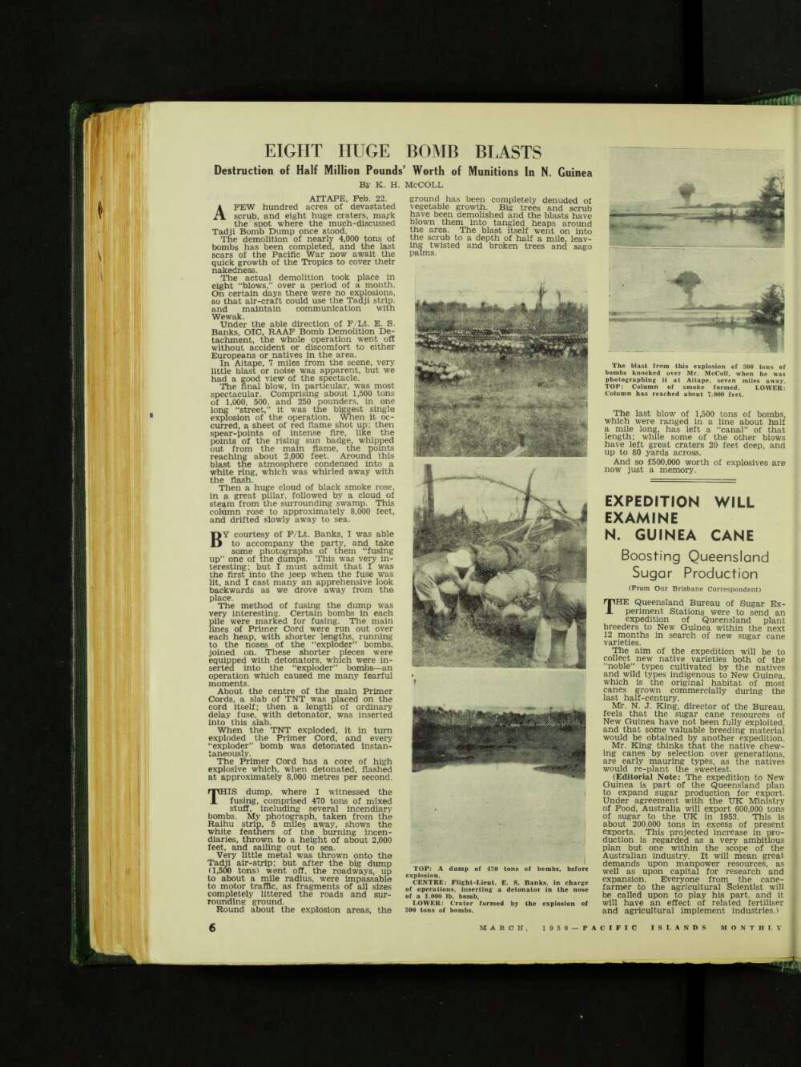
Destruction of Half Million Pounds’ Worth of Munitions In N. Guinea
By K. H. Mccoll
Aitape, Feb. 22.
A FEW hundred acres of devastated scrub, and eight huge craters, mark the spot where the much-discussed Tadji Bomb Dump once stood.
The demolition of nearly 4,000 tons of bombs has been completed, and the last scars of the Pacific War now await the quick growth of the Tropics to cover their nakedness.
The actual demolition took place in eight “blows,” over a period of a month.
On certain days there were no explosions, so that air-craft could use the Tadji strip, and maintain communication with Wewak.
Under the able direction of F/Lt. E. S.
Banks, OIC, RAAF Bomb Demolition De tachment, the whole operation went off without accident or discomfort to either Europeans or natives in the area.
In Aitape, 7 miles from the scene, very little blast or noise was apparent, but we had a good view of the spectacle.
The final blow, in particular, was most spectacular. Comprising about 1,500 tons of 1,000, 500, and 250 pounders, in one long “street,” it was the biggest single explosion of the operation. When it oc curred, a sheet of red flame shot up; then spear-points of intense fire, like the points of the rising sun badge, whipped out from the main flame, the points reaching about 2,000 feet. Around this blast the atmosphere condensed into a white ring, which was whirled away with the flash.
Then a huge cloud of black smoke rose, in a great pillar, followed by a cloud of steam from the surrounding swamp. This column rose to approximately 8,000 feet, and drifted slowly away to sea.
BY courtesy of P/Lt. Banks, I was able to accompany the party, and take some photographs of them “fusing up” one of the dumps. This was very in teresting: but I must admit that I was the first into the jeep when the fuse was lit, and I cast many an apprehensive look backwards as we drove away from the place.
The method of fusing the dump was very interesting. Certain bombs in each pile were marked for fusing. The main lines of Primer Cord were run out over each heap, with shorter lengths, running to the noses of the “exploder” bombs, joined on. These shorter pieces were equipped with detonators, which were in serted into the “exploder” bombs—an operation which caused me many fearful moments.
About the centre of the main Primer Cords, a slab of TNT was placed on the cord itself; then a length of ordinary delay fuse, with detonator, was inserted into this slab.
When the TNT exploded, it in turn exploded the Primer Cord, and every “exploder” bomb was detonated instan taneously.
The Primer Cord has a core of high explosive which, when detonated, flashed at approximately 8,000 metres per second.
THIS dump, where I witnessed the fusing, comprised 470 tons of mixed stuff, including several incendiary bombs. My photograph, taken from the Raihu strip, 5 miles away, shows the white feathers of the burning incen diaries, thrown to a height of about 2,000 feet, and sailing out to sea.
Very little metal was thrown onto the Tadji air-strip; but after the big dump (1,500 tons) went off, the roadways, up to about a mile radius, were impassable to motor traffic, as fragments of all sizes completely littered the roads and sur rounding ground.
Round about the explosion areas, the
ground has been completely denuded of vegetable growth. Big trees and scrub have been demolished and the blasts have blown them into tangled heaps around the area. The blast itself went on into the scrub to a depth of half a mile, leav ing twisted and broken trees and sago palms.
The last blow of 1,500 tons of bombs, which were ranged in a line about half a mile long, has left a “canal” of that length; while some of the other blows have left great craters 20 feet deep, and up to 80 yards across.
And so £500,000 worth of explosives are now just a memory.
TOP: A dump of 470 tons of bombs, before explosion.
CENTRE: Flight-Lieut. E. S. Banks, in charge of operations, inserting a detonator in the nose of a 1,000 lb. bomb.
LOWER: Crater formed by the explosion of 300 tons of bombs.
The blast from this explosion of 300 tons of bombs knocked over Mr. McColl, when he was photographing it at Aitape, seven miles away.
TOP: Column of smoke formed. LOWER: Column has reached about 7,000 feet.