Highlands, now
pp. 56-73 · Read in the full issue
They are digging up strange artifacts in N.G.
Culture predating the present Native People is suggested by “Daika
AN interesting—but by no means un usual —discovery, in Central New Guinea, recently, brought to light more of the stone objects whose origin is unknown, and which lead one to be lieve that long before the white man set foot in this vast and fascinating region, there were here a people whose culture was different and perhaps better de veloped than that of the present inhabi tants.
The artifacts have been found by hun dreds, and they were prized as souvenirs by members of the Australian Military Forces stationed in the Highlands during the war. They also have been collected by missionaries and settlers. The fact that these objects are so common has not helped to solve the mystery of their origin. Many of us have formed theories,
but the fact remains that no scientific explanation has yet been published.
Artifacts so far discovered range from round, flat stones, each with a hole in its centre, through stone mortars and pestles, to almost perfectly-fashioned birds. The latter are the rarest of the artifacts yet found.
The most common are the round, flat stones, which are believed to have been used as fighting clubs. They range in size from 2 inches in diameter to 6 inches in diameter. The hole in the centre is generally about half an inch in diameter; and the centre thickness of the stone would be about the same size. Thev are not limited to any one type—the specimens found so far are of limestone, sandstone and basalt. The hole is bevelled perfectly on both sides; and if the accepted explanation is cor rect, it would take the handle of the club.
The main argument against these ob jects having been the heads of clubs is the fact that the stick that would fit such a small hole would hardly be strong enough to withstand swinging, let alone a solid blow. This argument is perhaps answered by the fact that there are trees from which it is possible to select handles which are as capable of withstanding as much hard usage as the stone itself.
Another argument against the stone being a weapon is that it was used as currency. This, probably, is because arti facts of a similar appearance, but many times larger, found elsewhere in the Pacific, were used for this purpose.
Yet another theory is that they were used for personal decoration in much the same manner as the natives now use shells.
As there are no established facts, any or all of these theories could be correct.
One argument in favour of the club theory is that there is still one uncon trolled tribe in the interior, using weapons of a similar nature, to this day.
This, as far as I can ascertain, is just conjecture because the recent use of any of these club weapons does not ap pear to be on record anywhere.
That these obiects formed some part of the dailv life of their owners is strongly indicated by the fact that they have been so widely distributed. Natives in most portions of the Wahgi Valley have found these objects—and have benefited accordingly, through the white man’s eagerness to acquire them.
In the early days, when missionaries entered a native hamlet, they were faced with this type of artifact mounted on sticks, and fastened to the headman’s house. At first, they were not allowed to touch them as the “big-men” consid ered themselves to be recipients of special favours from the Tambarans (Spirits). Lesser men were forbidden to touch the objects, lest they be punished by the spirits.
As European influence spread, the big-
men slowly but surely lost their super stition regarding the stones, and began to sell them. It was a long time, how ever, before the rank and file members of the tribe plucked up courage to handle the objects.
Missionaries inquired about the origin of the artifacts, but, as a general rule, they were unsuccessful. It was found, however, that in some areas the natives used them in supplications to the spirits, to aid their planting efforts, and as good luck charms in inter-tribal battles.
In all interrogations of natives —from no matter what area—the answer was al ways the same: “We do not know what these objects are. They are the work of the spirits.” This was always accom panied by a shrug of the shoulders, as much to say, “Why meddle in these af fairs —no good can possibly come of it.”
Maybe they are right. But, as yet, no harm has come from it either.
OF the same culture, there have been found other stone objects which, conceivably, could have been used either as stone axes, or as weapons for hand-to-hand fighting. These objects are fiat, between an inch and two inches in thickness, and have concave indenta tions on the two long sides. The hole in the centre is larger than in the cir cular stones, and it could accommodate the two middle fingers of the hand. On the face of the stone is found two grooves which apparently take the index and little fingers. Thus, the correct grip of this artifact would be: the two middle fingers through the centre hole, the in dex and little fingers placed along the grooves, the thumb around one side and the concave surface (unsharpened) fit ting into the palm of the hand.
In some stones of this type, it is found that there has been another hole formed which would appear to take the index finger. In this stone also, there is a groove at the bottom to accommodate the little finger.
The blade of the stone is half rounded, and has an edge that has been ground down to knife-like sharpness.
However, as there is as little known about this object as about the > round stones, its use is a matter of conjecture.
But the thought of receiving a blow from a weapon of this description is not pleasant.
That it was used as a tomahawk is doubtful, because the hand using it would have to be exceptionally strong and tough, and the time taken to chop down one small tree would make house-build
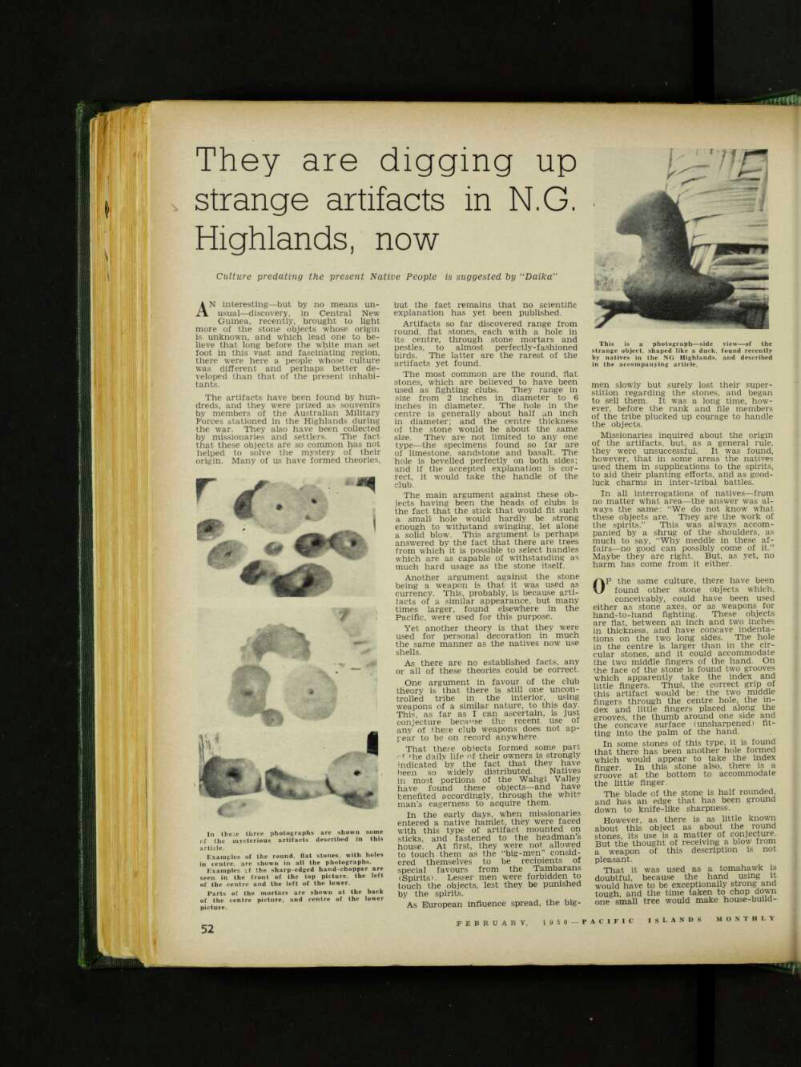
In these three photographs are shown some of (he mysterious artifacts described in this article.
Examples of the round, flat stones, with holes in centre, are shown in all the photographs.
Examples if the sharp-edged hand-chopper are seen in the front of the top picture, the left of the centre and the left of the lower.
Parts of the mortars are shown at the back of the centre picture, and centre of the lower picture.
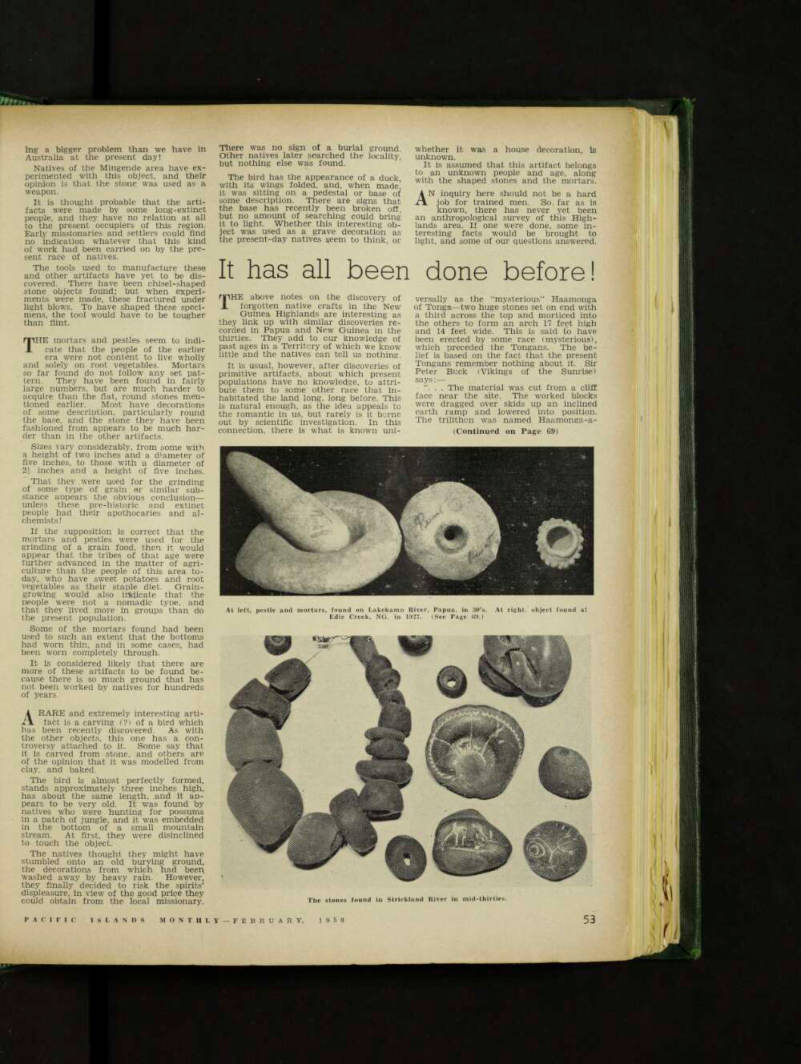
This is a photograph—side view—of the strange object, shaped like a duck, found recently by natives in the NG Highlands, and described in the accompanying article.
ing a bigger problem than we have in Australia at the present day!
Natives of the Mingende area have ex perimented with this object, and their opinion is that the stone was used as a weapon.
It is thought probable that the arti facts were made by some long-extinct people, and they have no relation at all to the present occupiers of this region.
Early missionaries and settlers could find no indication whatever that this kind of work had been carried on by the pre sent race of natives.
The tools used to manufacture these and other artifacts have yet to be dis covered. There have been chisel-shaped stone objects found; but when experi ments were made, these fractured under light blows. To have shaped these speci mens, the tool would have to be tougher than flint.
THE mortars and pestles seem to indi cate that the people of the earlier era were not content to live wholly and solely on root vegetables. Mortars so far found do not follow any set pat tern. They have been found in fairly large numbers, but are much harder to acquire than the flat, round stones men tioned earlier. Most have decorations of some description, particularly round the base, and the stone they have been fashioned from appears to be much har der than in the other artifacts.
Sizes vary considerably, from some with a height of two inches and a diameter of five inches, to those with a diameter of 2 h inches and a height of five inches.
That they were used for the grinding of some type of grain or similar sub stance anpears the obvious conclusion— unless these pre-historic and extinct people had their apothecaries and al chemists !
If the supposition is correct that the mortars and pestles were used for the grinding of a grain food, then it would appear that the tribes of that age were further advanced in the matter of agri culture than the people of this area to day, who have sweet potatoes and root vegetables as their staple diet. Grain growing would also indicate that the people were not a nomadic type, and that they lived more in groups than do the present population.
Some of the mortars found had been used to such an extent that the bottoms had worn thin, and in some cases, had been worn completely through.
It is considered likely that there are more of these artifacts to be found be cause there is so much ground that has not been worked by natives for hundreds of years.
A RARE and extremely interesting arti fact is a carving f?) of a bird which has been recently discovered. As with the other objects, this one has a con troversy attached to it. Some say that it is carved from stone, and others are of the opinion that it was modelled from clay, and baked.
The bird is almost perfectly formed, stands approximately three inches high, has about the same length, ,and it ap pears to be very old. It was found by natives who were hunting for possums in a patch of jungle, and it was embedded in the bottom of a small mountain stream. At first, they were disinclined to touch the object.
The natives thought they might have stumbled onto an old burying ground, the decorations from which had been washed away by heavy rain. However,’ they finally decided to risk the spirits’ displeasure, in view of the good price they could obtain from the local missionary.
There was no sign of a burial ground.
Other natives later searched the locality, but nothing else was found.
The bird has the appearance of a duck, with its wings folded, and, when made] it was sitting on a pedestal or base of some description. There are signs that the base has recently been broken off, but n ,9 P se pi c .hing could bring it to light. Whether this interesting object was used as a grave decoration as the present-day natives seem to think, or
whether it was a house decoration, is unknown. it is assumed that this artifact belongs
wV“Sd stS and V/ mona?f
snapea stones ana tne mortars.
AN inquiry here should not be a hard job for trained men. So. far as is known, there has never yet been an anthropological survey of this High lands area. If one were done, some in teresting facts would be brought to light, and some of our questions answered.
It has all been done before!
rpHE above notes on the discovery of X forgotten native crafts in the New Guinea Highlands are interesting as they link up with similar discoveries recorded in Papua and New Guinea in the thirties. They add to cur knowledge of past ages in a Territory of which we know little and the natives can tell us nothing.
It is usual, however, after discoveries of primitive artifacts, about which present populations have no knowledge, to attribute them to some other race that inhabitated the land long, long before. This is natural enough, as the idea appeals to the romantic in us, but rarely is it borne out by scientific investigation. In this connection, there is what is known uni-
versally as the “mysterious” Haamonga of Tonga—two huge stones set on end with a third across the top and morticed into the others to form an arch 17 feet high and 14 feet wide. This is said to have been erected by some race (mysterious), which preceded the Tongans. The be lief is based on the fact that the present Tongans remember nothing about it. Sir Peter Buck (Vikings of the Sunrise)
says:— . , ,
. • • • The material was cut from a cliff f ace near the site. The worked blocks wer( L dragged over skids up an inclined earth ramp and lowered into position, The trilithon was named Haamonga-a
(Continued on Page 69)
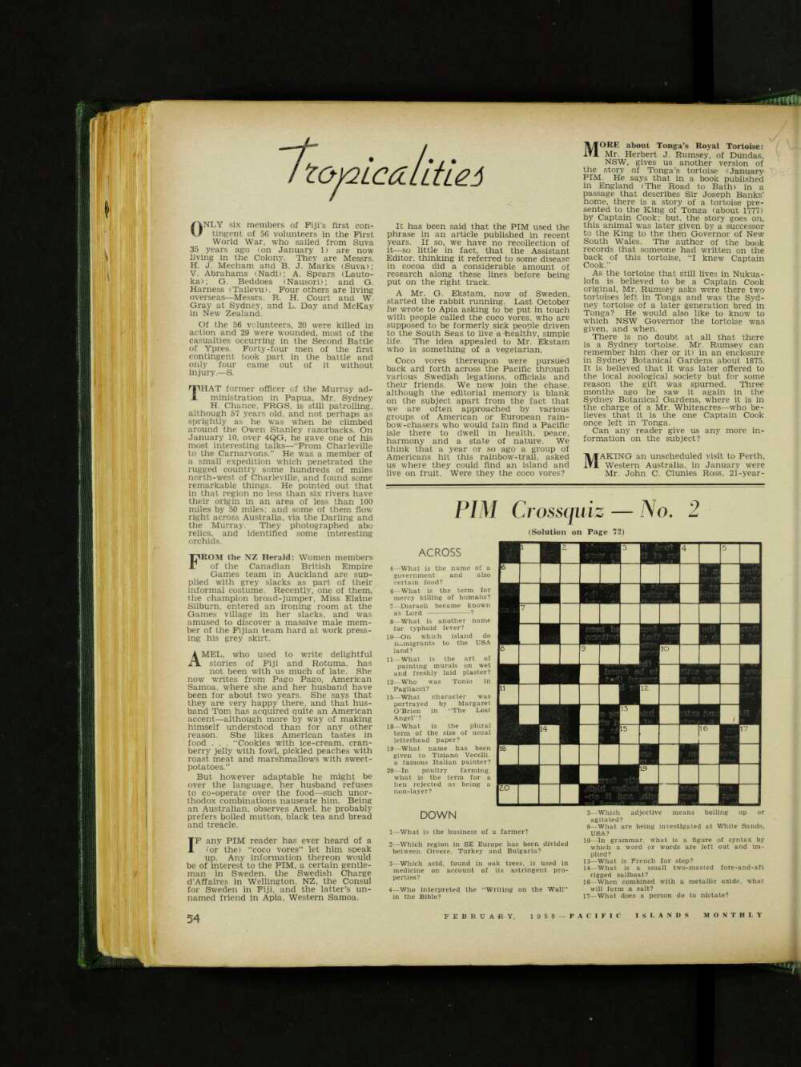
At left, pestle and mortars, found on Lakekamu River, Papua, in 30’s. At right, object found at Edie Creek, N]G, in 1927. (See Page 69.)
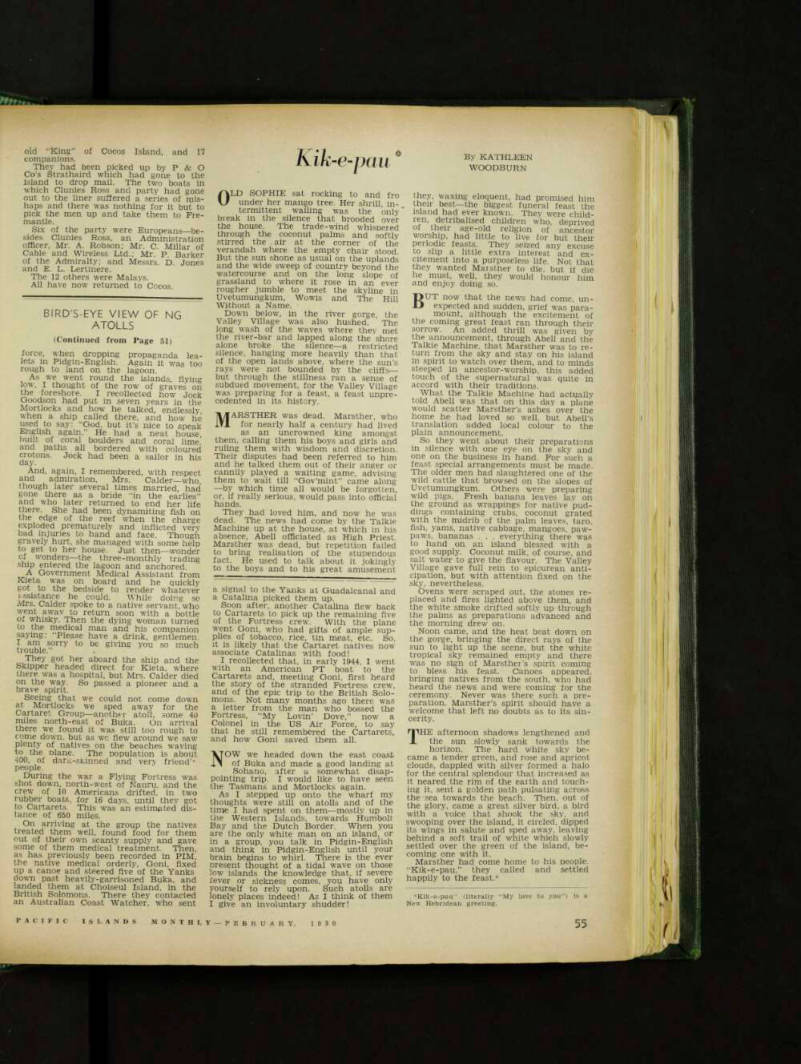
The stones found in Strickland River in mid-thirties.
Maui (Burden of Maui), the two uprights being likened to burdens supported on the ends of a carrying pole. It was built by Tuitatui, eleventh Tui Tonga, as a monument to his two sons. The form and size of the memorial are so unique that imaginative writers have advanced the theory that it was made by some archaic civilisation that preceded the Tongans.”
Sir Peter, therefore, does not see any thing mysterious about it and I, for one, prefer to stake my faith in his profound knowledge of Polynesia rather than in the credulity of tourists.
In May, 1937, an article was published in PIM with two photographs of stone artifacts. It was stated that , . They seem to have little, if any, connection with the present races of primi tive aborigines (in Papua and New Guinea), and suggest a connection with an extinct and higher culture.” It is odd how it is always assumed that such people must necessarily have been of higher culture. If we are to believe at all in the theory of Pacific migrations, it is obvious that the first wave of people to reach Papua and New Guinea, later to be absorbed and/or pushed inland by following waves, were by no means superior.
The two photographs which were pub lished with the May, 1937, article are re printed here. One photograph shows quite clearly that the artifacts that came from the Lakekamu River (Papua) and Edie Creek (New Guinea) are similar to those now found in the Highlands. The other stones, from the Strickland River area and found Jack Hides and David Lyall (both now dead) are somewhat dif ferent. The small round stones with the holes in them, it was stated, could be used for whistles. These Strickland stones were given to the National Museum in Canberra.
It was stated also, that in a shipyard in Pert Moresby at this time there was a curiously shaped piece of rock which could represent the head of an eagle. No one knew where it came from or what it was, although it was believed to have some connection with Papua’s primitive past, The natives used it to anchor small boats.
As Melanesia was populated by a suc cession of waves of people, the most primi tive coming first, it is likely that there have been also successive cultures. The people have, however, all been of the same basic stock and there seems nothing in a few stone artifacts to suggest that a superior race of beings once roamed those parts.
In our own European history we Jiave had different phases of culture —much of which would have been forgotten long since if we had not been capable of keep ing written records. The natives could not write and relied on memory which is, at best, fickle. Even in the last 30 or 50 years, Europeans who have lived among them have seen old crafts and customs thrown into the discard. The natives “don’t savvy” any more; they have for gotten. Most Melanesians act dumb when questioned about past history or any as pect of their culture.
Take the carved, wooden Tambarans— grotesque caricatures of man or woman, a foot or two long, daubed with natives’ paints and, in the minds of the old fashioned missionary, obscene. In 1939 it was impossible to purchase one of these in the coastal villages between Wewak and Aitape where the mission church had taken the place of the House-Tambaran.
But inland, between Maprik and the mountains, where mission influence had not penetrated, I bought many of them over a period of a year or so. I do not know the significance of these things; they were brought in with many giggles and coyly wrapped in banana leaves but
that they had no particular spiritual meaning is obvious from the fact that the men were willing to exchange them for salt or trade beads. Perhaps the era of the Tambaran was ebbing even out there, for these were no artifacts whipped up for my edification but old, begrimed with the smoke of many house fires, and genuine enough. Since then there has been a war in those parts—Jap soldiers and Allied and now anew deal for natives. I do not know how the elaborate, towering House-Tambarans, with their brightly painted facades have fared; or if one may still buy the crude little figures, but if their days have not passed at least they are numbered. And, no doubt, 200 years from now, some Pitt Street scientist will unearth one from the ruins of a deserted native village and
say: “Ha! This proves without doubt that way back before the dawn of history an other and more highly cultured race
lived hereabouts.”-