Bird's-eye View of New Guinea's Atolls
pp. 55-59 · Read in the full issue
New Guinea's Atolls
By F. P. A
Jf/HEN the Administrator of Papua-
New Guinea (Colonel J. K.
Murray) visited Bougainville at the end of last year he, with his party, intended to take in the Mortlock and Tasman Groups—outlying atolls that are included in the Bougainville dis trict for Administrative purposes.
Colonel Murray and his party tried to make these interesting Polynesian
outposts of Melanesia, hut nature
thwarted them.
FPA, who went along, tells the story, and reflects on some of the more recent history of the atolls.
THE lonely Mortlocks lie about 140 miles east of Bougainville, with the even more lonely Tasmans another 100 miles further east—and nothing in be tween. In the old days, sailing and auxiliary schooners often set out to seek them, were buffeted by contrary winds and strong seas, were unable to find them and returned to base to report that the group had probably sunk!
These are true atolls and are inhabited by people of Polynesian strain. There is the usual formation that is found in all atolls—a lagoon enclosed by a ring of reefs, and small sandy islands connected by reefs, and with occasional deep chan nels allowing entrance to the lagoon. The islands are all very low, entirely of sand and coral, and planted with coconut palms. The population of the Tasmans — pre-war—was between 300 and 400, and that of the Mortlocks about 250. In former years, island trading vessels made calls with goods and collected copra, but. since the war that has not occurred.
The party -which went from Sohano, on the Catalina, comprised Colonel Murray, Dr. Gunther, the Director of Public Health. Dr. May, Assistant Director, Mr.
R. Cole. A/District Officer of Bougain ville. Dr. K. Pike. Medical Officer of Bougainville, and Mr. Gordon Witson of the Agricultural Department. Colonel Murray gave me an invitation to join the nartv as I had known the Tasman and Mortlock natives of pre-war days.
The Catalina took off from Sohano soon after 8 a m. and headed for the Tasmans though the weather did not look very promising. It was a bumpy trio, in parts, and we went through some very heavy rain soualls. Some of the nartv decided to “take it easy’’ and reclined as best they could.
Suddenly we arrived right over the Tas mans—good navigation, that —and. com ing down fairlv low. circled the group.
Among those present in the nlane was a Tasman native, who had been niched no nearly two vears previously at the Group, given a course in medical matters, and was to be returned to minister unto his fellow islanders. He craned his neck as he looked down on his well-beloved “home town”, though no natives were to
be seen, only some native built huts among the palms. Probably they were frightened at the plane’s appearance and suspected evil, as they cannot have seen many planes, not even during the war.
THERE they were below us—those lonely isles where a number of
I K. had lc i lown I l ad , 1 bad fnnoL b f mg ’ and s 0 ? 16 , had dled lonely deaths from blackwater fever.
While we circled I recollected the story E i?^ n i a d si cided to plant up the island which, until 5’ had been only a trading station She sent out a ship from Rabaul with a German overseer aboard, some 75 native labourers, and necessary supplies. They duly landed but, unknown, one or two of the labourers had dysentery. Some months later one of “Queen Emma’s’’ ships called at the Tasmans and found the German overseer weak and at death’s door, only 25 of the native labourers alive and a large portion of the island population dead—all from effects of dysentery.
As we wheeled and circled, I thought too, of the row of graves down there that I had seen—of Connelly, away back in 1923, who was three months’ dead, and still in his bed, when the ship called.
Also of poor Alf Jones, who went out there to save money to take him back to S6 u- bis people. He de- Xa 1 tS od or l H eVer ’ , wh J, c b • to b la ckwater, and, as he daily felt himself getting weaker, he prayed that he might last until a ship arrived to succour him.
But the ship arrived three weeks after his death. Kobramor, his personal servant, told me all about it and how they used to pray together.
When Johns died he made a coffin for him, dressed the body in white clothes,
put socks and shoes on the leet, and put £lO in silver In the coffin, so that he could pav his wav in the next worm Then he Juried hhn between two other graves, so that he would not feel lonely, and at the graveside he offered up a simple prayer: “God. you please look out good along Master belong me. Amen ”
And that was that 0 , . * , Somewhere down there was Kobramor y nd Mogatiro, j* n d the kids, 1 wondered how they fared, Just at that stage of my reflections the pilot announced that it was too rough to land in the lagoon, and Dr. Gunther told the Tasman medical orderly the sad news, This native had been away from home for two years and had been keenly looking forward to getting back. His face showed his bitter disappointment, and he turned away, putting his head on his arms whilst his shoulders shook. \TOW we headed back to the Mortlocks with bad weather accompanying us.
We circled the group and I noted the well-remembered entrance to the lagoon. Natives were visible on the beaches and an orderly row of houses showed on the main island, ._, . , was years £ in j 0 A ad been in the la g° on - put I had been over it m war-time, with planes of the NZ air
(Continued on Page 55)
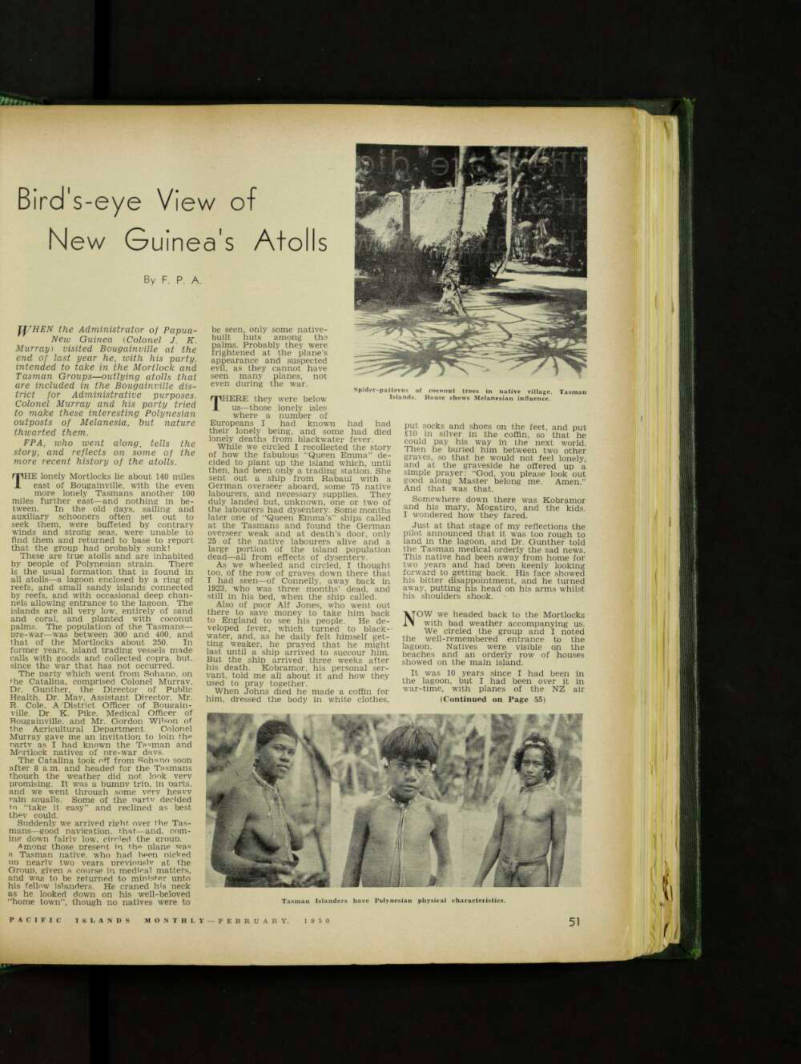
Spider-patterns of coconut trees in native village, Tasman Islands. House shows Melanesian influence.
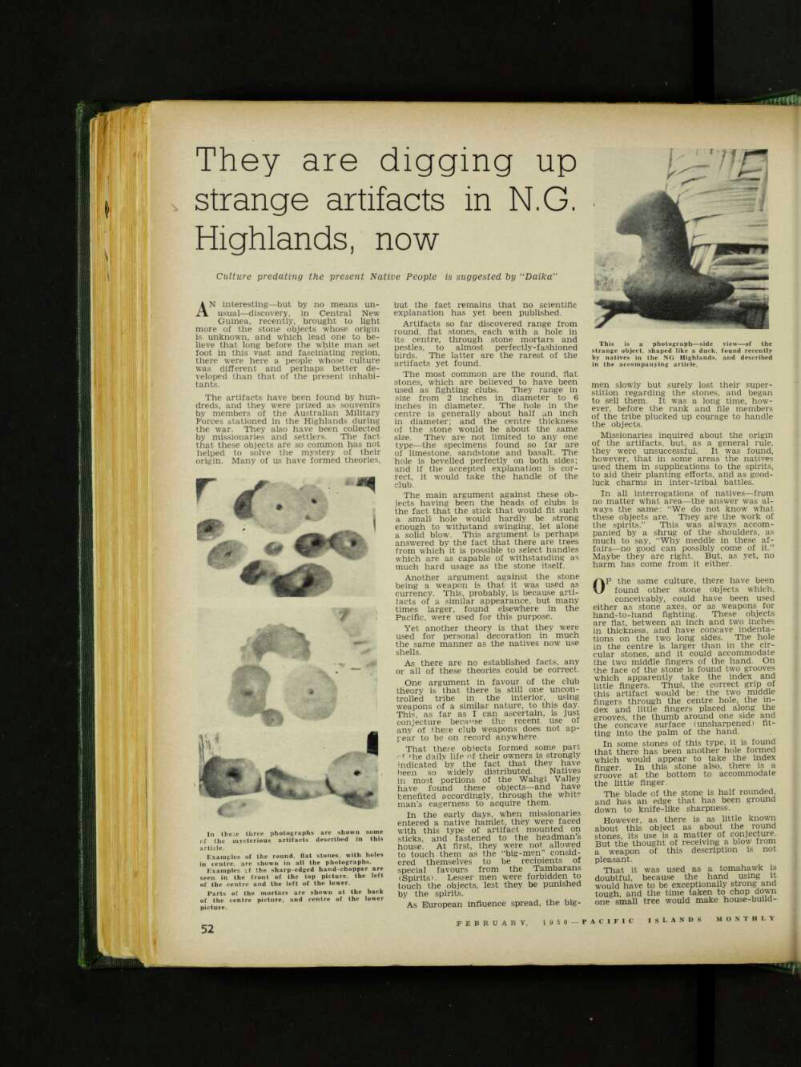
Tasman Islanders have Polynesian physical characteristics.
force, when dropping propaganda lea lets in Pidgin-English. Again it was too rough to land on the lagoon.
As we went round the islands, flying low, I thought of the row of graves on the foreshore. I recollected how Jock Goodson had put in seven years in the Mortlocks and how he talked, endlessly when a ship called there, and how he used to say: “God, but it’s nice to speak English again.” He had a neat house, built of coral boulders and coral lime and paths all bordered with coloured crotons. Jock had been a sailor in his day.
And, again, I remembered, with respect and admiration, Mrs. Calder—who though later several times married, had gone there as a bride “in the earlies” and who later returned to end her life there. She had been dynamiting fish on the edge of the reef when the charge exploded prematurely and inflicted very bad injuries to hand and face. Though gravely hurt, she managed with some help to get to her house. Just then —wonder of wonders —the three-monthly trading ship entered the lagoon and anchored.
A Government Medical Assistant from Kleta was on board and he quickly got to the bedside to render whatever assistance he could. While doing so Mrs. Calder spoke to a native servant, who went away to return soon with a bottle of whisky. Then the dying woman turned to the medical man and his companion saying: “Please have a drink, gentlemen.
I am sorry to be giving you so much trouble.”
They got her aboard the ship and the Skipper headed direct for Kieta, where there was a hospital, but Mrs. Calder died on the way. So passed a pioneer and a brave spirit.
Seeing that we could not come down at Mortlocks we sped away for the Cartaret Group—another atoll, some 4U miles north-east of Buka. On arrival there we found it was still too rough to come down, but as wc flew around we saw plenty of natives on the beaches waving to the nlane. The population is about 400, of darx-skinned and very friend’" people.
During the war a Flying Fortress was shot down, north-west of Nauru, and the crew of 10 Americans drifted, in two rubber boats, for 16 days, until they got to Cartarets. This was an estimated dis tance of 650 miles.
On arriving at the group the natives treated them well, found food for them out of their own scanty supply and gave some of them medical treatment. Then, as has previously been recorded in PIM, the native medical orderly, Goni, fixed up a canoe and steered five of the Yanks down past heavily-garrisoned Buka, and landed them at Choiseul Island, in the British Solomons. There they contacted an Australian Coast Watcher, who sent
a signal to the Yanks at Guadalcanal and a Catalina picked them up.
Soon after, another Catalina flew back to Cartarets to pick up the remaining five of the Fortress crew. With the plane went Goni, who had gifts of ample sup plies of tobacco, rice, tin meat, etc. So, it is likely that the Cartaret natives now associate Catalinas with food!
I recollected that, in early 1944, I went with an American PT boat to the Cartarets and, meeting Goni, first heard the story of the stranded Fortress crew, and of the epic trip to the British Solo mons. Not many months ago there was a letter from the man who bossed the Fortress, “My Lovin’ Dove,” now a Colonel in the US Air Force, to say that he still remembered the Cartarets, and how Goni saved them all.
NOW we headed down the east coast of Buka and made a good landing at Sohano, after a somewhat disap pointing trip. I would like to have seen the Tasmans and Mortlocks again.
As I stepped up onto the wharf my thoughts were still on atolls and of the time I had spent on them —mostly up in the Western Islands, towards Humbolt Bay and the Dutch Border. When you are the only white man on an island, or in a group, you talk in Pidgin-English and think in Pidgin-English until your brain begins to whirl. There is the ever present thought of a tidal wave on those low islands, the knowledge that, if severe fever or sickness comes, you have only yourself to rely upon. Such atolls are lonely places indeed! As I think of them I give an involuntary shudder!
*Kik-e-pau” (literally “My love to you’’) is a New Hebridean greeting.