The Noose
pp. 56-76 · Read in the full issue
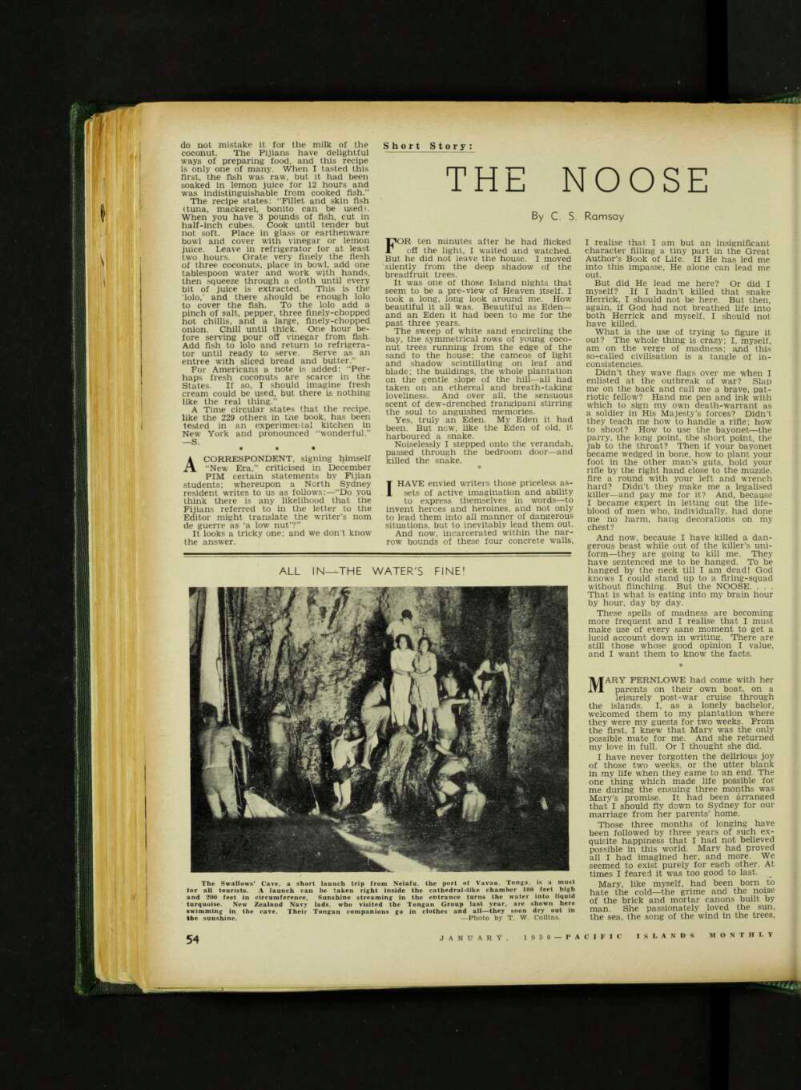
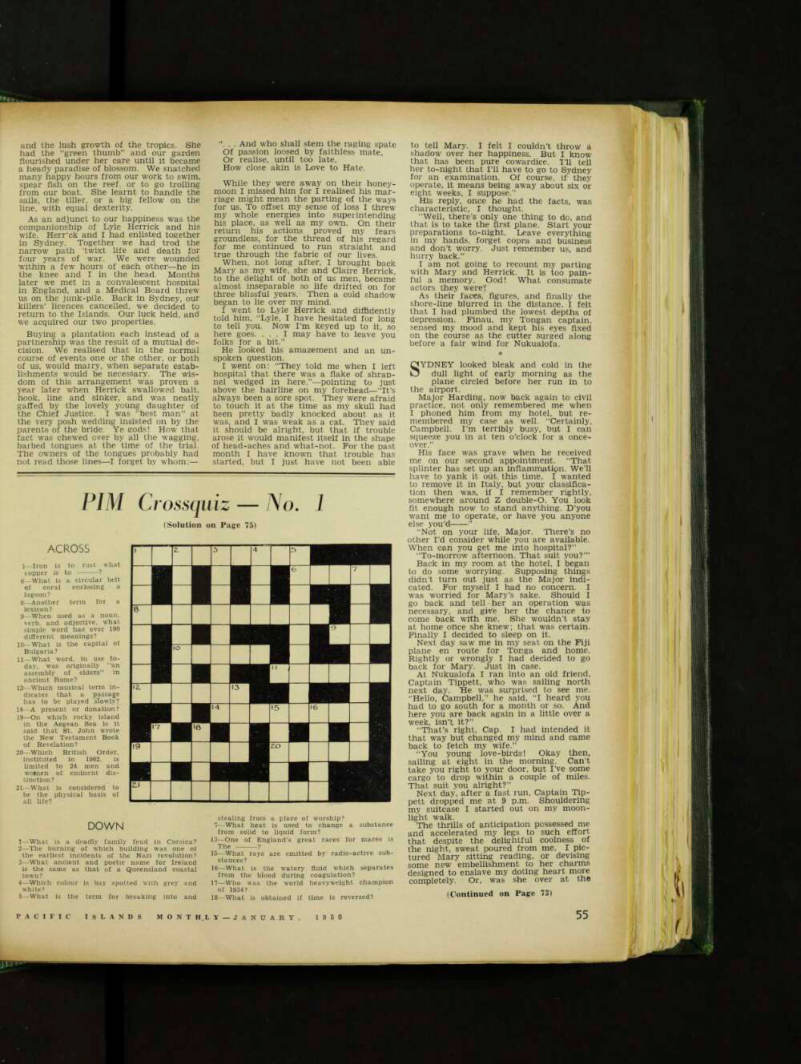
Short Story:
By C. S. Ramsay
FOR ten minutes after he had flicked off the light, I waited and watched.
But he did not leave the house. I moved silently from the deep shadow of the breadfruit trees.
It was one of those Island nights that seem to be a pre-view of Heaven itself. I took a long, long look around me. How beautiful it all was. Beautiful as Eden— and an Eden it had been to me for the past three years.
The sweep of white sand encircling the bay, the symmetrical rows of young coco nut trees running from the edge of the sand to the house; the cameos of light and shadow scintillating on leaf and blade; the buildings, the whole plantation on the gentle slope of the hill—all had taken on an ethereal and breath-taking loveliness. And over all, the sensuous scent of dew-drenched frangipani stirring the soul to anguished memories.
Yes, truly an Eden. My Eden it had been. But now, like the Eden of old, it harboured a snake.
Noiselessly I stepped onto the verandah, passed through the bedroom door —and killed the snake. * IHAVE envied writers those priceless as sets of active imagination and ability to express themselves in words —to invent heroes and heroines, and not only to lead them into all manner of dangerous situations, but to inevitably lead them out.
And now, incarcerated within the nar row bounds of these four concrete walls,
I realise that I am but an insignificant character filling a tiny part in the Great Author’s Book of Life. If He has led me into this impasse, He alone can lead me out.
But did He lead me here? Or did I myself? If I hadn’t killed that snake Herrick, I should not be here. But then, again, if God had not breathed life into both Herrick and myself, I should not have killed.
What is the use of trying to figure it out? The whole thing is crazy; I, myself, am on the verge of madness; and this so-called civilisation is a tangle of in consistencies.
Didn’t they wave flags over me when I enlisted at the outbreak of war? Slap me on the back and call me a brave, pat riotic fellow? Hand me pen and ink with which to sign my own death-warrant as a soldier in His Majesty’s forces? Didn’t they teach me how to handle a rifle; how to shoot? How to use the bayonet—the parry, the long point, the short point, the jab to the throat? Then if your bayonet became wedged in bone, how to plant your foot in the other man’s guts, hold your rifle by the right hand close to the muzzle, fire a round with your left and wrench hard? Didn’t they make me a legalised killer—and pay me for it? And, because I became expert in letting out the life blood of men who, individually, had done me no harm, hang decorations on my chest?
And now, because I have killed a dan gerous beast while out of the killer’s uni form —they are going to kill me. They have sentenced me to be hanged. To be hanged by the neck till I am dead! God knows I could stand up to a firing-squad without flinching. But the NOOSE. . . .
That is what is eating into my brain hour by hour, day by day.
These spells of madness are becoming more frequent and I realise that I must make use of every sane moment to get a lucid account dowp in writing. There are still those whose good opinion I value, and I want them to know the facts. * MARY FERNLOWE had come with her parents on their own boat, on a leisurely post-war cruise through the islands. I, as a lonely bachelor, welcomed them to my plantation where they were my guests for two weeks. From the first, I knew that Mary was the only possible mate for me. And she returned my love in full. Or I thought she did.
I have never forgotten the delirious joy of those two weeks, or the utter blank in my life when they came to an end. The one thing which made life possible for me during the ensuing three months was Mary’s promise. It had been arranged that I should fly down to Sydney for our marriage from her parents’ home.
Those three months of longing have been followed by three years of such ex quisite happiness that I had not believed possible in this world. Mary had proved all I had imagined her, and more. We seemed to exist purely for each other. At times I feared it was too good to last. Mary, like myself, had been born to hate the cold—the grime and the noise of the brick and mortar canons built by man. She passionately loved the sun, the sea, the song of the wind in the trees,
and the lush growth of the tropics. She had the “green thumb” and our garden flourished under her care until it became a heady paradise of blossom. We snatched many happy hours from our work to swim, spear fish on the reef or to go trolling from our boat. She learnt to handle the sails, the tiller, or a big fellow on the line, with equal dexterity.
As an adjunct to our happiness was the companionship of Lyle Herrick and his wife. Herfck and I had enlisted together in Sydney. Together we had trod the narrow path ’twixt life and death for four years of war. We were wounded within a few hours of each other—he in the knee and I in the head. Months later we met in a convalescent hospital in England, and a Medical Board threw us on the junk-pile. Back in Sydney, our killers’ licences cancelled, we decided to return to the Islands. Our luck held, and we acquired our two properties.
Buying a plantation each instead of a partnership was the result of a mutual de cision. We realised that in the normal course of events one or the other, or both of us, would marry, when separate estab lishments would be necessary. The wis dom of this arrangement was proven a year later when Herrick swallowed bait, hook, line and sinker, and was neatly gaffed by the lovely young daughter of the Chief Justice. I was "best man” at the very posh wedding insisted on by the parents of the bride. Ye gods! How that fact was chewed over by all the wagging, barbed tongues at the time of the trial.
The owners of the tongues probably had not read those lines —I forget by whom:—
"... And who shall stem the raging spate Of passion loosed by faithless mate, Or realise, until too late, How close akin is Love to Hate.
While they were away on their honey moon I missed him for I realised his mar riage might mean the parting of the ways for us. To offset my sense of loss I threw my whole energies into superintending his place, as well as my own. On their return his actions proved my fears groundless, for the thread of his regard for me continued to run straight and true through the fabric of our lives.
When, not long after, I brought back Mary as my wife, she and Claire Herrick, to the delight of both of us men, became almost inseparable so life drifted on for three blissful years. Then a cold shadow began to lie over my mind.
I went to Lyle Herrick and diffidently told him, "Lyle, I have hesitated for long to tell you. Now I’m keyed up to it, so here goes. ... I may have to leave you folks for a bit.”
He looked his amazement and an un spoken question.
I went on; "They told me when I left hospital that there was a flake of shrap nel wedged in here,” —pointing to just above the hairline on my forehead—"lt’s always been a sore spot. They were afraid to touch it at the time as my skull had been pretty badly knocked about as it was, and I was weak as a cat. They said it should be alright, but that if trouble arose it would manifest itself in the shape of head-aches and what-not. For the past month I have known that trouble has started, but I just have not been able
to tell Mary. 1 felt I couldn’t throw a shadow over her happiness. But I know that has been pure cowardice. I’ll tell her to-night that I’ll have to go to Sydney for an examination. Of course, if they operate, it means being away about six or eight weeks, I suppose.”
His reply, once he had the facts, was characteristic, I thought.
"Well, there’s only one thing to do, and that is to take the first plane. Start your preparations to-night. Leave everything in my hands, forget copra and business and don’t worry. Just remember us, and
hurry back.”
I am not going to recount my parting with Mary and Herrick. It is too pain ful a memory. God! What consumate actors they were!
As their faces, figures, and finally the shore-line blurred in the distance. I felt that I had plumbed the lowest depths of depression. Finau, my Tongan captain, sensed my mood and kept his eyes fixed on the course as the cutter surged along before a fair wind for Nukualofa. * SYDNEY looked bleak and cold in the dull light of early morning as the plane circled before her run in to the airport.
Major Harding, now back again to civil practice, not only remembered me when I phoned him from my hotel, but re membered my case as well. "Certainly, Campbell. I’m terribly busy, but I can squeeze you in at ten o’clock for a once over.”
His face was grave when he received me on our second appointment. "That splinter has set up an inflammation. We’ll have to yank it out this time. I wanted to remove it in Italy, but your classifica tion then was, if I remember rightly, somewhere around Z double-O. You look fit enough now to stand anything. D’you want me to operate, or have you anyone else you’d ”
"Not on your life, Major. There’s no other I’d consider while you are available.
When can you get me into hospital?”
"To-morrow afternoon. That suit you?”’
Back in my room at the hotel, I began to do some worrying. Supposing things didn’t turn out just as the Major indi cated. For myself I had no concern. I was worried for Mary’s sake. Should I go back and tell her an operation was necessary, and give her the chance to come back with me. She wouldn’t stay at home once she knew; that was certain.
Finally I decided to sleep on it.
Next day saw me in my seat on the Fiji plane en route for Tonga and home.
Rightly or wrongly I had decided to go back for Mary. Just in case.
At Nukualofa I ran into an old friend, Captain Tippett, who was sailing north next day. He was surprised to see me.
“Hello, Campbell,” he said, "I heard you had to go south for a month or so. And here you are back again in a little over a week, isn’t it?”
"That’s right, Cap. I had intended it that way but changed my mind and came back to fetch my wife.”
"You young love-birds! Okay then, sailing at eight in the morning. Can t take you right to your door, but I’ve some cargo to drop within a couple of miles.
That suit you alright?”
Next day, after a fast run, Captain Tip pett dropped me at 9 p.m. Shouldering my suitcase I started out on my moon light walk.
The thrills of anticipation possessed me and accelerated my legs to such effort that despite the delightful coolness of the night, sweat poured from me. I pic tured Mary sitting reading, or devising some new embellishment to her charms designed to enslave my doting heart more completely. Or, was she over at the
(Continued on Page 73)
Herricks’. I could only hope she was at home, and strode the faster.
At last the well-remembered boundary, and then the house and—yes, a light burning on the vine-enclosed verandah we used as sitting-room.
I moved silently over the dewy grass toward the house. Gently parting the thick-growing creeper, I peered through There are times in the lives of few of us when some catastrophic happening en gulfs us, wrenches our puny anchors from their insecure hold in the shifting sands of happiness, and crashes our souls and the very fabric of our existence down to the lowest depths of hell.
Such a thing happened that night to me My brain at first refused to credit the evidence of sight. Mary was standing near the table, close in the arms of Lyle Herrick!
Eve and the snake!
Then she raised her head, put her arms around his neck and said: “Lyle, I’ve loved you from the first.”
Disengaging her arms, he stepped across to the switch —that lightning-plant had been a Christmas gift to her —and, with an evil smile, he flicked off the light.
Swiftly I stepped back to the deep shadows lest they see me outlined against the moonlight.
I had to think. Think what course to take —what punishment I would inflict.
From the moment that I knew their treachery I had no further thought for myself or the future. Only one passionate desire obsessed me—to kill! Kill them both.
A low murmur of voices reached me once, then silence.
My head was throbbing with almost unbearable pain, as though a saw were biting through bone to the brain. It was difficult to think. Suddenly I saw that I could punish her the more by killing only him. Let her live out her days reaping the harvest of her rotten, treacherous heart.
It was astonishingly easy. I had always been a stronger man than he, and I had, too, the advantage of surprise. I re member I laughed at the way their eyes popped as I snapped on the light in the bed-room.
The I reached for him. Took him by the throat and strangled him. Strangled him while Mary screamed and screamed * AND now, to-morrow morning, I too am to die. I wonder how the Great Author will round off my little part in His Book.
My fellow-men are going to carry out the sentence passed by their little puppet judge. I can recall every feature of his face —every pompous mannerism as he said —“You shall be hanged by the neck until you are dead.”
Of course, I hadn’t a chance from the first. My plea of the “unwritten law” was ridiculed and refuted as soon as I had put it forward. Every well-known factor of our intimate friendship with the Her ricks gave it the lie. All our friends and acquaintances, even our boys knew that Herrick’s and my regard for each other had been equalled only by Mary’s love for me. And though Mary could not be called to testify against me, she flatly denied my revelation of her adultery. Without a witness, what could I do?
I am glad they have granted my re quest for the light. Otherwise I could
not have finished this. The buzz-saw has been rasping into my skull to such a degree that at times I have thought I would be able to cheat the hangman after all.
Well, there’s but little more to add and time is short. My narrow, barred window looks less black than it was. Ah. the light has just gone out and day is here In Its place. Not long now. Another hour or so. An hour ol life, then an eternity of sleep.
Strange how much more reconciled I feel about things at this moment. The pain in my head has entirely gone. Gone too is all rancour against Mary. She, her wrong to me, I myself, the fools who dragged me here, the gallows, and even that piece of twisted hemp waiting to swing me to eternity, all are nothing.
There Is movement going on outside.
One atom bomb released from the bay of a plane, and hundreds of thousands
perish. Yet all this preparation and paraphernalia to send me off, alone!
Well, this is it! They are “granting the condemned man his last request” and waiting till I write these, my last words on earth —The iron door is open. Across the sunlight at the end of the grey, stone passage lies a long, black shadow. The shadow of the gallows and —the noose! * DRUGGED senses fought for claiity of thought as my eyes opened to white clad figures around me. With tre mendous effort I forced words to my lips; “The —the gallows —the noose—where—”
Then the answer, in Major Harding’s voice: “Gallows? No gallows around here, my lad. The anaesthetic set you dream ing. It often does, especially in an opera tion like yours. You’re OK now. Be home in no time. Here’s a present for you.”
He held up his hand for me to see Black against a piece of cotton-wool lay a fragment of shrapnel. ‘And then I re membered coming only yesterday straight from the hotel to the hospital—and I thanked God as I have never thanked Him before.
Recounting this and what I dreamed I had written, has helped to pass an im patient convalescence.
But I swear I’ll never show it to Mary!
Mrs. Joan Hay, previously of Kavieng, New Guinea, who has been staying with her brother, Mr. Neville Holland, in Rabaul, has gone on to Wau, where she is the guest of Mr. and Mrs. W. Seale.
Mr. P. Costello, of Suva, has been ap pointed a director of Emperor Mines Ltd., filling the vacancy caused by the retire ment of Sir Maynard Hedstrom.